Two-way FX risk returns

It appears that there is a bit of a sea change taking place in currency markets. Since early June the trend in currency markets would have looked like a one way bet to most casual observers. For instance, the USD index was declining fairly steadily and predictability as US growth worries intensified and markets anticipated a resumption of quantitative easing by the Fed. This changed quite dramatically over recent days, with a significant degree of two-way risk re-entering the market as the USD shook off worries about Fed quantitative easing and instead rallied in the wake of higher risk aversion.

The introduction of two-way risk into the market will cause a rethink of the increasingly fashionable view that the USD was about to embark on a renewed negative trend. This change in market perspective has coincided with renewed concerns about European sovereign risks, even as European growth has come in much stronger than expected over Q2. Other currencies have also lost ground against the USD more recently, with the notable exception of the JPY which remains close to the psychological level of 85.00.

Until recently the move in FX markets since early June contrasted with my view that Q3 would be a period of uncertainty and volatility. Improved risk appetite reflected a decline in uncertainty but whilst I now believe that Q3 will see less of an increase in risk aversion than previously anticipated, my core views remain unchanged. I see the USD resuming an appreciation trend against the EUR and funding currencies (JPY and CHF) whilst weakening against higher yielding risk currencies (AUD, NZD and CAD) over the medium term.

Although FX markets will likely gyrate between the influences of risk aversion on the one hand and growth/interest rates on the other, risk is likely to take the upper hand over the coming weeks. The influence of risk aversion has jumped sharply over the last few weeks for almost all currencies. As risk appetite was improving as it has done for much of the period since early June, it played negatively for the USD but the recent increase in risk aversion – brought about by renewed growth concerns, sovereign worries in the eurozone, with Ireland in particular coming under scrutiny – has managed to reverse this trend. The one-way bet for investors now appears to be over.

Only time will tell if the EUR’s recent bull run has come to an end but there is sufficient evidence to suggest that plenty of good news has now been priced in and that further upside will be much more difficult to achieve. Even the recently strong growth data in the eurozone has thrown up potential problems including growing divergence as well as the potential for a slowdown over coming quarters. Further strengthening of the EUR will be a particular problem for eurozone growth, especially for exporting countries such as Germany. In any case, even the recent drop in the EUR leaves the currency at an overvalued level and susceptible to further falls. Over the coming weeks a period of consolidation is likely, with the EUR set to take a weaker tone.

The JPY in contrast has shown little sign of weakening and continues to flirt with the key psychological level of 85.00 much to the detriment of the Japanese economy, leading to growing frustration from Japanese officials. Much weaker than expected Q2 GDP data has given even more reason to engineer a weaker JPY but as yet the only intervention has come verbally and even this has not been particularly strong. In the absence of FX intervention, the Japanese authorities may be forced to consider other options such as increasing outright JGB purchases.

Like the EUR and JPY, GBP will find it tough to extend gains against the USD especially given that the doves at the Bank of England will likely remain in the ascendancy as growth moderates. GBP is also less undervalued than it was just a few weeks back suggesting that the argument for GBP strength has weakened. Nonetheless, GBP is likely to outperform against a generally weaker EUR ending 2010 around 0.78.

Similarly, CHF will likely maintain its strength against the EUR in the short term but unlike GBP this will likely give way to weakness and a gradual move higher in EUR/CHF to around 1.37 by year end. An eventual improvement in risk appetite and some relative economic underperformance will undermine the case for holding CHF.

Scandinavian currencies are likely to struggle in the short term due to market nervousness about a US double dip in an environment of elevated risk aversion. Interest rates will also play an important role in driving NOK and SEK as will be the case for most currencies eventually. Divergence in rate views for Norway and Sweden suggests holding a short SEK long NOK position. Overall, with two-way risk now much more evident as many investors return from their summer break the FX market will look far less predictable than it did before they left.
Quantitative easing and the USD

US earnings are coming in ahead of expectations, with Q2 income at the 42 S&P 500 companies reporting so far beating estimates by 11% whilst revenues are 3.3% ahead of forecasts, according to Bloomberg. The overall tone to equities looks positive helped by expectations of an agreement by BP to sell some of its assets and strong earnings reported by Apple after the close of US trade.

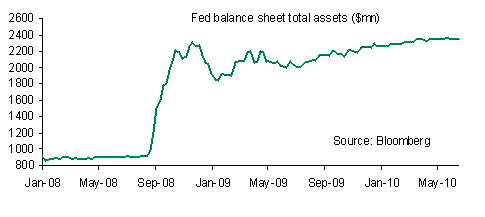
Market sentiment was also boosted by speculation that the Fed will embark on fresh monetary stimulus measures. Although there has been no indication that Fed Chairman Bernanke will announce such measures at his semi-annual testimony to the Senate today and to the House tomorrow, speculation of Fed action is rife and there is likely to be some questioning of Bernanke on the issue in the Q&A. If in any way quantitative easing is hinted at by Bernanke, it will act to undermine the USD.

US economic data is helping to compound expectations of further quantitative easing, with yet another weaker than forecast release in the form of a 5.0% drop in June housing starts as hinted at by the bigger than expected drop in homebuilders confidence on the previous day. Separately ABC consumer confidence declined more than expected in the week to July 18, its third consecutive weekly decline, supporting the evidence that consumer confidence is deteriorating once again.

In the absence of major data releases Bernanke’s testimony will be the main driver for markets but earnings from Coca-Cola and Morgan Stanley will also be of interest. Elsewhere the minutes of the Bank of England’s July MPC meeting will be under scrutiny. MPC member Sentance is expected to have voted for a rate hike at the meeting, but any sign that other members joined him, will give GBP a lift. Sentiment for European assets continues to improve, with Greece concluding a well received T-bill auction and Ireland auctioning EUR 1.5bn in 6 and 10-year bonds. Both were heavily oversubscribed although concerns over Hungary continue to linger.

There continue to be various leaks about the European bank stress tests. Banks are expected to detail three scenarios in the results including estimated Tier 1 capital ratios under a benchmark for 2011, an adverse scenario and finally, a “sovereign shock”, according to a document from the Committee of European banking Supervisors. Importantly and perhaps a factor that could hit the credibility of the tests, the sovereign shock scenario is said to not include a scenario of default on sovereign debt.

I continue to see downside risk for the EUR in the wake of the test results, with a “buy on rumour, sell on fact” reaction likely. EUR/USD is vulnerable to a short-term drop to technical support around 1.2763 but much depends on Bernanke’s speech today. Leaks, suggest that around 10-20 banks could fail the bank stress tests, with a total funding requirement in the region of EUR 70-90 billion. Confirmation will have to wait for the official release on Friday ahead of which most currencies are likely to remain range-bound.

Follow The Oracle

Many investors are probably wishing they had the psychic abilities of Paul the octopus. The mollusc once again gave the correct prediction, by picking Spain to beat the Netherlands to become the winner of the World Cup. This ability would have been particularly useful for currency forecasters, many of which have been wrong footed by the move higher in EUR/USD over recent weeks.

Confidence appeared to return to markets over the past week helped by a string of rate hikes in Asia from India, South Korea and Malaysia, and firm data including yet another consensus beating jobs report in Australia. An upward revision to global growth forecasts by the International Monetary Fund (IMF) also helped, with the net result being an easing in double-dip growth concerns.

The good news culminated in a much stronger than forecast June trade surplus in China. However, China’s trade numbers will likely keep the pressure on for further CNY appreciation, and notably US Senators are still pushing ahead with legislation on China’s FX policy despite the US Treasury decision not to name China as a currency manipulator.

Political uncertainty on the rise again in Japan following the loss of control of the upper house of parliament by the ruling DPJ party. The JPY has taken a softer tone following the election and will likely remain under pressure. CFTC IMM speculative JPY positioning has increased but this has been met with significant selling interest by Japanese margin accounts who hold their biggest net long USD/JPY position since October 2009 according to Tokyo Financial Exchange (TFX) data.

In the absence of the prodigious abilities of an “oracle octopus” data and events this week will continue to show slowing momentum in G3 country growth indicators but not enough to warrant renewed double-dip concerns. Direction will be largely driven by US Q2 earnings. S&P 500 company earnings are expected to have increased 27% from a year ago according to Thomson Reuters.

There are several data releases of interest in the US this week but the main release is the retail sales report for June which is likely to record another drop over the month. Data and events in Europe include the Eurogroup finance ministers meeting, with markets looking for further insight into bank stress tests across the region. Early indications are positive but the scope of the tests remains the main concern. The July German ZEW survey will garner some interest and is likely to show a further slight decline in economic sentiment.

EUR/USD gains looked increasingly stretched towards the end of last week, as it slipped back from a high of around 1.2722. Technical resistance around 1.2740 will prove to be tough level to crack over coming days, with a pullback to support around 1.2479 more likely. CFTC IMM data reveals that short covering in EUR has been particularly sharp in the last week, with net short positions cut by over half, highlighting that the scope for further short covering is becoming more limited.

Conversely aggregate net USD long positions have fallen by over half in the last week as USD sentiment has soured, with longs at close to a three-month low. The scope for a further reduction in USD positioning is less significant, suggesting that selling pressure may abate.

The Week Ahead

As last week progressed there was a clear deterioration in sentiment as growth worries crept back into the market psyche. It all started well enough, with a positive reaction to China’s de-pegging of the CNY but the euphoria faded as it became evident that there was still plenty of two-way risk on the CNY. A change in Prime Minister in Australia, which fuelled hopes of a resolution to a controversial mining tax, and an austere budget in the UK, were also key events. However, sentiment took a hit as the Fed sounded more cautious on the US economy in its FOMC statement.

The US Congress finalised a major regulatory reform bill towards the end of the week and markets, especially financial stocks, reacted positively as the bill appeared to give some concessions to banks and was not as severe as feared. However, equity market momentum has clearly faded against the background of renewed growth concerns including sprouting evidence of a double-dip in the US housing market as well as fresh worries about the European banking sector. As if to demonstrate this US Q1 GDP was duly revised lower once again, to a 2.7% annualised rate of growth.

The US Independence Day holiday and World Cup football tournament will likely keep liquidity thin in the run up to month and half year end. However, there is still plenty to digest this week including the all important employment report and consumer confidence data in the US. In Europe economic sentiment gauges, purchasing managers indices and the flash CPI estimate will be in focus. Elsewhere, Japan’s Tankan survey and usual slate of month end Japanese releases, Switzerland’s KoF leading indicator and Australian retail sales will be of interest.

On balance, economic data this week is unlikely to relieve growth concerns, with Eurozone, US and UK consumer and manufacturing confidence indicators likely to post broad based declines due to a host of factors. The data will further indicate a slowing in growth momentum following Q2 2010, with forward looking surveys turning lower, albeit gradually. Whilst a double-dip scenario still seems unlikely there can be no doubt that austerity measures and the waning of fiscal stimulus measures are beginning to weigh on growth prospects even if there is still plenty of optimism for emerging market and particularly Asian growth prospects.

This suggests that Q3 could turn into a period of heightened uncertainty in which equity markets and risk assets will struggle to gain traction. In addition to growth worries, some tensions in money markets remain in place whilst banking sector concerns seem to be coming back to the fore, especially in Europe and these factors will prevent a sustained improvement in risk appetite from taking place over the coming quarter. Some more clarity may come from the results of European stress tests but much will depend on just how stressful the tests are.

In the near term, the main focus of attention will be on the US June jobs report released at the end of the week. Non-farm payrolls are set to record a decline over the month due to a reversal in census hiring, with a consensus expectation of a 110k fall. Private sector hiring is likely to record a positive reading, however, suggesting some improvement in the underlying trend in jobs growth, albeit a very gradual one. Downside risks to consensus suggest plenty of scope for disappointment.

Interestingly, weaker US data of late, has managed to restrain the USD, suggesting that cyclical factors and not just risk aversion are beginning to play into FX movements. Notably the USD was on the back foot against a number of currencies as last week progressed. Even the beleaguered EUR managed to end the week well off its weekly low and close to where it closed the previous week whilst risk currencies such as the AUD and NZD as well as GBP also posted firm performances.

Perhaps some reversal of the optimism towards US recovery prospects give USD bulls some cause for concern, but pressure is likely to prove temporary, especially given that the US economy is still on course to outperform many other major economies. Over the short-term, especially ahead of the US jobs report markets are set to remain cautious with range trading likely to dominate in the week ahead, suggesting that EUR/USD is unlikely to breach the key level of 1.2500. GBP performance has been robust but even this currency is likely to make much headway above GBP/USD 1.5000, where there are likely to be plenty of sellers.

Stressing About European Stress Tests

Equities and risk appetite were bolstered by the relative success of the Spanish bond auction on Thursday. The results of the auction in which Spain sold EUR 3 billion in 10 year notes helped to stem some of the pressure on eurozone bond spreads, which despite the generalized improvement in market sentiment over recent days, had been continuing to widen.

Another key indicator that has been suggested that all is not well moving in the opposite direction to the improvement in many risk indicators is the Baltic Dry Index which has dropped by around a third since 26th May 2010.

Perhaps more significant in terms of providing sustainable support for markets was the news that the European Union agreed to publish the results of bank stress tests, slated for the second half of July. This could turn out to be a key stepping stone towards increasing the transparency of the eurozone banking sector.

However, doubts will remain until there is some clarity on the terms of the tests such as whether they include details of sovereign debt exposure. Also, if the stress tests reveal shortcomings in the banks in question it is unclear if government funding will be provided for them. Although the publishing of stress test results is a step in the right direction until these and other questions are answered it is difficult to see markets getting too excited.

It’s not all plain sailing for equity markets despite the relatively positive news in Europe as disappointing US data in the form of a surprise jump in weekly jobless claims and a bigger than expected drop in the June Philly Fed survey weighed in on the side of those expecting both a slow and jobless recovery in the US.

The CHF has been a key mover following the Swiss National Bank policy decision. The decision to leave interest rates unchanged was no surprise, but the change in rhetoric towards a less aggressive stance towards CHF strength opens up the floodgates for CHF buyers. will look to test its all time low around 1.3720.

Another central bank that has shown concern about a strengthening currency is the Bank of Japan but unlike the SNB Japan’s central bank has not intervened for several years. The BoJ in the minutes of its May meeting noted that it will “watch if Europe’s crisis strengthens JPY”, indicating some concern about JPY strength.

This sentiment that was echoed by the Japanese government in the release of Economic Growth Strategy aimed at avoiding an excessive rise in the JPY via fiscal and monetary steps to beat deflation. The JPY barely reacted to both the minutes and the growth strategy, with market players likely sceptical until concrete measures are actually implemented.

It still look like an environment of sell on rallies for the EUR and other risk currencies, with their gains likely to run out of steam over coming days. The next key technical level for EUR/USD is around 1.2454, a level that will prove a tough nut to crack.