Waiting for a solution to Europe’s crisis

The boost to sentiment following Germany’s approval of changes to the EFSF bailout fund was brief. Although the outcome of the vote was not particularly surprising political concerns were assuaged by the fact that Chancellor Merkel secured support from within her coalition. Markets were also helped by a bigger than expected drop in weekly US jobless claims but this also failed to provide a lasting impact.

The bottom line is that there is still a huge degree of scepticism on the ability of policymakers to resolve the crisis in the eurozone periphery while growth worries have not receded. Even the approved changed to the EFSF bailout fund are increasingly being seen as old news given the view that it will need deeper changes including ‘leveraging’ it up.

Consequently risk aversion remains at a highly elevated level and is showing no sign of easing. It may be difficult to turn sentiment around as we go into the final quarter of the year, especially as those investors registering profits for the year may want to capitalise on these profits rather than sit through continued volatility in the weeks ahead. Indeed the sharp drop in gold prices over the last couple of weeks even in an environment of elevated risk aversion may reflect this.

Similarly risk assets may struggle to recover over coming weeks unless there is a major improvement in the situation in Europe or in growth data. Markets will go into the end of this week looking ahead to key events next week including an Ecofin meeting at the beginning of next week, a European Central Bank (ECB) meeting and the US September jobs report.

There will be plenty of attention on the Ecofin meeting of European Finance Ministers on Monday especially given that much of the reason for the stability in markets recently is the hope of concrete measures to resolve the crisis in the region. In this respect the scope for disappointment is high, suggesting that the EUR is vulnerable to a further drop.

While the extent of short market positioning at the beginning of week left open some scope for EUR short covering the absence of any good news will mean the impetus for short covering diminishes. Unless the Ecofin meeting delivers on expectations EUR/USD will likely re-test the 26 September low around 1.3363.
Euro supported by hope

Hope appears to be the overriding sentiment filtering through markets at present. Such hope includes expectations that the European authorities will be able to ring fence Greece and avoid much deeper and wider comtagion to other eurozone peripheral countries than has already taken place. This may involve a European version of the US Troubled Asset Relief Program (TARP). Various other measures are being speculated on including covered bond purchases from the ECB, provision of 12 month liquidity by the ECB, a policy rate cut, banking sector recapitalization and a beefing up of the EFSF bailout fund.

The result of such speculation has been to provide some stability to the EUR and asset markets but there is a long way to go before hopes turn into action. The next few weeks will be critical to determine whether a firmer base to sentiment and the EUR can be established and markets will turn their attention to a meeting of eurozone finance ministers on October 3 and the European Central Bank on October 6. Meanwhile national votes on changes to the EFSF bailout fund will continue this week including Germany’s vote on Thursday. While the vote is likely to pass it may draw attention to divisions within Chancellor Merkel’s party.

One thing is certain. There is no room for any more disappointment especially given that the plans agreed by European officials in July have yet to be implemented. If there is no concrete action over coming weeks the EUR will come under renewed pressure and indeed the risk is still heavily skewed towards more EUR weakness given the various disagreements between officials. Nonetheless, the improved mood in the short term will likely help prevent the currency from sliding further for now and a base appears to be forming just under 1.35 against the USD.

Euro vulnerable to event risk

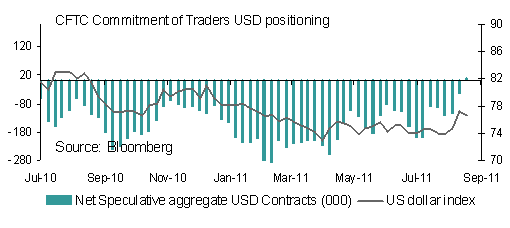
The USD is benefitting in the current environment of elevated risk aversion reflected in a jump in USD speculative positioning over recent weeks, with current IMM positioning currently at its highest since June 2010.

Admittedly there is still plenty of scope for risk aversion to intensify but what does this mean for the USD? The USD index is currently trading just over 78 but during the height of the financial crisis it rose to around 89, a further gain from current levels of around of around 14%.

The main obstacle to further USD strength in the event of the current crisis intensifying is if the Fed implements QE3 but as the Fed has indicated this is unlikely to happen anytime soon, as “Operation Twist” gets underway.

Now that the Fed FOMC meeting is out of the way markets will also be less wary of buying USDs as the prospect of more QE has diminished for now. Data this week will likely be USD supportive too, with increases in consumer confidence, durable goods orders, an upward revision to Q2 GDP expected.

The EUR remains highly vulnerable to event risk this week. Various votes in eurozone countries to approve changes to the EFSF bailout fund will garner most attention in FX markets, with the German vote of particular interest although this should pass at the cost of opposition from within Chancellor Merkel’s own party.

The EUR may garner some support if there is some traction on reports of a three pronged approach to help solve the crisis which includes ‘leveraging’ the EFSF fund, large scale European bank recapitalisation and a managed default in Greece, but there has been no confirmation of such measures.

Meanwhile, the potential for negotiations between the Troika (EC, IMF, ECB) and the Greek government to deliver an agreement on the next loan tranche for the country has increased, which could also offer the EUR a boost this week, albeit a short lived one.

Speculation of a potential European Central Bank (ECB) rate cut has increased a factor that could undermine the EUR depending on whether markets see it as growth positive and thus EUR positive or as a factor that reduced the EUR’s yield attraction. There is also more speculation that the ECB will offer more liquidity in the form of a 1-year operation but once again there has been no confirmation.

A likely sharp drop in the German IFO survey today and weakness in business and economic confidence surveys on Thursday will support the case for a rate cut, while helping to maintain the downward pressure on the EUR.

Given the potential for rumours and events to result in sharp shifts in sentiment look for EUR/USD to remain volatile, with support seen around 1.3384 and resistance around 1.3605.

Euro fails too hold on to gains

Any improvement in sentiment following the USD liquidity support announcement by various central banks last week is already filtering away against the background of European Union (EU) officials’ failure to make any headway at the Ecofin meeting over the weekend, a delay in the approval of the next bailout tranche for Greece and ongoing collateral dispute between Greece and Finland. On top of all of this German Chancellor Merkel suffered a further setback in regional elections over the weekend.

Greece will remain in focus this week and markets will look for signs that the country is back on track on its austerity plans and its next loan tranche. Prime Minister Papandreou cancelled a trip to the US while the Greek cabinet are apparently deciding on new fiscal measures. Attention will turn to a teleconference today from the Greek Finance Minister with EU and IMF officials.

Speculative sentiment for the EUR has already soured further and according to the latest CFTC IMM report, positioning in EUR is at its lowest since the end of June 2010. EUR/USD will continue to look very vulnerable having already dropped sharply from a high of around 1.3899 in Asian morning trading as the bad weekend news hit the currency. EUR/USD will find some technical support just below 1.3500 this week but any upside is set to prove limited unless some concrete announcements are delivered relating to Greece over coming days.

In contrast to the EUR, USD speculative appetite has turned net long for the first time since July 2010. The extended Fed FOMC meeting will help to dictate USD sentiment as markets wait for further measures to stimulate the economy. The Federal Reserve has already committed to hold rates steady until at least mid 2013 and the extended two day meeting this week will likely discuss further options. However, more quantitative easing (QE3) appears unlikely at this stage while an ‘Operation Twist’ type approach is more probable. The USD will benefit from a lack of further quantitative easing but this is largely already priced in.

Euro slides as Greek worries intensify

The USD ended last week on high a note having overcome speeches by Fed Chairman Bernanke and President Obama. Bernanke’s lack of detail on potential further Fed stimulus offered the USD a lifeline as there was no mention of QE3 but nervousness may mount ahead of the September 21 FOMC meeting.

This week’s data releases (including retail sales, inflation, industrial production and regional manufacturing surveys may offer some direction to the USD and it is likely that the data over coming days will look less negative than in past weeks, giving the USD some support. Having broken above its 200 day moving average around 76.1986 for the first time in a year the USD index is set to begin the week in positive mode and will likely extend its gains over coming days.

In sharp contrast, EUR/USD crumbled at the end of last week dropping through its 200 day moving average despite positive news from Germany (rejection of bills in the constitutional court) and Italy (passage of austerity measures). The European Central Bank (ECB) did not help the EUR’s cause however, with the change in its stance to a more balanced assessment of risks from its more hawkish stance previously.

However, the real damage occurred as speculation of a Greek default intensified and ECB hawk Stark resigned from the ECB council, highlighting the divisions within the governing board. This week attention will remain on Greece as negotiations between the Troika (ECB, EU and IMF) and Greek officials resume.

Ahead of the talks Greece approved a further EUR 2 billion in austerity measures over the weekend but nonetheless, despite denials by Greek officials speculation of a debt default will continue to hammer the EUR lower. Near term technical support is seen around 1.3525 for EUR/USD.

GBP found some relief last week following the decision by the Bank of England to leave policy unchanged though it is unlikely to be able to make much if any headway against the USD over coming sessions as expectations of further UK quantitative easing may simply have been pushed back to the November meeting.

Inflation data this week will give further clues to policy but once again there is likely to be no sign of any easing in inflation pressure, limiting the room for maneuver for the BoE. Moreover, a weak outcome for UK retail sales in August will maintain the trend of soft UK data keeping up the pressure for more BoE action. As a result GBP will struggle against the USD but given that problems in Europe look even worse, GBP will likely extend gains against the EUR this week.