EUR slides as summit hopes fade

Any boost to confidence following the recent EU Summit is fading fast. Policy easing from the European Central Bank, Bank of England, and PBoC in China, have done little to turn things around. Moreover, the weaker than expected US June jobs report has added to the calls for the Federal Reserve to inject more monetary stimulus via another round of quantitative easing but this is unlikely anytime soon.

Admittedly the jobs data which reported an 80k increase in payrolls and unemployment rate remaining at 8.2%, was disappointing but it was not weak enough to trigger imminent Fed action. Congressional testimony by Fed Chairman Bernanke on July 17 and 18 will provide the next key clues to whether the Fed is moving closer to more QE.

This leaves markets in a miserable state of being. It was hoped that the recent EU Summit would provide much needed breathing space and relief to Eurozone peripheral bond markets. However, renewed policy implementation doubts, concerns that the Summit did not go far enough and opposition from Finland and the Netherlands who appear to have taken an even tougher stance than Germany, have resulted in Spanish and Italian bonds facing significant pressure once again with yields higher than pre summit levels.

A delay in the ESM permanent bailout fund, timing of the setting up of a banking supervisory authority and doubts about the size of the bailout fund given that the ECB appears to have ruled out a banking license as a means of leveraging up the ESM, are just a few of the concerns afflicting markets. Meanwhile, added to this list is the fact that Greece’s next bailout tranche has been delayed to mid September. Many of these issues as well as the bailout of Spanish banks will be discussed at today’s Ecofin meeting but the chances of much progress remain limited.

The EUR which is of course not uncrorrelated with peripheral bond yields has itself fallen sharply. Thin trading conditions have helped to exacerbate the drop in the EUR while the realisation that the EU summit has been no game changer is increasingly weighing on the currency. I had thought that the Summit may have helped to at least provide a floor under the EUR but this now looks like a case of misplaced optimism.

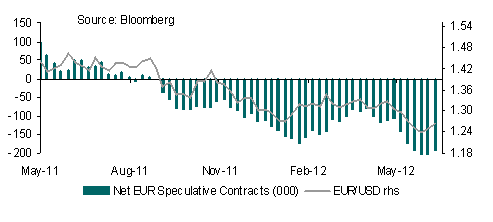
The only supportive factor for the currency is that it looks heavily oversold, with market positioning extremely short. However, if a break below the 2012 EUR/USD low around 1.2288 can be sustained markets will quickly latch onto 1.20 as the next target. Given the lack of major events or data releases over coming days there looks like little to offer the EUR any support.
More bad news in Europe, INR not impressed by new measures

Nervousness or simply just impatience is growing ahead of the EU Summit beginning on Thursday. The formal application by Spain for a banking bailout of up to EUR 100 billion has started the process while Greece is looking to renegotiate the terms of its bailout following the formation of a new government in the country.

European equities are not reacting well, however, with sharp declines registered yesterday following by drops in US stocks. Risk assets have come under pressure as noted by the sharp 12.5% jump in the VIX index overnight while the USD index continued to strengthen.

Interestingly despite the rise in risk aversion, many high beta currencies are holding up reasonably well. Indeed, those with the biggest sensitivities to risk such as ZAR, MXN, PLN and EUR have failed to drop while implied currency volatility has been falling over recent weeks. This may reflect the beginning of summer trading conditions rather than resilience in currency markets but nonetheless, it suggests a dose of FX calm ahead of the EU summit.

EUR/USD came under pressure hitting a low around 1.2471 failed to extend losses. The bad news intensified and included the formal Spanish bank aid request, Moody’s downgrade of 28 Spanish banks’ ratings, Fitch’s decision to cut Cyprus’ ratings to junk status, lack of concessions from German Chancellor Merkel who maintained her strong stance against common Eurobonds and inflexibility about the use of rescue funds. As a result it looks increasingly unlikely that a concrete plan will emerge from this week’s EU summit. EUR/USD will find technical support around 1.2442 and resistance around 1.2584.

One currency that has failed to perk up is the Indian rupee. New measures announced yesterday to shore up the INR including a $5 billion increase in the foreign investment cap in government bonds and an increase in the limit for domestic firms to borrow from overseas of up to $40 billion, failed to have more than a fleeting impact on the currency.

What were missing were measures to increase exports and cut excise duties. The measures left markets who had expected much more, with a taste of disappointment. While the measures are a decent starting point clearly much more will need to be done to appease markets and reverse the gloom among INR bears.

Chronology of a Crisis – endgame?

Please see below an extract from my forthcoming book Chronology of a Crisis (Searching Finance 2012).

The departure of Greece from the Euro is by no means a forgone conclusion but if it happens it is not clear that global policy makers have much ammunition left to shield markets from the resulting fallout.

Stimulus after stimulus has only left governments increasingly indebted. The price of such largesse is now being paid in the form of higher borrowing costs. Even central banks do not have much ammunition left. Admittedly further rounds of quantitative easing, and central bank balance sheet expansion may help to shore up confidence but the efficacy of such policy actions is questionable. Moreover, policy support may only help to buy time but if underlying structural issues are not resolved pressure could resume quickly.

Against this background Europe is under intense pressure and there is little time left before it results in something catastrophic for global markets via a disorderly break up of the Eurozone. EU leaders and the European Central Bank (ECB) have to act to stem the crisis. However, at the time of writing the ECB under the helm of Mario Draghi is steadfastly refusing to provide further assistance to the Eurozone periphery either directly via lower interest rates or securities market purchases or indirectly via another Long term refinancing operation (LTRO). Any prospect of debt monetization as carried out already by other central banks including the Fed and Bank of England is a definite non-starter. The reason for this intransigence is that the ECB does not want to let Eurozone governments off the hook, worrying that any further assistance would allow governments to slow or even renege upon promised reforms.

Whether this is true or not it’s a dangerous game to play. The fact that the previously unthinkable could happen ie a country could exit the Eurozone should have by now prompted some major action by European officials. Instead the ECB is unwilling to give ground while Germany continues to stand in the way of any move towards debt mutualisation in the form of a common Eurobond and/or other measures such as awarding a banking license to the EFSF bailout fund which would effectively allow it to help recapitalize banks and purchase peripheral debt. Germany does not want to allow peripheral countries to be let off the hook either, arguing that they would benefit from Germany’s strong credit standing and lower yields without paying the costs.

To be frank, it’s too late for such brinkmanship. The situation in The Eurozone is rapidly spiraling out of control. While both the ECB and Germany may have valid arguments the bottom line is that the situation could get far worse if officials fail to act. As noted above there are various measures that could be enacted. Admittedly many of these will only buy time rather than fix the many and varied structural problems afflicting a group of countries tied together by a single currency and monetary policy and separate fiscal policies but at the moment time is what is needed the most. Buying time will allow policymakers to enact reforms, enhance productivity, reform labour markets, increase investment funds etc. Unfortunately European policy makers do not appear to have grasped this fact. Now more than at any time during the crisis much depends on the actions of policy makers. This is where the major uncertainty lies.

If officials do not act to stem the crisis, economic and market turmoil will reach proportions exceeding that of even the Lehmans bust.

Euro gives up its gains, GBP tracks lower

Although attention may briefly turn to the Fed FOMC outcome tomorrow the lack of progress to resolve’s Europe’s crisis threatens to inflict much more severe damage onto global markets. Against this background the European summit at the end of the week will be particularly important but the scope for disappointment remains high.

As with news of Spain’s banking bailout the positive EUR reaction to the Greek elections has faded even more quickly than I anticipated. EUR/USD’s inability to build on gains above 1.2700 despite extreme short market positioning, highlights the lack of confidence in resolving the crisis. EUR/USD appears to be increasingly following the moves in peripheral bond spreads and the news here is not good either especially in Spain, with spreads continuing to widen out.

The G20 communiqué offered no support to the EUR, with little by way of concrete measures while Germany continues to stick to its stance of no renegotiation of Greece’s bailout terms. The EU finance ministers summit in a couple of days time may provide some relief but only if concrete measures are outlined. In the meantime EUR/USD will continue to remain under pressure. As noted yesterday, I look for a test of EUR/USD 1.2515 which could happen as early as today.

Considering that the prospects of a further round of Bank Of England quantitative easing has grown as hinted at by BoE Governor King, GBP has shown some resilience. Indeed, it is not clear that GBP will weaken if and when the BoE expands its balance sheet again. My analysis reveals that the reaction of GBP has been mixed both to the announcement and implementation of asset purchases.

Inflation data will provide some clues to the room for further monetary stimulus while the minutes of the last MPC meeting two weeks ago will provide some inkling of the support within the Committee for fresh QE. CPI is likely edge higher but this will be due to seasonal factors, while the minutes will likely reveal two dissenters.

GBP meanwhile, will continue to track the EUR with the currency pair trading in a 0.80-0.81 range. EUR’s drop overnight has taken the wind out of GBP’s sails, but strong technical support will be found around GBP/USD 1.5601.

Euro rallies on Greek election outcome but gains to be short lived

The Greek election outcome will be met with a sigh of relief across markets. However, there is still likely to be plenty of horse trading before a new government is formed and even then Greece’s fiscal/debt/growth problems will not just miraculously go away. Market pressure will resume after a brief delay.

At least for the early part of this week markets will likely find some support however, and with events including the FOMC meeting, G20 meeting and EU Summit coming up, hopes that some solutions may be forthcoming may at least prevent sentiment for risk assets from deteriorating too significantly.

The EUR garnered support following news that pro-bailout parties have gained sufficient votes to form a government in Greece. Negotiations will begin to form a coalition government between the first placed party New Democracy and third placed Pasok but the risk remains that prolonged discussions could quickly result in the EUR erasing its gains. Indeed, Pasok leaders are talking about the need to form a ‘government of national unity’, suggesting the process of forming a government will not be straightforward.

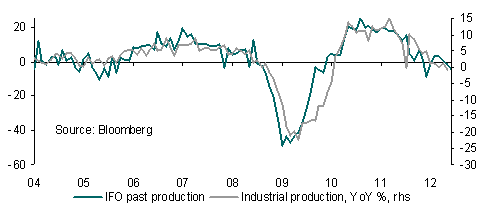
A slightly less negative shift in EUR sentiment has been apparent from the CFTC IMM data which revealed that net short positions dropped (ie there has been some short covering) even before the election outcome. The election result will encourage more short covering although data releases this week including the June German ZEW investor confidence and IFO business confidence surveys, both of which are set to decline, will caution against becoming overly bullish EUR. Short term EUR/USD resistance is seen around 1.2750 but a move back down to around 1.2515 is more likely as the week progresses.
a href=”https://econometer.org/wp-content/uploads/2012/06/gerifo.gif”>
One of the reasons the EUR has managed to garner support over recent days has been growing speculation of Fed action to boost the economy in the wake of a rash of softer data releases. Such expectations have put the USD under pressure, with last week’s data revealing disappointing retail sales, industrial production and consumer confidence. On Wednesday the markets will find an answer to speculation of more Fed action, with the Fed FOMC policy decision.

Expectations of more quantitative easing will be disappointed but the Fed will likely increase Operation Twist buying time to evaluate incoming data releases. A combination of a relatively positive Greek election outcome together with speculation of more QE will keep the USD under pressure ahead of Wednesday’s outcome but weakness ought to prove short lived, with USD gains expected following the Fed decision not to expand its balance sheet further.