More bad news in Europe, INR not impressed by new measures

Nervousness or simply just impatience is growing ahead of the EU Summit beginning on Thursday. The formal application by Spain for a banking bailout of up to EUR 100 billion has started the process while Greece is looking to renegotiate the terms of its bailout following the formation of a new government in the country.

European equities are not reacting well, however, with sharp declines registered yesterday following by drops in US stocks. Risk assets have come under pressure as noted by the sharp 12.5% jump in the VIX index overnight while the USD index continued to strengthen.

Interestingly despite the rise in risk aversion, many high beta currencies are holding up reasonably well. Indeed, those with the biggest sensitivities to risk such as ZAR, MXN, PLN and EUR have failed to drop while implied currency volatility has been falling over recent weeks. This may reflect the beginning of summer trading conditions rather than resilience in currency markets but nonetheless, it suggests a dose of FX calm ahead of the EU summit.

EUR/USD came under pressure hitting a low around 1.2471 failed to extend losses. The bad news intensified and included the formal Spanish bank aid request, Moody’s downgrade of 28 Spanish banks’ ratings, Fitch’s decision to cut Cyprus’ ratings to junk status, lack of concessions from German Chancellor Merkel who maintained her strong stance against common Eurobonds and inflexibility about the use of rescue funds. As a result it looks increasingly unlikely that a concrete plan will emerge from this week’s EU summit. EUR/USD will find technical support around 1.2442 and resistance around 1.2584.

One currency that has failed to perk up is the Indian rupee. New measures announced yesterday to shore up the INR including a $5 billion increase in the foreign investment cap in government bonds and an increase in the limit for domestic firms to borrow from overseas of up to $40 billion, failed to have more than a fleeting impact on the currency.

What were missing were measures to increase exports and cut excise duties. The measures left markets who had expected much more, with a taste of disappointment. While the measures are a decent starting point clearly much more will need to be done to appease markets and reverse the gloom among INR bears.
Is gold losing its lustre?

Hopes and expectations of more Fed quantitative easing in the wake of a run of weak US data, including the US May jobs report, has been attributable to the bounce in gold prices over recent weeks. However, Fed Chairman Bernanke dampened such hopes in his speech to Congress, in which he did not indicate a desire to move towards more QE. The Fed is unlikely in my view to embark on more QE any time soon.

Clearly, should the Fed implement more QE it will help to renew the attraction of gold. Once again markets will see the consequences of Fed QE as a means to debase the USD. A shift in Fed stance cannot be ruled out if US economic conditions worsen further and/or the Eurozone crisis escalates. Assuming no more QE and no more USD debasement, gold prices ought to decline over coming months.

One of the biggest factors putting downward pressure on gold prices has been the strength of the USD. While I do not expect the USD to continue to strengthen at the same pace as it has done recently, further gradual gains in the currency are likely. My FX forecasts predict a further small gain for the USD index by the end of the year but I also believe that the recent run up in the USD may have been too rapid. Assuming that the USD continues on a gradual upward trajectory I expect it to exert a negative influence on gold prices.

Gold appears to have lost its sensitivity to risk aversion. Indeed, gold’s relationship with risk has actually inverted over recent months, with a negative but significant relationship registered over the past 3 months between gold prices and my Risk Aversion Barometer. In other words as risk aversion goes up, gold prices actually drop.

The lack of reaction to higher risk aversion shows that the lustre of gold as a safe haven has faded as investors pull capital out of this as well as many other asset classes. However, gold’s drop is not unusual when compared to other commodity prices, with oil and copper prices falling too and gold maintaining a strong correlation with these commodities.

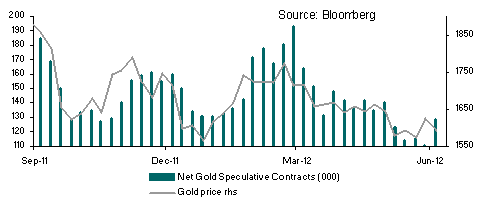
Some deterioration in sentiment towards gold prices has been reflected in the drop in speculative appetite for the commodity. Speculative demand for gold hit a cyclical high in August 2011 but since then there has been a steady reduction in appetite for gold from these investors. Indeed, CFTC IMM data reveals that speculative gold positioning dropped well below its three-month average. However, positioning is still well above its all time lows reached in February 2005, suggesting if anything, there is scope for more declines.

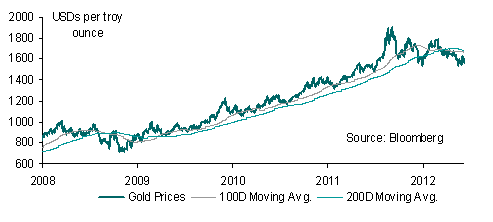
On top of the drop in speculative appetite for gold the technical picture has turned bearish. Since March 2009 at the height of the financial crisis the 100 day moving average price of gold had been trading above the 200 day moving average. On 27 March 2012 the 100 day moving average crossed below the 200 day moving average. Moreover, gold is now trading below both the 100 and 200 day moving average prices which sends a bearish technical message. Over the near term some key levels to look for are the 100 day moving average around 1658 on the topside and trendline support around the 1530 level on the bottom.

Another determinant of gold prices is demand from India and China. Growth in both countries is slowing, suggesting that gold demand is also weakening. While I certainly do not expect a collapse in demand from either country I have no doubt that compared to last year the strength of demand will be softer over coming months. Although I still look for a soft landing in China the Indian economic picture has clearly deteriorated while the Indian rupee has weakened. A weaker INR means that has become increasingly more expensive to import gold to India for domestic purchasers.

Overall, a weaker real demand picture taken together with reduced speculative appetite implies little support for gold prices. Moreover, a firmer USD in general will continue to weigh on prices. Perhaps a dose of inflation would help gold prices but there is little risk of this given the still sizeable amount of excess capacity in major economies.

Uncertainty about QE will help to limit any downside pressure on gold prices but elevated risk aversion will provide little assistance to gold. If however, the Eurozone and global picture deteriorates further gold will find itself with a lifeline but only if this means more currency debasement and a Fed engineered lower USD. If not, a further decline is on the cards and I forecast a drop in gold prices to around USD 1475 by the end of the year.

Indian Rupee – How low can it go?

Sentiment for the Indian rupee (INR) has gone from bad to worse. A number of concerns have hit the currency including weak economic data, deteriorating confidence in government policies, and intensifying risk aversion. The latest blow to the rupee came from data showing that economic growth in Q1 2012 slowed to 5.3% the slowest pace of growth in nine years. Worryingly high interest rates in the wake of persistent inflation pressures have damaged investment spending, a major weak point in the Q1 data. High inflation at over 7% means that the Reserve Bank of India has limited room to ease policy but the central bank has hinted at lower rates in the wake of lower oil prices.

These economic pressures have come at a time when the global environment has worsened. India was already more vulnerable compared to its Asian neighbours due it’s twin current account and fiscal deficits. Strong growth had put concerns about these deficits on the backburner but with growth slowing it only exposes India’s fragility. While less exposed to a global trade slowdown compared to other countries in the region India nonetheless is highly exposed to financial contagion. The INR is a high beta currency, sensitive to the vagaries of risk. The rise in risk aversion over recent weeks left the currency highly vulnerable as its sharp decline attests to.

Despite a host of regulation changes from the authorities the INR has continued to fall, with no let up in sight. While the RBI has suggested that it could sell USDs to oil companies to stem the decline in the rupee it may only result in slowing INR declines in the current environment. It’s decline against the USD has surpassed other Asian currencies. Interestingly there has not been a major exodus of portfolio capital from India, surprising given that other Asian countries such as Korea and Taiwan have seen significant outflows of equity capital. Nonetheless an escalation in the Euro crisis could quite easily change the picture for the worse.

It is not all bad news for the INR. While it will remain under pressure for some time yet from a valuation perspective the INR is looking increasingly cheap. I wouldn’t run out and buy it just yet but I would argue that a lot of bad news is already priced in to the currency. Investors will need to see some better news both externally and domestically and unfortunately this is lacking, but should risk appetite began to turn around the potential for rupee appreciation is significant for a currency that has lost close to around 20% of its value over the last 12 months. In the meantime, the best that could be hoped for is a slowing in the pace of depreciation, with a fall to around 57-58 versus USD on the cards over coming weeks.

Asian currencies vulnerable to equity outflows

Asian currencies are set to continue to trade cautiously. One big headwind to further appreciation is the fact that there has been a substantial outlook of equity capital over recent weeks. Over the last month to date Asian equity markets have registered an outflow of $3.3 billion in outflows. However, whilst Taiwan, South Korea, Thailand and India have seen outflows Indonesia, Philippines, and Vietnam have registered inflows.

The net result is that equity capital inflows to Asia so far this year are almost flat, a stark contrast from 2009 and 2010 when inflows were much higher at the same point in the year. The odds for further strong inflows do not look good, especially as the Fed ends QE2 by the end of June. While a sharp reversal in capital flows is unlikely, it also seems unlikely that Asia will register anywhere near as strong inflows as the last couple of years.

This will have a significant impact on Asian currencies, whose performance mirrors capital flows into the region. Almost all Asian currencies have dropped against the USD so far this month and could remain vulnerable if outflows continue. Given the relative stability of the USD over recent weeks and imminent end to QE2, the better way to play long Asia FX is very much against the increasingly vulnerable EUR.

The THB has been the worst performing currency this month but its weakness has been attributable to upcoming elections on July 3, which has kept foreign investor sentiment cautious. Thailand has seen an outflow of $812mn from its equity market this month. Polls show the PM Abhisit’s party trailing the opposition and nervousness is likely to persist up to the elections at least. THB weakness is not likely to persist over coming months, with USD/THB forecast at 29.2 by year end.

USD/KRW has been whipsawed over the past week but made up ground despite a continued outflow of equity capital over recent days. KRW has been particularly resilient despite a firmer USD environment and a drop in consumer sentiment in June. Next week the KRW will likely continue to trade positively, helped by a likely firm reading for May industrial production on Thursday. USD/KRW is set to trade in a 1070-1090 range, with direction likely to come from Greece’s parliament vote on its austerity measures.

TWD has traded weaker in June, having been one of the worst performing currencies over the month. USD/TWD does not have a particularly strongly correlation with movements in the USD or risk aversion at present but the currency has suffered from a very sharp outflow of equity capital over recent weeks (biggest outflow out of all Asian countries so far this month). Next week’s interest rate decision on Thursday by the central bank (CBC) will give some direction to the TWD but a 12.5bps increase in policy rates should not come as a big surprise. TWD is likely to trade with a weaker bias but its losses are likely to be capped around the 29.00 level versus USD.

Asian currencies – What’s correlated with what?

Asian currencies as reflected in the performance of the ADXY index have been on bit of a rollercoaster ride over recent weeks, dropping sharply in the face of a resurgent USD (note most Asian currencies have had a high correlation with the movements in the USD index over the past three-months) only to strengthen briefly before resuming weakness. Since the end of last month almost all Asian currencies are weaker, with the biggest falls led by MYR, KRW, SGD and INR.

Correlation analysis shows that Asian currencies are not particularly being influenced by yield differentials at present, with only USD/IDR and USD/PHP possessing a significant correlation with 2-year bond differentials. In the case of the IDR there has been a narrowing in the yield differential with the US over recent weeks as Indonesian yields have dropped, a factor that could be undermining the IDR at present.

Similarly risk aversion does not appear to be playing a major role in influencing Asian currencies, with a low correlation registered between my Risk Aversion Barometer and all Asian currencies over the past three-months. However, equity performance is more important for some currencies, with the SGD, THB, PHP, IDR and TWD all having a high sensitivity to the performance of their local equity market. Interestingly the INR is less sensitive to equity performance even though India has recorded heavy outflows of equity capital over recent weeks.

Asian currencies are likely to continue to track the gyrations of the USD in general over the short-term as has been the case over recent weeks but it will not be a one way bet for the USD. Whilst I remain bullish on the USD’s prospects over the medium term I am cautious about the ability of the USD to sustain its currency bounce given that there has not been any back up in US bond yields or any clarification on what the Fed will do after QE2 has been completed.

Against this background I do not expect Asian currency weakness to extend much further. Top picks for the year are KRW and PHP as well as the CNY. In any case given the strong influence of general USD direction on Asian currencies, I suggest playing long Asian FX positions versus EUR over coming months, especially given that the EUR is likely to slide much further against the USD by year end, with 1.30 remaining my target.