Euro crisis intensifies

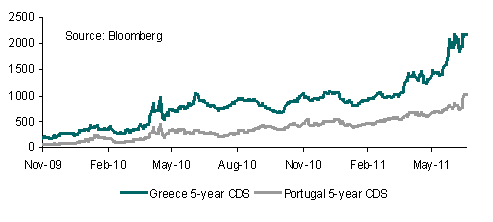
The blowout in eurozone non-core debt has intensified and unlike in past months the EUR has been a clear casualty. The lack of a concrete agreement over a solution given divergent views of EU officials, the European Central Bank (ECB) and private sector participants threatens a further ratcheting higher of pressure on markets over coming weeks.

The only real progress overnight as revealed in the Eurogroup statement appeared to be in the renewing the option of buying back Greek debt via the eurozone bailout fund, extending maturities and lowering interest rates on loans. This will be insufficient to stem the pressure on the EUR, with the currency verging on a sharp drop below 1.40.

The USD continues to take advantage of the EUR’s woes and has actually staged a break above its 100-day moving average yesterday after several attempts previously. This sends a bullish signal and the USD is set to remain supported given that there is little in sight of a resolution to the problems festering in the eurozone.

Today’s release of the June 22 Fed FOMC minutes will give some clues to Fed Chairman Bernanke’s testimony to the House of Representatives tomorrow, but as long as the minutes do not indicate a greater willingness to embark on more asset purchases, the USD is set to remain resilient.

GBP has also benefitted from the EUR’s weakness, and unlike the EUR has only drifted rather than dived versus the USD. However, the UK economy is not without its own problems as revealed in a further drop in retail sales overnight, albeit less negative than feared, with the British Retail Consortium (BRC) like for like sales falling 0.6% in June.

A likely increase in June CPI inflation in data today to a 4.8% annual rate will once again highlight the dichotomy between weak growth and high inflation. In turn, such data will only provoke further divisions within the Bank of England MPC. While further gains against the beleaguered EUR are likely, with a test of EUR/GBP 0.8721 on the cards in the short term, GBP will struggle to sustain any gain above 1.6000 versus USD.

Both AUD and NZD are vulnerable against the background of rising risk aversion and a firmer USD in general. However, both currencies are not particularly sensitive to risk aversion. Interestingly the major currency most sensitive to higher risk aversion in the past 3-months is the CAD and in this respect it may be worth considering playing relative CAD underperformance versus other currencies.

As for the AUD it is more sensitive to general USD strength, suggesting that it will be restrained over coming sessions too and given that market positioning is still very long AUD, there is scope for further downside pressure to around 1.0520 versus USD.
Which is the ugliest currency?

The contest of the uglies has once again been set in motion in FX markets as last Friday’s weak US jobs report, which revealed a paltry 18k increase in June payrolls, downward revisions to past months and a rise in the unemployment rate, actually left the USD unperturbed. Europe’s problems outweighed the negative impact of more signs of a weak US economy, leaving the EUR as a bigger loser.

The USD’s resilience was even more impressive considering the drop in US bond yields in the wake of the data. However, news over the weekend that talks over the US budget deficit and debt ceiling broke down as Republicans pulled out of discussions, will leave USD bulls with a sour taste in their mouth.

Should weak jobs recovery dent enthusiasm for the USD? To the extent that it may raise expectations of the need for more Fed asset purchases, it may prove to be an obstacle for the USD. However, there is sufficient reason to look for a rebound in growth in H2 2011 while in any case the Fed has set the hurdle at a high level for more quantitative easing (QE).

Fed Chairman Bernanke’s reaction and outlook will be gleaned from his semi-annual testimony before the House (Wed) although he will likely stick to the script in terms of US recovery hopes for H2. This ought to leave the USD with little to worry about. There will be plenty of other data releases this week to chew on including trade data, retail sales, CPI and PPI inflation and consumer confidence as well as the kick off to the Q2 earnings season.

Fresh concerns in Europe, this time with contagion spreading to Italy left the EUR in bad shape and unable to capitalise on the soft US jobs report. In Italy high debt levels, weak growth, political friction and banking concerns are acting in unison. The fact that there is unlikely to be a final agreement on second Greek bailout package at today’s Eurogroup meeting will act as a further weight on the EUR.

Discussions over debt roll over plans, the role of the private sector and the stance of ratings agencies will likely drag on, suggesting that the EUR will not find any support over coming days and will more likely lose more ground as the week progresses. If these issues were not sufficiently worrisome, the release of EU wide bank stress tests on Friday will fuel more nervousness. Against this background EUR/USD looks vulnerable to a drop to technical support around 1.4102.

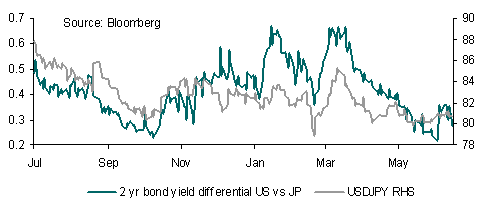
The Bank of Japan is the only major central bank to decide on interest rates this week but an expected unchanged policy decision tomorrow is unlikely to lead to any JPY reaction. In fact there appears to be little to move the JPY out of its current tight range at present. USD/JPY continues to be the most correlated currency pair with 2-year bond yield differentials and the fact that the US yield advantage has dropped relative to Japan has led to USD/JPY once again losing the 81.0 handle.

However, as reflected in the CFTC IMM data the speculative market is still holding a sizeable long position in JPY, which could result in a sharp drop in the currency should US yields shift relatively higher, as we expect over coming months. In the short-term USD/JPY is likely to be well supported around 80.01.