Egypt Unrest Hits Risk Trades

Recent weeks have seen a real contrast in policy and growth across various economies. A case in point was the surprise drop in UK GDP in Q4 contrasting sharply with the solid (albeit less than forecast) rise in US Q4 2010 GDP. The resilience of the US consumer was particularly evident in the data. The European Central Bank’s (ECB) hawkish slant as reflected in comments from President Trichet compared to the dovish pitch of the Fed FOMC is another clear contrast for markets to ponder.

The ECB’s hawkish tone gave the EUR a lift but expectations of an early Eurozone rate hike looks premature. Although Eurozone inflation data (Monday) will reveal a further rise in CPI above the ECB’s target, to around 2.4% in January, this will not equate to a policy rate hike anytime soon. This message is likely to be echoed at this week’s ECB meeting where policy will be characterised as “appropriate”.

Whilst monetary tightening expectations look overdone in the Eurozone the same can be said for hopes of an expansion in the EU bailout fund (EFSF). Indeed, the fact that EU Commissioner Rehn appeared to pour cold water over an expansion in the size of the fund could hit the EUR and the currency may find itself struggling to extend gains over coming weeks especially if interest rate expectations return to reality too, with a move to EUR/USD 1.4000 looking far harder to achieve than it did only a few days ago.

It’s worth noting that a renewed widening in peripheral debt spreads will also send an ominous signal for the EUR. Against this background the EU Council meeting on February 4 will be in focus but any expectation of a unified policy resolution will be disappointed.

However, markets perhaps should not solely focus on peripheral Europe as the downgrading of Japan’s credit ratings last week highlights. Warnings about US credit ratings also demonstrate that the US authorities will need to get their act together to find a solution to reversing the unsustainable path of the US fiscal deficit, something that was not particularly apparent in last week’s State of the Union Address.

Last week ended with a risk off tone filtering through markets as unrest in Egypt provoked a sell-off in risk assets whilst worries about oil supplies saw oil prices spike. Gold surged on safe haven demand too. This week, markets will focus on events in the Middle East but there will be thinner trading conditions as Chinese New Year holidays result in a shortened trading week in various countries in Asia.

The main release of the week is the US January jobs report at the end of the week. Regional job market indicators and the trend in jobless claims point to a 160k gain in January although the unemployment rate will likely edge higher. Final clues to the payrolls outcome will be deemed from the ISM manufacturing confidence survey and ADP private sector jobs report this week. Whilst the January jobs report is unlikely to alter expectations for Fed policy (given the elevated unemployment rate) the USD may continue to benefit from rising risk aversion.
Euro Sentiment Jumps, USD Sentiment Dives

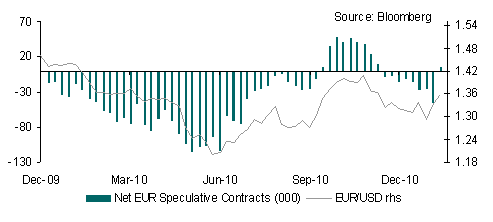
The bounce in the EUR against a broad range of currencies as well as a shift in speculative positioning highlights a sharp improvement in eurozone sentiment. Indeed, the CFTC IMM data reveals that net speculative positioning has turned positive for the first time since mid-November. A rise in the German IFO business confidence survey last week, reasonable success in peripheral bond auctions (albeit at unsustainable yields), hawkish ECB comments and talk of more German support for eurozone peripheral countries, have helped.

A big driver for EUR at present appears to be interest rate differentials. In the wake of recent commentary from Eurozone Central Bank (ECB) President Trichet following the last ECB meeting there has been a sharp move in interest rate differentials between the US and eurozone. This week’s European data releases are unlikely to reverse this move, with firm readings from the flash eurozone country purchasing managers indices (PMI) today and January eurozone economic sentiment gauges expected.

Two big events will dictate US market activity alongside more Q4 earnings reports. President Obama’s State of The Union address is likely to pay particular attention on the US budget outlook. Although the recent fiscal agreement to extend the Bush era tax cuts is positive for the path of the economy this year the lack of a medium to long term solution to an expanding budget deficit could come back to haunt the USD and US bonds.

The Fed FOMC meeting on Wednesday will likely keep markets treading water over the early part of the week. The Fed will maintain its commitment to its $600 billion asset purchase program. Although there is plenty of debate about the effectiveness of QE2 the program is set to be fully implemented by the end of Q2 2011. The FOMC statement will likely note some improvement in the economy whilst retaining a cautious tone. Markets will also be able to gauge the effects of the rotation of FOMC members, with new member Plosser possibly another dissenter.

These events will likely overshadow US data releases including Q4 real GDP, Jan consumer confidence, new home sales, and durable goods orders. GDP is likely to have accelerated in Q4, confidence is set to have improved, but at a low level, housing market activity will remain burdened by high inventories and durable goods orders will be boosted by transport orders. Overall, the encouraging tone of US data will likely continue but markets will also keep one eye on earnings. Unfortunately for the USD, firm US data are being overshadowed by rising inflation concerns elsewhere.

Against the background of intensifying inflation tensions several rate decisions this week will be of interest including the RBNZ in New Zealand, Norges Bank in Norway and the Bank of Japan. All three are likely to keep policy rates on hold. There will also be plenty of attention on the Bank of England (BoE) MPC minutes to determine their reaction to rising inflation pressures, with a slightly more hawkish voting pattern likely as MPC member Posen could have dropped his call for more quantitative easing (QE). There will also be more clues to RBA policy, with the release of Q4 inflation data tomorrow.

Both the EUR and GBP have benefitted from a widening in interest rate futures differentials. In contrast USD sentiment has clearly deteriorated over recent weeks as highlighted in the shift in IMM positioning, with net short positions increasing sharply. It is difficult to see this trend reversing over the short-term, especially as the Fed will likely maintain its dovish stance at its FOMC meeting this week. This suggests that the USD will remain on the back foot.

Temporary Euro Relief

Eurozone peripheral country travails continue to garner most market attention. There was at least a semblance of improvement on this front as peripheral bond spreads with German bunds narrowed on Tuesday but this was largely due to European Central Bank (ECB) bond buying than any improvement in sentiment. The fact that German bund yields also rose helped to narrow bund-peripheral spreads further.

A clearer test of sentiment will be today’s debt sales by Portugal followed by actions by Spain and Italy tomorrow. ECB buying of Portuguese bonds has given some relief to other debt, with Spanish and Italian debt spreads narrowing too. Even Greece managed to sell short term debt (EUR 1.95 bn of 26 week T-bills) but at a higher cost than the previous sale.

Perhaps a stronger boost to sentiment will come from the news that European Union (EU) governments are discussing an increase in the EUR 440 billion bailout fund in recognition of the fact that the fund may prove too small to cope if the crisis spreads to Spain. However, don’t expect a decision anytime soon, with next week’s meeting of EU finance ministers unlikely to agree to such a move. Support (or lack) of from Germany may prove to be a sticking point against the background of domestic political pressure.

Other options being considered include the possibility of the EFSF (European Financial Stability Facility) purchasing bonds in the secondary market and lowering interest rates on EFSF bailout loans. News that Japan will buy 20% of EFSF bonds this month as well as recent supportive comments from China suggest that an increase in the size of the EFSF may be easily funded by such investors. The EUR will gain some support against the background of such speculation but its upside may be restrained around its 200-day moving average at EUR/USD 1.3071.

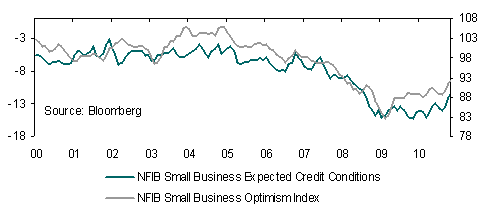
In the US the economic news was not so positive for a change as the National Federation of Independent Business (NFIB) small business optimism survey came in weaker than expected in December, an outcome that will come as a blow given that it suggests some stuttering in the recovery process as well as hiring.

There is only secondary data scheduled today, with most attention on the Fed’s Beige Book later tonight. The survey of Federal Reserve districts will likely reveal a broad based but moderate improvement in economic conditions with the exception of housing activity. A speech by the Fed’s Fisher on Monetary policy will also be in focus. Like the Fed’s Plosser overnight he may highlight some caution about the impact of Fed quantitative easing (QE).

The AUD is increasingly feeling the impact of the flooding in Queensland Australia as the extent of economic damage is revealed. Reserve Bank of Australia (RBA) board member McKibbin estimated that it could knock off at least 1% from economic growth. This may prove too negative and although the flooding will result in a significantly negative impact on growth in Q1 rebuilding and reconstruction will mean that overall growth for 2011 will not be as significantly impacted. Nonetheless, a paring back in RBA policy tightening expectations will see the AUD come under further pressure, with a move down to around AUD/USD 0.9634 on the cards over the short-term.

What QE2 means for currencies

The sweeping gains for the Republican party in the US mid term elections has sharply changed the political dynamic in the US, with the prospects of further fiscal stimulus looking even slimmer than before although the chances of the Bush tax cuts being extended have likely increased.

The onus is on monetary policy to do the heavy lifting and the Fed delivered on its end of the bargain, with the announcement of $600 billion of purchases of long-term securities over 8-months through June 2011.

Given the likelihood that the economic impact of the asset purchases is likely to be limited and with little help on the fiscal front the Fed has got a major job on its hands and $600 billion may end up being a minimum amount of purchases necessary for the Fed to fulfil its mandate.

The decline in the USD following the Fed decision is unlikely to mark the beginning of a more rapid pace of USD decline though further weakness over coming months remains likely. The USD remains a sell on rallies for now and an overshoot on the downside is highly probable as the Fed begins its asset purchases.

The bottom line is that the Fed’s program of asset purchases implies more USD supply and in simple economic terms more supply without an increase in demand implies a lower price. The USD will remain weak for some months to come and the Fed’s actions will prevent any USD recovery as the USD solidifies its position as the ultimate funding currency.

Nonetheless, with market positioning close to extreme levels, US bond yields unlikely to drop much further, and the USD already having sold off sharply in anticipation of QE2, (USD index has dropped by around 14% since June) those looking for a further sharp drop in the USD to be sustained are likely to be disappointed.

It is difficult however, to fight the likely further weakness in the USD even if turns out not to be a rapid decline. The path of least resistance to some likely USD weakness will be via the likes of the commodity currencies, scandies and emerging market currencies. There will be less marked appreciation in GBP, CHF and JPY against the USD.

The Fed’s actions will continue to fuel a rush of liquidity into emerging markets, particularly into Asia. This means more upward pressure on Asian currencies but will likely prompt a variety of responses including stronger FX intervention as well as measures to restrict and control such flows.

There have been various comments from central banks in the region warning about the Fed’s actions prompting further “hot money” flows into the region and even talk of a coordinated response to combat such flows.

This suggests more tensions ahead of the upcoming G20 meeting in Seoul. Assuming that at least some part of the additional USD liquidity flows into Asia, the implications of potentially greater FX intervention by Asian central banks to prevent Asian currencies from strengthening, will have a significant impact on major currencies.

Already it is apparent that central banks in Asia have been strongly using the accumulated USDs from FX intervention to diversify into EUR and other currencies including AUD and even JPY. Perversely this could end up exacerbating USD weakness against major currencies.

G20 Leaves The US Dollar Under Pressure

The G20 meeting of Finance Ministers and Central bankers failed to establish any agreement on clear targets or guidelines. Perhaps the problem of trying to achieve consensus amongst a variety of sometimes conflicting views always pointed to an outcome of watered down compromise but in the event the G20 summit appears to pass the buck to November’s summit of G20 leaders in Seoul where more concrete targets may be outlined.

Officials pledged to “move towards more market determined exchange rate systems” and to “refrain from competitive devaluation of currencies”. What does this actually mean? The answer is not a great deal in terms of practical implications. The first part of the statement is the usual mantra from such meetings and the addition of the latter part will do little to stop central banks, especially in Asia from continuing to intervene given that no central bank is actually devaluing their currency but rather preventing their currencies from strengthening too rapidly.

The communiqué highlighted the need for advanced economies being “vigilant against excess volatility and disorderly movements in exchange rates”, but once again this is the mantra found in the repertoire of central bankers over past years and is unlikely to have the desired effect of reducing the “excessive volatility in capital flows facing some emerging countries”. In other words many emerging countries will continue to have an open door to impose limited restrictions on “hot money” flows.

Although the language on currencies was stronger than in previous summits it arguably changes very little in terms of the behaviour of central banks and governments with respect to currencies. The communiqué is wide open to varying interpretations by countries and is unlikely to prevent the ongoing trend of USD depreciation and emerging market country FX appreciation and interventions from continuing over coming weeks.

The onus has clearly shifted to the November summit of G20 leaders but once again it seems unlikely that substantial agreements will be found. In the interim the November 3 Fed FOMC meeting will be the next major focus and if the Fed embarks on renewed asset purchases as widely expected FX tensions will remain in place for some time yet.

So whilst a “currency war” was always unlikely “skirmishes” will continue. In the meantime the USD is set to remain under pressure although it’s worth noting that speculative positioning has recorded a reduction in net aggregate USD short positions over the last couple of weeks, suggesting that some of the USD selling pressure may have abated. Whether this reflected caution ahead of the G20 meeting (as the data predates the G20 meeting) or indicated the USD having priced in a lot of quantitative easing (QE2) expectations already, is debatable.

The path of least resistance to USD weakness remains via major currencies including AUD, CAD and NZD. Officials in Europe are also showing little resistance to EUR strength despite the premature tightening in financial conditions and negative impact on growth that it entails. Scandinavian currencies such as SEK and NOK have also posted strong gains against the USD and will likely continue to show further outperformance.

The JPY has been the best performing major currency this year followed not far behind by the CHF despite the FX interventions of the authorities in Japan and Switzerland. Although USD/JPY is fast approaching the 80.00 line in the sand level expected to result in fresh FX intervention by the Japanese authorities, the path of the JPY remains upwards. Japan is unlikely to go away from the G20 meeting with any change in policy path as indicated by officials following the weekend deliberations.