Caution ahead of EU Summit

Risk appetite has continued to firm over the last few weeks although notably risk is still elevated compared to the the levels seen in May, suggesting that there is some way to go before risk appetite normalises. Improving risk appetite perhaps reflects rising expectations of a credible set of solutions to the Eurozone crisis but various summits and official meetings including the G20 meeting have failed to deliver anything of this nature.

Attention will turn to the EU Summit on 28-29 June where various issues ranging from debt mutualisation to fiscal and banking union as well as a potential renegotiation of Greece’s bailout terms, will be discussed. Markets are likely to remain relatively range bound ahead of the Summit.

There are also plenty of data releases to contend with over coming days including new home sales, consumer confidence and durable goods orders in the US as well as flash CPI inflation estimates, economic confidence gauges and Italian debt auctions in the Eurozone. Japan will release inflation data too and industrial production data.

On balance US data will continue to outperform although consumer confidence is likely to slip in June. In Europe, confidence indices will reveal some further deterioration in June, while in Japan weak industrial production and a drop in monthly inflation will maintain the pressure on policymakers to act in the country.

The USD will continue to find support from the fact that the Fed did not implement more quantitative easing but firmer risk appetite will cap the ability of the USD to strengthen much from current levels. It is notable that the USD long positions dropped sharply according to IMM data ahead of the Fed meeting but it is likely that Fed QE inaction will result in some rebuilding of USD longs.

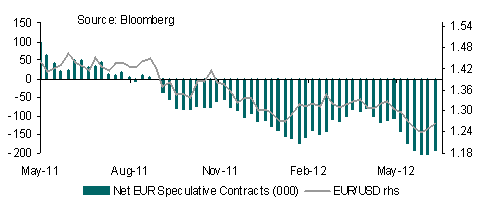
In any case, given the uncertainty ahead of the EU Summit it is unlikely that the EUR will break out of its current ranges. Notably there was a major bout of EUR short covering last week, with EUR/USD shorts dropping sharply according to the IMM data. Hopes ahead of the EU Summit may encourage more short covering but as usual scope for disagreement and disappointment on many fronts, suggests that investors should not become overly bullish. EUR/USD will find some initial resistance around 1.2583 to any upside.
Chronology of a Crisis – endgame?

Please see below an extract from my forthcoming book Chronology of a Crisis (Searching Finance 2012).

The departure of Greece from the Euro is by no means a forgone conclusion but if it happens it is not clear that global policy makers have much ammunition left to shield markets from the resulting fallout.

Stimulus after stimulus has only left governments increasingly indebted. The price of such largesse is now being paid in the form of higher borrowing costs. Even central banks do not have much ammunition left. Admittedly further rounds of quantitative easing, and central bank balance sheet expansion may help to shore up confidence but the efficacy of such policy actions is questionable. Moreover, policy support may only help to buy time but if underlying structural issues are not resolved pressure could resume quickly.

Against this background Europe is under intense pressure and there is little time left before it results in something catastrophic for global markets via a disorderly break up of the Eurozone. EU leaders and the European Central Bank (ECB) have to act to stem the crisis. However, at the time of writing the ECB under the helm of Mario Draghi is steadfastly refusing to provide further assistance to the Eurozone periphery either directly via lower interest rates or securities market purchases or indirectly via another Long term refinancing operation (LTRO). Any prospect of debt monetization as carried out already by other central banks including the Fed and Bank of England is a definite non-starter. The reason for this intransigence is that the ECB does not want to let Eurozone governments off the hook, worrying that any further assistance would allow governments to slow or even renege upon promised reforms.

Whether this is true or not it’s a dangerous game to play. The fact that the previously unthinkable could happen ie a country could exit the Eurozone should have by now prompted some major action by European officials. Instead the ECB is unwilling to give ground while Germany continues to stand in the way of any move towards debt mutualisation in the form of a common Eurobond and/or other measures such as awarding a banking license to the EFSF bailout fund which would effectively allow it to help recapitalize banks and purchase peripheral debt. Germany does not want to allow peripheral countries to be let off the hook either, arguing that they would benefit from Germany’s strong credit standing and lower yields without paying the costs.

To be frank, it’s too late for such brinkmanship. The situation in The Eurozone is rapidly spiraling out of control. While both the ECB and Germany may have valid arguments the bottom line is that the situation could get far worse if officials fail to act. As noted above there are various measures that could be enacted. Admittedly many of these will only buy time rather than fix the many and varied structural problems afflicting a group of countries tied together by a single currency and monetary policy and separate fiscal policies but at the moment time is what is needed the most. Buying time will allow policymakers to enact reforms, enhance productivity, reform labour markets, increase investment funds etc. Unfortunately European policy makers do not appear to have grasped this fact. Now more than at any time during the crisis much depends on the actions of policy makers. This is where the major uncertainty lies.

If officials do not act to stem the crisis, economic and market turmoil will reach proportions exceeding that of even the Lehmans bust.

Fed disappoints, NZD jumps on firm GDP

The decision by the Fed to extend its maturity extension program through year end by USD 267 billion left markets with a taste of disappointment. Although the Fed noted that it was “prepared to take further action” it was clear that FOMC members were resistant to such action at this point in time. Nonetheless, any downside to risk assets was limited by the potential for more quantitative easing (QE) somewhere down the line.

Indeed, while equity markets took a softer tone it was notable that the VIX ‘fear gauge’ continued to drop reflecting an improvement in risk sentiment. The VIX has dropped by 35% from its high at the beginning of the month. Commodity prices remained under downward pressure, however. The lack of further Fed balance expansion capped gold prices too. The outcome is likely to play positively for the USD given that the Fed is not going to debase the currency any further for now.

Following the Fed decision clearly pressure is on other central banks to act. The European Central Bank’s Coeure hinted at the prospects a press interview while the Bank of England minutes were surprisingly dovish, indicating a strong likelihood of further UK QE at the next MPC meeting.

EUR/USD dropped to around 1.2638 following the FOMC outcome but rebounded probably helped by the fact that the Fed left open the door for further balance sheet expansion. EUR/USD 1.2750 remains a major barrier to the currency pair but if breached there is plenty of upside potential.

Flash Eurozone purchasing managers indices (PMI) releases today will likely restrain the EUR, with a further slight declines in manufacturing confidence expected, consistent with further contraction in activity. The data will put further pressure on the ECB to cut interest rates. EUR direction today will also come from Spanish and French bond auctions today.

It’s worth highlighting the surprisingly robust New Zealand Q1 GDP data released this morning. The data revealed a strong 1.1% quarterly increase compared to consensus expectations of a 0.4% increase. The data boosted NZD which rallied to a high of 0.8018 versus the USD and remains well supported. NZD/USD 200 day moving average around 0.7952 will provide decent support for the currency especially given the sharp move hawkish move in NZ interest rate markets.

Euro rallies on Greek election outcome but gains to be short lived

The Greek election outcome will be met with a sigh of relief across markets. However, there is still likely to be plenty of horse trading before a new government is formed and even then Greece’s fiscal/debt/growth problems will not just miraculously go away. Market pressure will resume after a brief delay.

At least for the early part of this week markets will likely find some support however, and with events including the FOMC meeting, G20 meeting and EU Summit coming up, hopes that some solutions may be forthcoming may at least prevent sentiment for risk assets from deteriorating too significantly.

The EUR garnered support following news that pro-bailout parties have gained sufficient votes to form a government in Greece. Negotiations will begin to form a coalition government between the first placed party New Democracy and third placed Pasok but the risk remains that prolonged discussions could quickly result in the EUR erasing its gains. Indeed, Pasok leaders are talking about the need to form a ‘government of national unity’, suggesting the process of forming a government will not be straightforward.

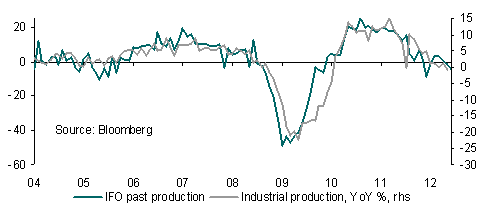
A slightly less negative shift in EUR sentiment has been apparent from the CFTC IMM data which revealed that net short positions dropped (ie there has been some short covering) even before the election outcome. The election result will encourage more short covering although data releases this week including the June German ZEW investor confidence and IFO business confidence surveys, both of which are set to decline, will caution against becoming overly bullish EUR. Short term EUR/USD resistance is seen around 1.2750 but a move back down to around 1.2515 is more likely as the week progresses.
a href=”https://econometer.org/wp-content/uploads/2012/06/gerifo.gif”>
One of the reasons the EUR has managed to garner support over recent days has been growing speculation of Fed action to boost the economy in the wake of a rash of softer data releases. Such expectations have put the USD under pressure, with last week’s data revealing disappointing retail sales, industrial production and consumer confidence. On Wednesday the markets will find an answer to speculation of more Fed action, with the Fed FOMC policy decision.

Expectations of more quantitative easing will be disappointed but the Fed will likely increase Operation Twist buying time to evaluate incoming data releases. A combination of a relatively positive Greek election outcome together with speculation of more QE will keep the USD under pressure ahead of Wednesday’s outcome but weakness ought to prove short lived, with USD gains expected following the Fed decision not to expand its balance sheet further.

Central banks ready to act

Markets are in wait and see mode ahead of Greek elections with range trading likely to dominate market action, albeit with a slightly risk on bias. US data disappointed once again, with jobless claims coming in worse than expected, compounding the growing fears about deterioration in US job market conditions. Perversely the poor jobs data coming against the background of soft May CPI inflation data have fuelled expectations of Fed action at next week’s Federal Reserve FOMC meeting.

It is not only the Fed that markets believe may act, with reports overnight suggesting that there may be some form of coordinated action by central banks should the Greek election outcome prove to be unfavourable. On this front, the news appears to be a little more encouraging as expectations that pro bailout parties will garner relatively more votes has grown as reflected in the 10% rally in Greek shares overnight.

If it takes weak economic data for markets to rally nowadays then there will be plenty available today, with declines expected for the May Empire manufacturing survey and June Michigan confidence, while industrial production is only likely to register a marginal gain in May. While the data may add more fuel to the fire, I suspect it will still be insufficient to result in more Fed balance sheet expansion.

European Central Bank (ECB) President Draghi is scheduled to speak today but I doubt he will suggest a move towards another LTRO or Securities Market Purchases. On the subject of central banks the Bank of Japan will announce its policy decision today but I expect no change in stance despite the fact that the 1% inflation goal remains a long way off. Currencies will remain in ranges but hopes of central bank action and a favourable outcome to the Greek elections will provide support for risk currencies and keep the USD under pressure.