EUR to struggle to extend gains

Once again the USD index failed to break above its 100-day moving average, its third failure to do so over recent weeks. The USD is now trading below its 20- and 50- day moving averages and looks vulnerable to further weakness. However, much will depend on the travails of the EUR and how quickly the boost to this currency fades following last week’s Greek austerity plan approval.

The USD was helped last week by the relative move higher in US bond yields, which saw 2-year yield differentials between the Eurozone and US drop below 100bps for the first time since the beginning of April. Given that the six-month correlation between 2-year bond yield differentials and EUR/USD is at a very high level, it is reasonable to assume that this will remain an important factor driving the currency pair going forward.

The yield differential narrowing seen last week has reversed as German yields have moved sharply higher this week, however. This is in large part attributed to more positive developments in Greece but nonetheless, it has helped to push the EUR higher.

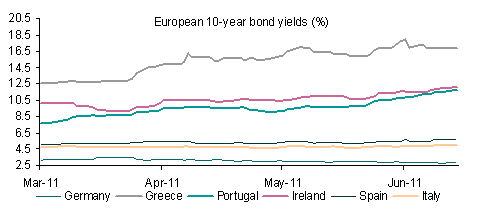
Ratings agencies may yet spoil the party for the EUR, with S&P’s warning that Greece’s debt rollover plans may put the country’s ratings into select default, fuelling some caution. Should ratings agencies downgrade Greek debt to junk it will not only be international investors that will re-think their exposure to the country but the European Central Bank (ECB) could also stop holding Greek debt as collateral for loans although an official from the Bank noted that this would happen only if all the major ratings agencies downgrade Greek debt to default.

Attention is now turning to the implementation risks of austerity measures and asset sales. While Greece’s contribution to eurozone GDP is small, the pain of implanting more budget cuts will push the economy deeper into recession and reveal the stark divergences in growth in the eurozone at a time when the ECB is hiking interest rates.

In reaction to such concerns there is likely to be a series of measures announced over coming days and weeks to boost growth according to Greece’s finance minister. As the S&P comments and implementation/growth concerns suggest, the EUR may struggle to extend gains, especially as the currency is looking increasingly stretched at current levels, with this week’s ECB rate hike largely in the price. Top side resistance for EUR/USD is seen around 1.4598.
Asian currencies at multi-year highs

Asian currencies are stronger in the wake of a sharp improvement in risk appetite following the approval of Greece’s austerity measures. The rally in Asian FX is revealed in the ADXY (an index of Asian currencies) index which is approaching a test of its 2nd May high around 119.26 around its highest level since August 1997. Technical indicators have turned more bullish, with the ADXY breaking above its key moving average levels (20, 50 & 100 day) and the 14-day relative strength index also turning higher.

The Asian FX rally has been led by the KRW, the Asian currency that has had the highest correlation with risk over the past few weeks. Given that risk aversion has dropped sharply since mid June it is no surprise that this currency has strengthened the most. USD/KRW is trading around its lowest level since August 2008. Strong equity capital outflows had kept the KRW on the back foot over much of June but there has been a bounce back in flows recently. However, USD/KRW is likely to find it tough to break below 1060 over the short-term, especially given likely resistance from the local authorities.

The THB, the worst performing Asian currency in June, has rapidly reversed some of its losses. The THB looks set to consolidate its gains following a decisive election result which saw the opposition Puea Thai Party gain control of parliament. The biggest relief for markets was the fact that the outcome was relatively clear cut, suggesting a potentially a smooth handover of power. Nonetheless, the currency has already jumped and after having dropped to around 30.40 from a high of around 31.01 USD/THB is likely to trade off gyrations in risk appetite.

The fact that the USD has lost some ground in the wake of firmer risk appetite and better news in Greece has also allowed Asian currencies to strengthen although it’s worth noting that amongst Asian currencies only the MYR has maintained a significant correlation with the USD index over the past 3-months. In other words, although USD weakness has helped to facilitate Asian currency strength, the recent strengthening in Asian FX is more likely to have been due to a rebound in capital inflows to the region.

Further Asian FX gains are likely over the near term especially as China continues to fix the CNY higher versus USD but given the recent rapid gains in some currencies, there is a risk of growing official resistance and intervention to slow or stem Asian FX gains. Moreover, the end of QE2 in the US suggests that the downside risks for the USD in general are not likely to be as prevalent, with a potential recovery in the USD over H2 likely to stand in the way of strong Asian FX gains over coming months.

EUR higher but resistance looms

EUR and risk currencies in general were buoyed by the passage of the austerity bill in the Greek parliament. The implementation bill is also likely to be passed later today opening the door for the disbursement of EUR 12 billion from the European Union / IMF from the EUR 110 bailout agreed for the country. Combined with news that German banks are progressing towards agreeing on a mechanism to roll over Greek debt alongside French banks as well as likelihood of an European Central Bank (ECB) rate hike next week, the EUR is set to remain supported over the short term.

Nonetheless, it once again looks as though a lot of good news is priced in and it would be surprising if EUR/USD could extend to above strong resistance around 1.4557 given the many uncertainties ahead, not the least of which includes the stance of ratings agencies on any Greek debt rollover.

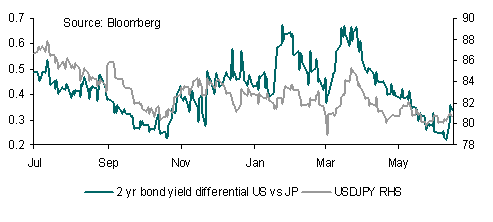
USD/JPY is the only major currency pair that is correlated with bond yield differentials at present (2-year yields) and therefore it should not come as a surprise that USD/JPY has moved higher as the yield differential between the US and Japan has widened by around 10bps over the past week. Indeed, yesterday’s move above 81.00 was spurred by the move in yield differentials although once again the currency pair failed to build sufficient momentum to close above this level.

Further gains will require US bond yields to move even higher relative to Japan but perhaps the end of QE2 today may mark a turning point for US bond markets and currencies. The end of QE2 taken together with a jump in bond supply over coming months, will see US Treasury yields will move sharply higher, implying much more upside for USD/JPY.

AUD has bounced back smartly over recent days, with the currency eyeing resistance around 1.0775 versus USD. A general improvement in risk appetite has given the currency some support but markets will be unwilling to push the currency much higher ahead of the Reserve Bank of Australia (RBA) meeting next week. On the plus side, there are no rate hikes priced in for Australia over the remainder of the year, suggesting an asymmetric risk to next week’s meeting.

In other words, unless the RBA openly discusses rate cuts in the statement, the AUD will likely remain supported. Conversely any indication that a rate hike may be in prospect will be AUD supportive. In any case we continue to believe the AUD offers better value especially relative to NZD and maintain our trade idea to buy AUD/NZD.

US dollar on the rise

Risk aversion is on the rise as uncertainties about Greece and worries about weaker economic data weigh on sentiment. A number of key events rather than data will be the main drivers this week. First and foremost amongst these is the vote in the Greek parliament on the country’s budget reform plan, which if passed will pave the way for the way for a disbursement of EUR 12 billion from the European Union / IMF and a new bailout package.

Meanwhile in the US talks on raising the debt ceiling are likely to resume in earnest, with the market likely to become increasingly nervous about the lack of resolution on the issue. Nonetheless, it is Europe that will dominate the headlines and on this front even if the reform plan is passed any market relief is likely to be limited given the ongoing uncertainty about private sector participation in any Greek debt roll over. This suggests that the EUR will remain under pressure over the week despite reassuring comments from Chinese Premier Wen.

Data releases will be relegated to background noise but what there is will not help sentiment. Signs of slowing activity remain evident as revealed in disappointing eurozone manufacturing surveys last week and this will be echoed in the US ISM manufacturing survey at the end of this week. Economic sentiment gauges in Europe are also set to reveal a decline. Given the lack of ammunition and/or unwillingness to risk using further stimulus from the Fed, the sensitivity of markets to weak data will be high, keeping risk aversion elevated.

Indeed, although well flagged the end of the Fed’s QE2 this week will mark a major shift in market dynamics, especially in currency markets where the USD will finally see a massive weight lifted from its shoulders. As indicated by Fed Chairman Bernanke following the FOMC meeting the Fed is not considering a further round of asset purchases, a fact that will help the USD to find firmer support.

Notably the USD index moved has above its 100-day moving average providing a positive technical signal given that it has failed on its last two attempts. The USD index now looks set to break its April high around 76.610.

Asian currencies vulnerable to equity outflows

Asian currencies are set to continue to trade cautiously. One big headwind to further appreciation is the fact that there has been a substantial outlook of equity capital over recent weeks. Over the last month to date Asian equity markets have registered an outflow of $3.3 billion in outflows. However, whilst Taiwan, South Korea, Thailand and India have seen outflows Indonesia, Philippines, and Vietnam have registered inflows.

The net result is that equity capital inflows to Asia so far this year are almost flat, a stark contrast from 2009 and 2010 when inflows were much higher at the same point in the year. The odds for further strong inflows do not look good, especially as the Fed ends QE2 by the end of June. While a sharp reversal in capital flows is unlikely, it also seems unlikely that Asia will register anywhere near as strong inflows as the last couple of years.

This will have a significant impact on Asian currencies, whose performance mirrors capital flows into the region. Almost all Asian currencies have dropped against the USD so far this month and could remain vulnerable if outflows continue. Given the relative stability of the USD over recent weeks and imminent end to QE2, the better way to play long Asia FX is very much against the increasingly vulnerable EUR.

The THB has been the worst performing currency this month but its weakness has been attributable to upcoming elections on July 3, which has kept foreign investor sentiment cautious. Thailand has seen an outflow of $812mn from its equity market this month. Polls show the PM Abhisit’s party trailing the opposition and nervousness is likely to persist up to the elections at least. THB weakness is not likely to persist over coming months, with USD/THB forecast at 29.2 by year end.

USD/KRW has been whipsawed over the past week but made up ground despite a continued outflow of equity capital over recent days. KRW has been particularly resilient despite a firmer USD environment and a drop in consumer sentiment in June. Next week the KRW will likely continue to trade positively, helped by a likely firm reading for May industrial production on Thursday. USD/KRW is set to trade in a 1070-1090 range, with direction likely to come from Greece’s parliament vote on its austerity measures.

TWD has traded weaker in June, having been one of the worst performing currencies over the month. USD/TWD does not have a particularly strongly correlation with movements in the USD or risk aversion at present but the currency has suffered from a very sharp outflow of equity capital over recent weeks (biggest outflow out of all Asian countries so far this month). Next week’s interest rate decision on Thursday by the central bank (CBC) will give some direction to the TWD but a 12.5bps increase in policy rates should not come as a big surprise. TWD is likely to trade with a weaker bias but its losses are likely to be capped around the 29.00 level versus USD.