Temporary relief for US Dollar

Downbeat US economic news in the form of a widening US trade deficit, increase in jobless claims and bigger than expected increase in top line PPI inflation contrasted with upbeat earnings from Google. Google shares surged over 9% in after hours trading but US data tarnished the risk on mood of markets, leaving commodity prices and equities lower and the USD firmer. Higher US Treasury yields, especially in the longer end following a poor 30 year auction, helped the USD to push higher.

The USD’s trend is undoubtedly lower but profit taking may be the order of the day ahead of a speech by Fed Chairman Bernanke on monetary policy later today and the release of the highly anticipated US Treasury Report in which China may be named as a currency manipulator. A speech by the Minneapolis Fed’s Kocherlatoka (non voter) this morning sounded downbeat, even suggesting that “Fed asset purchases may have a muted effect”. Despite such comments the Fed appears likely to embark on QE2 at its 3 November meeting.

Today is also a key data for US data releases with September data on US retail sales, and CPI and October data on Michigan confidence and Empire manufacturing scheduled for release. Retail sales are likely to look reasonable, with headline sales expected to rise 0.5% and ex-autos sales expected up 0.4%. The gauges of both manufacturing and consumer confidence are also likely to show some recovery whilst inflation pressures will remain benign. Given the uncertainty about the magnitude of QE the Fed will undertake in November, the CPI data will have added importance.

The US trade will likely have resulted in an intensification of expectations that China will be labelled as a currency manipulator in the US Treasury report later today. The August trade deficit with China widened $28.04 billion, the largest on record. At the least it will give further ammunition to the US Congress who are spoiling for a fight ahead of mid-term congressional elections, whilst heightening tensions ahead of the November G20 meeting.

Indeed currency frictions continue to increase although “currency war” seems to be an extreme label for it. Nonetheless, Singapore’s move yesterday to widen the SGD band highlighted the pressure that many central banks in the region are coming under to combat local currency strength. Singapore’s move may be a monetary tightening but it is also a tacit recognition of the costs of intervening to weaken or at least limit the strength of currencies in the region. To have maintained the previous band would have required ongoing and aggressive FX intervention which has its own costs in terms of sterilization.

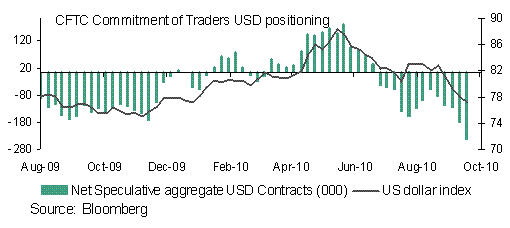
This problem will remain as long as the USD remains weak and this in turn will depend on US QE policy and bond yields. A lot of negativity is priced into the USD and market positioning has become quite extreme suggesting that it will not all be a downhill bet for the currency. Many currencies breached or came close to testing key psychological and technical levels yesterday, with EUR/USD breaching 1.4000, GBP/USD breaking 1.6000, USD/CAD breaking below parity and AUD/USD coming close to testing parity. Some reversal is likely today, but any relief for the USD is likely to prove temporary.
Contrasting Stance

Despite some recent Fed speakers putting doubts into the minds of the many now looking for the Fed to embark on QE2 in November, the minutes of the 21 September FOMC meeting gave the green light to the commencement of asset purchases next month. Although there is clearly no unanimity within the FOMC the majority favour further easing. Incremental data dependent asset purchases will be the most likely path.

The minutes leave the USD vulnerable to further declines but extreme short USD positioning suggest that there is plenty of risk of short covering and more likely we are probably set for a period of consolidation over coming weeks before the USD resumes its decline.

Unlike the Fed, BoJ and BoE, which remain in easing mode the ECB is already veering towards an exit strategy, albeit one that is unlikely to take effect for some time. Hawkish comments by the ECB’s Weber overnight managed to give a lift to the EUR in the wake of a further widening in interest rate differentials between the eurozone and US. Indeed, interest rate differentials (2nd contract futures) are at the widest since Feb 2009, a factor that is providing plenty of underlying support for the EUR.

Further out the follow through on the EUR will depend on whether markets believe Weber’s stance is credible. Germany’s economy is doing well but it is highly likely that Southern European officials would oppose any premature tightening in policy given the parlous state of their economies. The stronger EUR will also do some damage to growth, with its recent appreciation acting as a de facto monetary tightening.

Despite the positive influence of Weber’s comments short-term technical indicators show that the trend in EUR is vulnerable, with clear signs of negative divergence as the spot rate is still trending higher whilst the relative strength indices (RSI) are trending lower. Moreover, EUR speculative positioning is at its highest in a year, albeit still well of its all time highs. Speculators may be reluctant to build on longs in the near term. A clean and sustained break above EUR/USD 1.4000 level still looks like a stretch too far though any downside is likely to be limited to strong support around 1.3895.

Unlike the perception that the ECB is highly unlikely to follow the Fed in a path of QE2 the policy stance of the BoE is far more uncertain, a fact that continues to weigh on GBP, especially against the EUR. Recent data in the UK has played into the hands of the doves, with housing market activity and prices coming under renewed pressure, retail sales surveys revealing some deterioration and consumer confidence as revealed in the Nationwide survey overnight, weakening further.

BoE MPC member Miles summarized the situation by highlighting that the UK faces “some big risks” and even hinted that the BoE may “come to use QE”. UK jobs data today is unlikely to give any support to sentiment for GBP although as per its recent trend GBP is likely to remain resilient against the USD whilst remaining under pressure against the EUR, with a move to resistance around EUR/GBP 0.8946 on the cards in the short-term

No FX co-operation

Despite all the jawboning ahead of the IMF / World Bank meetings over the weekend the meeting ended with little agreement on how deal to with the prospects of a “currency war”. US officials continued to sling mud at China for not allowing its currency, the CNY, to appreciate quickly enough whilst China blamed the US for destabilizing emerging economies by flooding them with liquidity due to the Fed’s ultra loose monetary policy stance. Chinese trade data on Wednesday my throw more fuel on to the fire given another strong surplus expected, lending support to those in the US Congress who want to label China as a “currency manipulator”.

Although the IMF communiqué mentioned countries working co-operatively” on currencies there were no details on how such cooperation would take place. The scene is now set for plenty of friction and potential volatility ahead of the November G20 meeting in Seoul. Although many central banks are worrying about USD weakness when was the last time US Treasury Secretary Geithner talked about a strong USD? US officials are probably happy to see the USD falling and are unlikely to support any measure to arrest its decline unless the drop in the USD turns into a rout. In contrast, the strengthening EUR over recent weeks equates to around 50bps of monetary tightening, a fact that could put unwanted strain on Europe’s growth trajectory, especially in the periphery.

The outcome of the IMF meeting leaves things much as they left off at the end of last week. In other words there is little to stand in the way of further USD weakness apart from the fact that the market is already extremely short USDs. Indeed the latest CFTC IMM data revealed that aggregate net USD positioning came within a whisker of its all time low, with net positions at -241.2k contracts (USD -30 billion), the lowest USD positioning since November 2007. Interestingly and inconsistent with the sharp rise in the EUR, positioning in this currency remains well below its all time highs, supporting the view that rather than speculative investors it is central banks that are pushing the EUR higher.

The US jobs report at the end of last week proved disappointing, with total September payrolls dropping by 95k despite a 64k increase in private payrolls. The data will act to reinforce expectations that the Fed will begin a program of further asset purchases or quantitative easing (QE2) at its November meeting. Data and events this week will give further clues, especially the Fed FOMC minutes tomorrow and speeches from Fed Chairman Bernanke on Thursday and Friday as well as various other Fed speakers on tap.

Recent speeches by Fed officials have highlighted growing support for QE although some have tried to temper expectations. Questions about the timing and size of any new programme, as well as how it will be communicated remain unanswered. Although November seems likely for the Fed to start QE the Fed’s Bullard suggested that the Fed may wait until December. The minutes will be scrutinized for clues on these topics. The Fed is likely to embark on incremental asset purchases with the overall size being data dependent and the USD set to remain under pressure while this happens.

Quarter 3 Economic Review: Turbulent Times (With Some Opportunities)

I recently contributed a guest article to a website run by Sital Ruparelia dedicated to “Career & Talent Management Solutions“. In the article I discuss the outlook for the global economy.

Sital is a regular guest on BBC Radio offering career advice and job search tips to listeners. Being a regular contributor and specialist for several leading on line resources including eFinancial Careers and Career Hub (voted number 1 blog by ‘HR World’), Sital’s career advice has also been featured in BusinessWeek online.

Quarter 3 Economic Review: Turbulent Times (With Some Opportunities)

The global economy and markets continue to go through turbulent times. Unfortunately doubts about the sustainability of the recovery in global economic activity have persisted and signs of recovery have been limited and weak. On a positive note, the appetite for risk has improved and equity markets registered solid gains over the past quarter, bringing many equity indices back into positive territory for the year.

Slow and gradual recovery in the US

Whilst it now appears that the US economy will not go through a double dip recession over the coming months, it has also become apparent that any recovery will be extremely slow and gradual.

The simple fact that US consumers remain burdened with large amounts of debt means that consumer spending will not recover quickly especially given high levels of unemployment. Moreover, whilst the US economy as a whole is unlikely to undergo a double dip the housing market is facing a renewed downturn following the expiry of government tax credits for first time homebuyers.

Please click on this link below to read the rest…

Money Printing

It was a day of surprises on Tuesday as the Bank of Japan (BoJ) not only created a JPY 5 trillion fund to buy domestic assets including JGBs but also cut interest rates to zero. Expect more measures to come in the fight against a stronger JPY and deflation. The Reserve Bank of Australia (RBA) also surprised markets by leaving its policy rate unchanged at 4.5% delaying another rate hike yet again despite expectations by many including ourselves of a 25bps rate hike.

The easier policy stance from the BoJ and RBA taken together with firmer service sector purchasing managers indices – including the September US ISM non-manufacturing survey, which came in at 53.2 from 51.5 – gave risk appetite a solid lift. Even the AUD which dropped sharply following the RBA decision, managed to recoup all of its losses and more overnight.

Japan’s decision could have set the ball rolling for a fresh round of quantitative easing (QE) from central banks as they combat sluggish growth prospects ahead and ongoing deflation risks. The US Fed as has been much speculated on and the Bank of England (BoE) are likely candidates for more QE. Whilst the European Central Bank (ECB) is unlikely to adopt such measures there are reports that board members are split over the timing of exit policy. The BoE decision on Thursday may provoke more interest than usual against this background although the Bank is unlikely to act so quickly. The Fed on the other hand appears to be gearing up for a November move.

Growing prospects of fresh QE looks likely to provide further impetus for risk trades. Notably commodity prices jumped higher, with the CRB commodities index at its highest level since the beginning of the year. Although there is plenty of attention on the gold price which yet a fresh record high above $1340 per troy ounce as well as tin which also hit new highs, the real stars were soft commodities including the likes of sugar, coffee and orange juice up sharply.

The main loser once again is the US dollar and this beleaguered currency appears to be finding no solace, with any rally continuing to be sold into, a pattern that is set to continue. Although arguably a lot is in the price in terms of QE expectations, clearly the fact that the USD continues to drop (alongside US bond yields) highlights that a lot does not mean that all is in the price.

The USD is set to remain under pressure against most currencies ahead of anticipated Fed QE. The fact that the USD has already dropped sharply suggests a less pronounced negative USD reaction once the Fed starts buying assets but the currency is still set to retain a weaker trajectory once the Fed USD printing press kicks into life again as a simple case of growing global USD supply will push the currency weaker.

USD weakness will only spur many central banks including across Asia to intervene more aggressively to prevent their respective currencies from strengthening. A “currency war” looms, a fact that could provoke some strong comments at this weekend’s IMF and World Bank meetings. In the meantime intervention by central banks will imply more reserves recycling, something that will continue to benefit currencies such as EUR and AUD.