Currency Tensions Intensify Ahead of G7

Portugal, Greece and Spain remain firmly in the spotlight but it may not be long before the light broadens to include UK, US and many other countries facing similar difficulties on the fiscal front. Portuguese, Greek and Spanish equities were smashed in the wake of growing concerns and sentiment looks like it will get worse before it gets any better.

Events in each of these countries are not helping matters. In Portugal, parliament began to vote on a bill on financial transfers to the regions, which could damage the ability of the government to reduce the deficit whilst speculation that the Prime Minister is about to resign has intensified. In Greece tax collectors have started a 48-hour strike as social unrest worsens in the wake of the implementation of deficit cutting measures.

Although European officials pour cold water on the idea that the whole EMU Project could unravel bond markets are not taking any chances whilst the EUR looks destined to languish at ever weaker levels until there is a semblance of calm. Meanwhile. the European Central Bank (ECB) has clearly stated that does not want to get involved.

The G7 meeting in Canada will move rapidly into focus this weekend, with a joint press conference expected on Saturday. Sovereign debt concerns and restrictions and banks will likely be addressed whilst the not insignificant matter of China’s currency will also likely be discussed.

US pressure on China to strengthen the CNY has increased as has tensions between the two countries following US arms sales to Taiwan and a scheduled meeting between President Obama and the Dalai Lama.

There is growing speculation that the upcoming US Treasury report in April will label China as a currency manipulator which could result in tensions ratcheting up to a higher level. China holds the cards given the US reliance on Chinese money but with mid-term elections looming in the US and Obama’s promise to double US exports within five years, US pressure on China will intensify as will likely resistance from China.
Selling Risk Trades On Rallies

Disappointing earnings as well as a weaker than expected outcome for data on the health of the US service sector (the ISM non-manufacturing index failed to match expectations, coming in at 50.5 in January versus consensus of 51.0) has weighed on markets, undoing the boost received from the generally positive manufacturing purchasing managers (PMIs) indices earlier in the week. It was not all bad news however, as earnings from Cisco Systems beat expectations Meanwhile US ADP jobs data fell less than expected, dropping 22k whilst data for December was upwardly revised. These are consistent with a flat outcome for January non-farm payrolls.

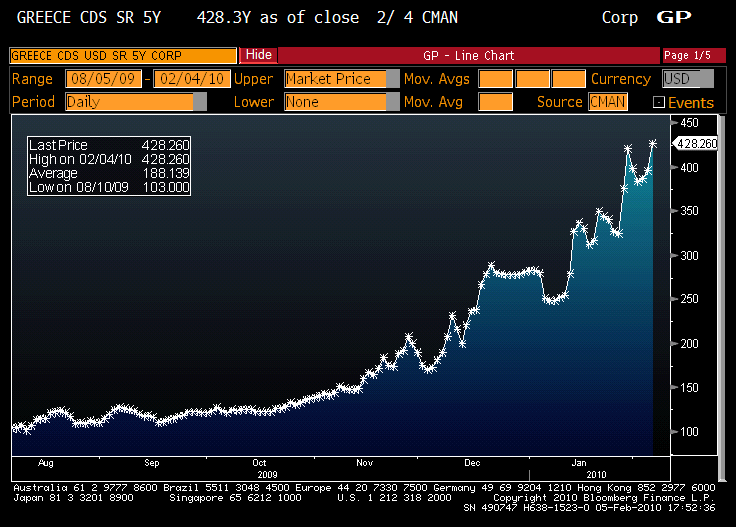
Various concerns are still weighing on confidence. Sovereign ratings/fiscal concerns remain high amongst these and although much has been made of the narrowing in Greek debt spreads, attention now seems to be turning towards Portugal. Greece is also far from being out of the woods, and whilst the European Commission accepted Greece’s economic plans the country would be placed under much greater scrutiny by the EC.

The US has not escaped either, with Moody’s warning that the US AAA credit rating would come under pressure unless more stringent actions were taken to reduce the country’s burgeoning budget deficit. The move follows the US administration’s forecast of a $1.565 billion budget deficit for 2010, the highest as a proportion of GDP since the second world war, with the overall debt to GDP ratio also forecast to rise further.

The current environment remains negative for risk trades and the pullback in high beta currencies has been particularly sharp over recent weeks. Sentiment for the NZD was dealt a further blow from a surprisingly weak Q4 jobs report in New Zealand. Unemployment rose to a decade high of 7.3% over the quarter whilst employment growth contracted by 0.1%. The pull back in wage pressures will also be noted by interest rate markets, as it takes some of the pressure off the RBNZ to raise rates anytime soon.

Data in Australia will not help sentiment for the AUD too. Australian retail sales dropped by 0.7% in December, a worse than expected outcome. The data will only serve to reinforce market expectations that the RBA will no hike interest rates as quickly as previously expected. Nonetheless, I would caution reading too much into the data, with real retail sales volumes rising by a solid 1.1% over Q4 whilst other data showed a strong 2.2% jump in building approvals.

The overall strategy against this background is to sell risk trades on rallies. There are still too many concerns to point to a sustained improve in risk appetite. Moreover, the market is still long in many major risk currencies. Asian currencies have so far proven more resilient to the recent rise in risk aversion however, a reflection of the fact that a lot of concerns are emanating from the US and Europe. However, Asian currencies will continue to remain susceptible to events in China, especially to any further measures to tighten policy.

Further USD strength against this background is likely, which could see EUR/USD testing support around 1.3748, AUD/USD support around 0.8735, and NZD/USD support around 0.6916.

Central banks in the spotlight

The market mood continues to be weighed down by a combination of worries including monetary tightening in China and Greece’s debt woes. Consequently, risk aversion has taken a turn for the worse over the last couple of weeks. Measures of currency and equity market volatility have also spiked. Meanwhile, risk currencies have remained under pressure, especially those that are most sensitive to risk aversion including AUD, NZD, CAD, and a long list of emerging market currencies.

Greece’s problems remain a major drag on the EUR, with speculative sentiment for the currency dropping close to the all time low recorded in September 2008, according to the CFTC IMM data. Further developments including news that the European Commission will officially recommend that Greece should implement more severe cuts on public sector spending are unlikely to help to reverse negative sentiment for the currency. A lack of confidence and scepticism over Greece’s ability to cut its budget deficit suggest little respite for the EUR in the weeks ahead.

Markets will have plenty of other things to focus on this week, with various manufacturing and service sector PMIs, four major central bank decisions, and the January US non-farm payrolls report, due for release. The PMIs are likely to confirm that output in both manufacturing and service industries remains expansionary but only consistent with limited growth rather than the rapid rebound in activity seen following past recessions.

The most interesting central bank decision this week is likely to be that of the Reserve Bank of Australia. Recent data has if anything given more reason for the central bank to raise interest rates, including the latest release which was the TD Securities inflation gauge, which jumped 0.8% in January, the biggest increase in 6-months. Although a hike is now largely discounted, some hawkish rhetoric from the RBA could be sufficient to give the AUD some support.

Although the UK Bank of England is unlikely to shift policy at its meeting on Thursday the statement will be scrutinized for clues as to whether quantitative easing is over. Any indication that there will be no further QE measures will play positively for GBP given that it has been restrained by speculation that the BoE will increase asset purchases. No change is also expected by the ECB but once again Greece will likely dominate the press conference. Meanwhile Norway’s Norges Bank is likely to pause in its policy of gradual tightening.

Clearly the funding currency of choice, the USD, has been one of the main beneficiaries of higher risk aversion and this has been reflected in the latest CFTC Commitment of Traders report, which shows that net short aggregate USD speculative positions have dropped sharply, with USD positioning close to flat again. Similarly, the other beneficiary, namely the JPY, has also seen a significant shift in positioning as shorts have been covered. Expect more to come.

Appetite for carry trades was not be helped by the news that the UK’s Lord Turner has signalled a regulatory crackdown on FX carry trades. The report in the UK press fuelled a sell of in JPY crosses but is unlikely to have more than a short term market impact given the practical difficulties in regulating carry trades. Nonetheless, the fact that speculative positioning is still quite long in the AUD, NZD and CAD suggest scope for more downside in such currencies in the current risk averse environment.

PIIGS fears fuelling risk aversion

Risk aversion has come back with a vengeance over the last 10 days driven by a host of concerns that continue to damage market sentiment. As has been evident over the past year the USD and JPY remain the best currency plays against the background of rising risk aversion and both currencies look well supported.

Market concerns are not going away quickly but some of the fears plaguing markets have at least receded especially on the US political front, with Obama’s State of the Union address, Geithner’s testimony on AIG and Bernanke’s reappointment all passing without too much incident, at least from a market perspective. I still believe that market fears are overblown but it is clearly evident that the market is not in the mood to concur. More pain is likely in the weeks ahead.

Euro-sovereign spreads continue to suffer from the ongoing Greek saga whilst the other major fear remains further monetary tightening in China. Rumours that China is about to imminently revalue the CNY are also running rife. The bigger than expected hike in the reserve ratio in India reflects the fact that Asia is on a faster track to tighten policy than Western economies.

As regular readers probably noticed, my articles on econometer.org have been sporadic recently. This is due to the fact that I have been on the road for the last two weeks giving client seminars across several countries in Asia. Without giving too much away it is evident that pessimism is pervasive and most investors I polled are looking for a “W” or “double dip” profile for economic growth in the G7 economies over coming months. Hardly anyone looked for a “V”.

The other casualty emanating from Greece’s woes, as well as worries that other European PIIGS (Portugal, Italy, Ireland, Greece, Spain) face ratings downgrades, is the EUR. EUR/USD slipped below the psychologically important level of 1.40 this week and is showing no sign of turning around. Warnings by S&P ratings that Portugal faces challenges on the fiscal front show that these sovereign concerns will be with us for a long while yet.

After letting investors believe that the European Commission would offer no support for Greece, there appears to be a growing realization that Greece is not simply a local problem but a Euro wide problem, as noted by European Commission President Barroso. Whilst this may be good for Greek debt the path to recovery is still likely to be a massively painful one, and the EUR may gain little support from this news.

The UK has not escaped the clutches of ratings agencies and warnings by S&P that UK banks are no longer among the “most stable and low-risk” in the world highlights the headwinds faced by GBP at present. The weaker than expected out-turn for Q4 GDP (0.1%) highlights the fact that UK economic recovery is fragile, which in turn plays negatively for the banking sector. This news has put a break on GBP but there appears to be plenty of demand for GBP above 1.600 vs USD.

Optimism dissipates

Markets have been highly fickle so far this year. Optimism about strong recovery led by China – recall the fact that disappointment from the surprisingly weak US non-farm payrolls report in December was outweighed by strong Chinese trade data – has dissipated. Instead of rejoicing at China’s robust GDP report last week, which revealed a 10.7% rise in the fourth quarter of 2009, investors began to fret about whether China would have to move more aggressively to tighten monetary policy. Fuelling these fears was the release of Consumer price data which showed inflation rising above expectations to 1.9% YoY in China.

If such fears were not sufficient to hit risk appetite, US President Obama’s plan to limit the size and trading activities of financial institutions dealt another blow to financial stocks. The plan followed quickly after the Democrats lost the state of Massachusetts to the Republicans and managed to shake confidence in bank stocks whilst fuelling increased risk aversion. Meanwhile, rumblings about Greece continue to weigh on markets and Greek debt spreads continued to widen even as global bond markets rallied.

Following the US administration’s plans to restrict banks’ activities the fact that the rise in risk aversion was US led rather than broad based led to an eventual pull back in the dollar which helped EUR/USD to avoid a break below 1.40. Risk trades including the AUD came under pressure as risk appetite pulled back. A drop in commodity prices did not help. The AUD was also hit by news that Australia’s Henry Tax Review would look to tax miners in the country. As a result AUD/USD dropped below 0.90 though this level is likely to provide good buying levels for those wanted to take medium term AUD long positions. The one currency that did benefit was the JPY which managed to drop below sub 90 levels.

The aftermath of the “Volker Plan” will reverberate around markets this week keeping a lid on equity sentiment. Meanwhile Greece will be in the spotlight especially its bond syndication. A bad outcome could be the trigger for EUR/USD to sustain a move below 1.40 though it looks as though it may find a bottom around current levels, with strong support seen around 1.4029. The German IFO business survey for January will be important to provide some direction for EUR and could be a factor that weighs on the currency if as expected it reveals some loss of momentum in the economy.

Aside from the Fed the other G3 central bank to meet this week is the Bank of Japan but unless the Bank is seen to be serious about fighting deflation, USD/JPY may remain under downward pressure against the background of elevated risk aversion. Below 90.0 there does appear to be plenty of USD/JPY buyers however, suggesting that further upside for the JPY will be limited. USD/JPY will find strong support around 88.84.

Much will depend on the key events in the US this week including the Fed FOMC meeting and the President’s State of the Union speech. USD bulls will look for some indication that the US government is serious about cutting the burgeoning budget deficit. Also watch out for the confirmation vote on the renomination of Bernanke as Fed Chairman which could end up being close. There is a heavy slate of data to contend with including new and existing home sales, consumer confidence, durable goods orders, the first glance at Q4 GDP and Chicago PMI.