RBA statement bullish for AUD

AUDIMM

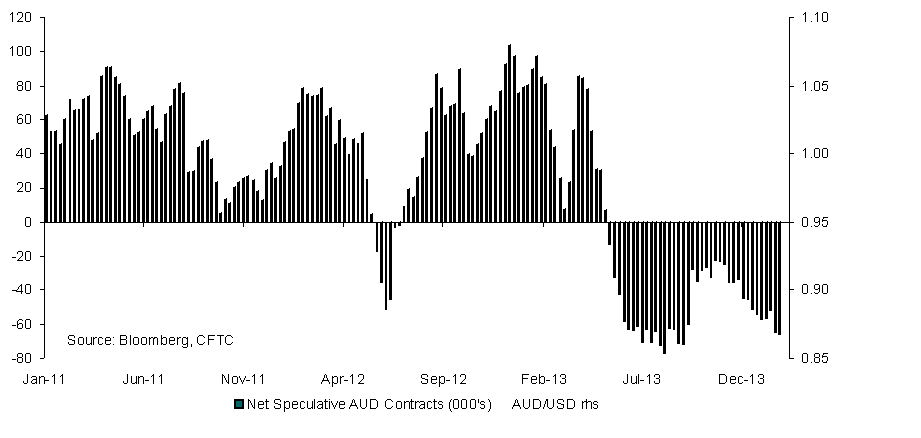
AUD has held up relatively well considering the pressure on risk currencies in general. The fact that speculative positioning in AUD has already fallen to extreme levels suggests 1) scope for further downside is limited and 2) AUD could bounce strongly in the event of good news.

In the event, the RBA unsurprisingly left policy rates unchanged but focussed attention on the recent rise in inflation. The RBA highlighted in its accompanying statement that inflation has been higher than forecast. Moreover, the RBA does not appear to be actively talking the AUD down but highlighting the benefits of past AUD weakness if sustained.

Overall, the statement is bullish for the AUD especially as it appears to confirm that the policy easing cycle is over. Consequently the bounce in AUD following the rate decision is likely to be strong.

AUD/USD technical support is seen around 0.8660, with resistance at 0.8889.

Posted in Australia. Tags: , . Leave a Comment »

Japanese yen firms as US yields drop

USDJPYyielddiff

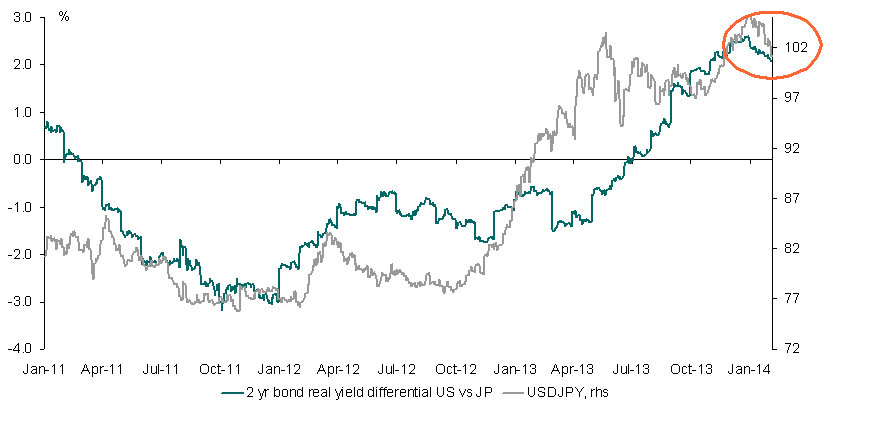
Safe haven currencies in particular the JPY and CHF remain well supported, with the former resting on its 100 day moving average around 101.10 versus USD. USD/JPY is set to remain under downward pressure but will face some difficulty in sustaining a move below 101.10 unless US bond yields slip further narrowing the US yield differential with Japan; the yield differential between 10 year US Treasuries and 10 year Japanese JGB yields has already dropped by around 89 basis points since the start of the year.

The drop in Japanese equities has also corresponded to upward pressure on the JPY, with the Nikkei among the worst performing stock markets so far this year. The prospect of further equity weakness suggests that JPY will not resume a weaker trend anytime soon.

Posted in Japan. Tags: , . Leave a Comment »

A further blow to risk appetite

Amid a market that is already very nervous the much weaker than expected US ISM manufacturing confidence index (51.3 versus 56.0 consensus) taken together with the weaker Chinese non manufacturing purchasing managers index (53.4 versus 54.6 prior) dealt another blow to risk appetite.

Consequently the VIX fear gauge has spiked to its highest level since the end of 2012 and our risk barometer has moved swiftly into risk hating territory. US Treasury yields have continued to drop, with the 10 year yield having slid by around 45 basis points so far this year.

Suffice to say investors should steer clear of risk assets over the short term as the turmoil does not look like it will be over anytime soon. A combination of tapering, a confluence of country specific emerging market country concerns and weaker growth in China provide the backdrop for a volatile few weeks if not longer, ahead.

The main event today is the Reserve Bank of Australia meeting where we look for no change in policy. However, the key events of the week are yet to come, with the European Central Bank and Bank of England policy decisions and US January jobs report all on tap over coming days. In brief, no change in policy is expected from either central bank and payrolls are expected to come in around 200k.

Some respite for emerging market assets

Large gains in many emerging market currencies have been registered in the wake of policy rate hikes in Turkey and to a lesser extent in India. Also some encouraging data in Asia in particular a widening in South Korea’s current account surplus helped to shore up confidence in regional currencies. Not wanting to throw cold water on the move but while everyone is lauding Turkey for its bold move the reality is that its aggressive rate hike will hit growth at a time when its economy is fragile.

The massive rate hike in Turkey (repo rate hiked from 4.5% to 10%) fuelled a bounce in risk appetite nonetheless, although most risk measures have only reversed part of the move registered over recent days. It is way too early to suggest that everything is returning back to normal and the rally in risk assets looks vulnerable to fading out over coming days.

While I am not a proponent of the nervousness in emerging markets turning into a renewed crisis, uncertainty about country specific issues such as slowing growth and deleveraging in China, fundamental and political uncertainties / elections in Thailand, India, Indonesia. Ukraine and countries in the “fragile 5” against the background of Fed tapering, suggest rocky times ahead.

Moreover, the market may have priced in another $10 billion of Fed tapering today but the reality is that the global liquidity injections provided by the Fed will be reduced over coming months. Additionally a likely renewed rise in US Treasury yields will add another layer of pressure on emerging market assets.

Although emerging market currencies have strengthened most G10 currencies remain in a tight range. G10 FX gains were led by the AUD and NZD while JPY came under renewed pressure. This pattern is likely to continue in the near term. Aside from the Fed FOMC there will be some attention on the Reserve Bank of New Zealand too. The RBNZ is expected to keep policy rates unchanged but there is a small chance of rate hike or at the least a hawkish accompanying statement which ought to keep the NZD supported.

GBP well supported ahead of GDP data

UK Q4 GDP today is likely to offer some further encouraging news on the economy. Indeed, the risk of an upside surprise compared to the consensus expectation of 0.7% QoQ suggests that GBP will also benefit.

After hitting a high around 1.6669 on 24 January GBP/USD slipped slightly but is showing little sign of reversing its gains and has jumped strongly this morning. A break of GBP/USD 1.6669 will open the door to a test of 1.6747

The fact that speculative sentiment for GBP is by no means excessive, suggests scope for even more gains in the weeks ahead. In particular, given the view that EUR/USD is set to decline further, I would suggest on capitalizing on further GBP appreciation prospects by playing the currency versus EUR too.