Quantitative easing and the USD

US earnings are coming in ahead of expectations, with Q2 income at the 42 S&P 500 companies reporting so far beating estimates by 11% whilst revenues are 3.3% ahead of forecasts, according to Bloomberg. The overall tone to equities looks positive helped by expectations of an agreement by BP to sell some of its assets and strong earnings reported by Apple after the close of US trade.

Market sentiment was also boosted by speculation that the Fed will embark on fresh monetary stimulus measures. Although there has been no indication that Fed Chairman Bernanke will announce such measures at his semi-annual testimony to the Senate today and to the House tomorrow, speculation of Fed action is rife and there is likely to be some questioning of Bernanke on the issue in the Q&A. If in any way quantitative easing is hinted at by Bernanke, it will act to undermine the USD.
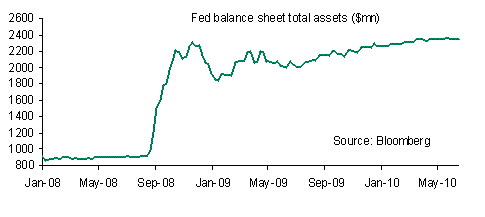
US economic data is helping to compound expectations of further quantitative easing, with yet another weaker than forecast release in the form of a 5.0% drop in June housing starts as hinted at by the bigger than expected drop in homebuilders confidence on the previous day. Separately ABC consumer confidence declined more than expected in the week to July 18, its third consecutive weekly decline, supporting the evidence that consumer confidence is deteriorating once again.

In the absence of major data releases Bernanke’s testimony will be the main driver for markets but earnings from Coca-Cola and Morgan Stanley will also be of interest. Elsewhere the minutes of the Bank of England’s July MPC meeting will be under scrutiny. MPC member Sentance is expected to have voted for a rate hike at the meeting, but any sign that other members joined him, will give GBP a lift. Sentiment for European assets continues to improve, with Greece concluding a well received T-bill auction and Ireland auctioning EUR 1.5bn in 6 and 10-year bonds. Both were heavily oversubscribed although concerns over Hungary continue to linger.

There continue to be various leaks about the European bank stress tests. Banks are expected to detail three scenarios in the results including estimated Tier 1 capital ratios under a benchmark for 2011, an adverse scenario and finally, a “sovereign shock”, according to a document from the Committee of European banking Supervisors. Importantly and perhaps a factor that could hit the credibility of the tests, the sovereign shock scenario is said to not include a scenario of default on sovereign debt.

I continue to see downside risk for the EUR in the wake of the test results, with a “buy on rumour, sell on fact” reaction likely. EUR/USD is vulnerable to a short-term drop to technical support around 1.2763 but much depends on Bernanke’s speech today. Leaks, suggest that around 10-20 banks could fail the bank stress tests, with a total funding requirement in the region of EUR 70-90 billion. Confirmation will have to wait for the official release on Friday ahead of which most currencies are likely to remain range-bound.

The Pain Of A Stronger Swiss Franc

Volatility and increasingly large market swings are characterizing current market conditions. A warning by Fitch on the UK’s “formidable” fiscal challenge, concerns about Bulgaria’s public finance statistics and a massive public sector strike in Spain, combined to fuel another bout of risk aversion.

Hungary’s government attempted to diffuse worries about its finances, with the country’s Prime Minister listing measures including cutting public pay and prohibiting mortgages denominated in foreign currencies, in order to hit the 3.8% of GDP budget deficit target. There was also some good news in the US, with small business confidence (NFIB) rising to its highest level since September 2008 whilst ABC consumer confidence edged higher.

The US Beige Book and Fed Chairman Bernanke’s testimony on the US economy to Congress, mark the highlights today. The Beige Book is set to reveal further signs of economic recovery but with limited inflation pressures. Bernanke is likely to maintain a similar tone to comments he made yesterday, highlighting a “moderate” economic recovery, with unemployment likely to stay “high for a while”. His testimony will be scrutinized for the timing of rate hikes, and any elaboration on his comments about rates rising before the economy is at full employment.

Against the background of the many and varied uncertainties still afflicting markets maintain a sell on rallies view on risk trades is still the best option. EUR/USD will struggle to breach resistance around 1.2010 and remains susceptible to test support around 1.1826. GBP/USD could target fresh lows in a “negative reversal”, with potential to head back down to 1.3996.

Confidence has plummeted to extreme lows and it will be several months before appetite for risk trades returns. The AUD and NZD as well as many Asian currencies will struggle over the interim period before their appreciation trend finally resumes.

In contrast to the weakening of risk currencies, CHF strength is showing little sign of letting up. Switzerland recorded a massive 50% jump in FX reserves in May to CHF 232 billion from CHF 153 billion in April. This is not usually market moving data but the scale of the jump in reserves is huge and it is not just due to valuation changes. The Swiss National Bank (SNB’s) effective abandonment of defending a particular level in EUR/CHF turned into more a smoothing operation but this did not stop the bank from massive FX interventions. Despite the interventions EUR/CHF dropped by 0.8% over the month.

Aside from alleviating upward pressure on the CHF the interventions had an indirect effect of reducing the pain of holders of CHF mortgages. E.g. around 30% of Hungary’s bank loans and 60% of mortgages are denominated in CHF but countries across Europe have plenty of CHF denominated loans, especially Austria. Although Hungary announced steps to meet its deficit targets its woes are far from over.

The CHF has appreciated by around 3% since the beginning of May versus HUF, exacerbating the pain for CHF borrowers in the country. The fact that CHF strength shows no sign of letting up on the back of strong data and safe haven flows, the pain for these borrowers will only add to the problems for banks and borrowers alike in Europe.

China tightens policy

Risk appetite has soured due to a combination of the rise in China’s reserve requirements, disappointing earnings including Alcoa and a profit warning by Chevron, setting the scene for a day in the red for Asian markets.  The turn in sentiment has hit commodities and commodity currencies particularly hard whilst the JPY has outperformed.  As would be expected against the background of higher risk aversion the US dollar made up some ground.

All eyes are on China and markets will now look to the implications for CNY policy.  Increasingly it seems that data and policy in China is driving global markets and aside from the hike in reserve requirements this was also evident in the fact that stronger trade data over the weekend helped to counter the impact of the soft US December payrolls report.  Further increases in the reserve ratio are likely over coming months followed by actual hikes in interest rates (likely the 1 year rate).  China’s move to tighten policy further over coming months will likely be accompanied by allowing greater appreciation of the CNY too.

The news worsened overnight as the ABC Consumer Confidence index dropped by 6 points to -47, the biggest one-week drop in the last 25 years.  US trade data also came in worse than expected, with the deficit widening to $36.4bn in November.  There is little on the data front today to keep markets occupied today, suggesting that direction will come from equity markets and with more earnings this week including Intel Corp and JPMorgan Chase & Co. there will be plenty to digest.  In the near term the tone of risk aversion is set to continue to dominate but any pull back in risk currencies is likely to prove short-lived.   

There will be more Fed speakers as well as the Fed’s Beige Book today to provide clues ahead of the January 26-27 FOMC meeting.   Aside from noting some improvements in the economy, weak labour market conditions as well as a lack of inflationary pressures will help support expectations that the Fed will hold off from raising interest rates this year.   Fed speakers include Fisher and Plosser both of whom give speeches on the US economy though neither are current voters on the FOMC.   Plosser’s comments so far have highlighted the need for a timely “exit strategy”.