Euro under growing pressure

A risk off tone has developed in the wake of disappointing economic data (Eurozone April purchasing managers indices, rise in March Eurozone and German unemployment, weaker US ADP jobs report). Additionally the second round of French Presidential elections is helping to keep Eurozone markets nervous. While hitting equities, the weaker market tone is likely to keep the USD buoyed.

The soft ADP report in particular highlights downside risks to the consensus for the April non-farm payrolls data, with analysts set to revise lower their forecasts fuelling concerns about a renewed weakening in the US jobs market. Ahead of this data, markets will contend with the outcome of the European Central Bank (ECB) policy meeting and bond auctions in France and Spain today. Several Fed speakers today will also be on tap.

The EUR will struggle to make any headway in the short term, having suffered in the wake of weak data. An unchanged policy decision from the ECB will give the EUR no assistance leaving EUR/USD vulnerable to a test of strong support around 1.3104. The ECB considers current policy settings as ‘appropriate’ but weaker growth data argue for lower rates.

The reality is that the ECB does not want to give Eurozone governments an excuse to renege on reforms. Should the ECB hint at lower rates in the near future it might actually play well for the EUR helping to alleviate growth concerns, but I suspect such a message is unlikely to emerge.

GBP has lost some ground after hitting a high just above 1.63 at the end of April but the currency looks reasonably well supported, especially against EUR. UK data remains relatively better looking as reflected in stronger readings for the PMI construction index, consumer credit and mortgage approvals.

EUR/GBP has broken its relationship with movements in EUR/USD for the time being, with independent GBP strength being seen. This is been reinforced by the shift in interest rate differentials between the UK and Eurozone, a move which has gone in favour of GBP strength. Indeed my quantitative model for EUR/GBP points to some further downside potential in this currency pair, with a test of technical support around 0.8067 on the cards.
US dollar tracking Treasury yields

Despite the firmer tone to risk appetite the USD index moved higher tracking the move in US Treasury yields. Indeed, the USD’s reaction was actually opposite to what would be expected given the rally in risk assets but its move clearly reflects the growing influence of yields.

The surprisingly robust April ISM manufacturing survey following the disappointing Chicago PMI for the same month highlights that recovery is not straightforward, suggesting that USD gains will also not be straightforward.

March factory orders are on tap today but the bigger focus will be on the April ADP jobs report, which will give important clues to Friday’s payrolls data. Expectations centre on a 170k outcome for the ADP report, a smaller increase than the 209k registered in March. In the meantime I expect the USD to hold its gains.

As noted at the start of the week EUR/USD was poised to edge higher despite the bad economic news emerging from the region. EUR/USD has continued to strengthen over recent weeks despite the release of data showing Eurozone economic underperformance relative to the US. A case in point is the April Eurozone purchasing manager’s data to be released today, which will reveal further weakness, especially in peripheral countries.

Some easing in peripheral bond yields has helped to support sentiment for the EUR leading to further short covering in the currency but further gains are expected to be limited. EUR/USD now sits around the middle of its 1.30-1.35 range but further upside will be restricted ahead of the key US jobs data on Friday. EUR/USD resistance is seen around the 1.3385 level.

US Economic Data Disappointments

Risk gyrations continue, with a sharp shift back into risk off mood for markets driven in large part by yet more disappointing US economic data as the May ADP jobs report came in far weaker than expected at 38k whilst the ISM manufacturing index dropped to 53.5 in May, its lowest reading since September 2009. This was echoed globally as manufacturing purchasing managers indices (PMI) softened, raising concerns that the global ‘soft patch’ will extend deeper and longer than predicted.

The market mood was further darkened by news that Moodys downgraded Greece’s sovereign credit ratings to Caa1 from B1, putting the country on par with Cuba and effectively predicting a 50% probability of default.

The resultant jump in risk aversion was pretty extensive, with US Treasury yields dipping further, commodity prices dropping led by soft commodities, and equity volatility spiking although notably implied currency volatility has remained relatively well behaved.

Global growth worries led by the US have now surpassed Greek and eurozone peripheral country concerns as the main driver of risk aversion, especially as it increasingly looks as though agreement on a further bailout package for Greece is moving closer to being achieved. Moreover, it seems as though a ‘Vienna initiative’ type of plan is moving towards fruition involving a voluntary rollover of debt.

The lack of first tier economic data releases today suggests that it will be a case of further digestion or perhaps indigestion of the weak run of US data releases over recent weeks and the implications for policy. For instance, it is no coincidence that QE3 is now being talked about again following the end of QE2 although it still seems very unlikely.

Bonds may see some respite from the recent rally given the lack of data today although this may prove short-lived as expectations for the May US jobs report tomorrow are likely to have been revised sharply lower in the wake of the weak ADP jobs data and ISM survey yesterday, with an outcome sub 100k now likely for May US non-farm payrolls.

Meanwhile, FX markets are caught between the conflicting forces of higher risk aversion and weaker US data, leaving ranges to dominate. On balance, risk currencies will likely remain under pressure today and the USD may get a semblance of support in the current environment.

This may be sufficient to prevent EUR/USD from retesting its 1 June high around 1.4459 as markets wait for further developments on the Greek front. Once again the likes of the CHF and to a lesser extent JPY will do well in a risk off environment whilst the likes of the AUD and NZD will suffer.

Gold / FX correlations

There is no shortage of cash rich investors in Asia even amidst the current troubles in Dubai. Indeed, sentiment in the gemstones market is particularly upbeat, with a rare five-carat pink diamond selling for a record HK$84.24 million in Hong Kong. Perhaps this is a good reflection of abundant liquidity and of course wealth in Asia and in particular China, with talk that mainland Chinese investors were strong participants in the diamond auction.

It’s not just diamonds that are selling for record prices; gold hit a fresh high above $1,200 and once again at least part of this is attributable to the appetite of Asian central banks as well as demand from China as the country tries to increase its gold reserves. The rise in gold prices has coincided with a bullish announcement from the world’s top gold producer that it has completely eliminated its market hedges earlier than forecast due to the positive outlook on prices and waning supply.

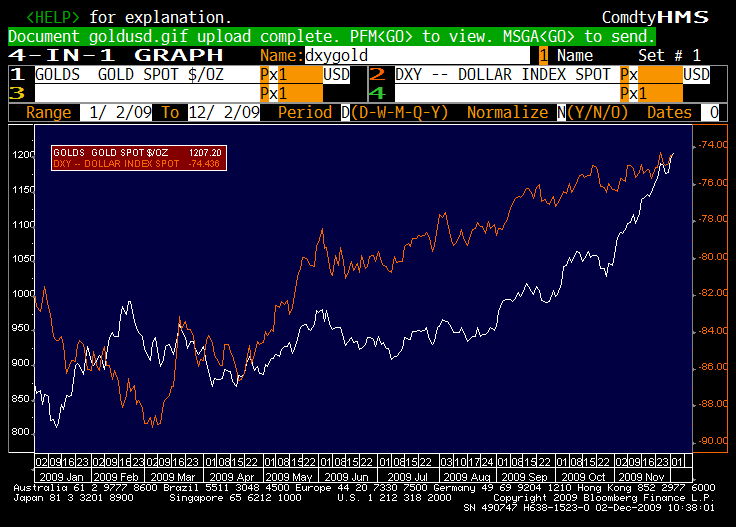
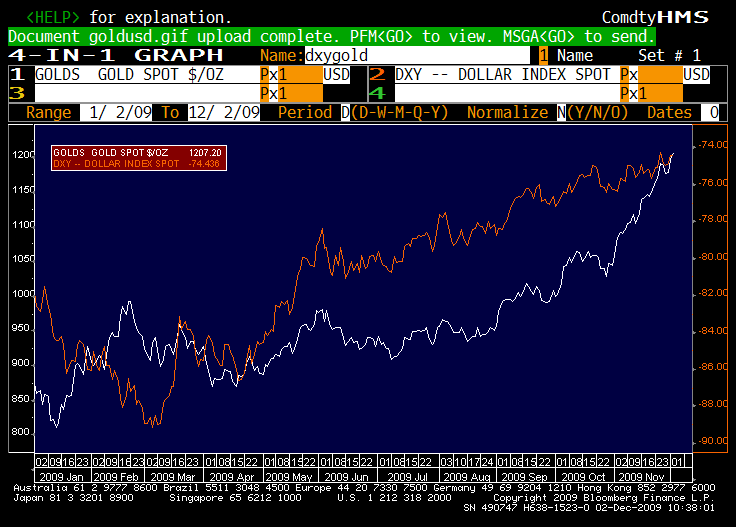
The correlation between gold prices and the USD remains very strong at -0.88 over the last 3-months, with firmer gold prices, implying further USD weakness. In fact, the gold / USD correlation has been consistently strong over the past few months and is showing little sign of diminishing.

Over the past 6-months the correlation has been -0.91 and over the past 1-month it was -0.75.  Assuming that anything above 0.70 can be considered statistically significant, the relationship shows that USD weakness has been well correlated with gold strength and that despite talk of a breakdown in the relationship it appears to remain solid. 

As long as the bullish trend in gold continues, the pressure on the USD will remain in place.  Adding to this pressure is the fact that risk is back on for now. Markets took the news of a fall in the ISM manufacturing index and in particular the drop in the employment component in its stride even though it supports the view of a weaker than consensus drop in payrolls in November when it is published on Friday.

There are still plenty of reasons to be cautious in the weeks ahead and although we appear to be back in a “risk on” environment markets are likely to gyrate between “risk on” and “risk off” over coming weeks. At least for now, the USD looks to remain under pressure but if risk aversion creeps back up as I suspect it may then the USD will see a bit more resilience into year end. 

Moreover, central banks globally are reaching the limits of their tolerance of USD weakness and will be tested once again, with EUR/USD back above 1.5000, EUR/CHF moving back below 1.5100 and the USD/JPY set to re-test 85.00 following the relatively benign measures announced by the BoJ in which the Bank did little to stem deflationary pressure or weaken the JPY.