Risk Aversion Creeps Higher

The USD index has dropped by around 17% since June 2010 high and despite a slight bounce this week it is unlikely to mark the beginning of a sustained turnaround. Nonetheless, I would caution about getting carried away with positioning for USD weakness. Whilst an imminent recovery looks unlikely the risk/reward of shorting the USD is becoming increasingly unfavourable.

Until then Federal Reserve comments will be watched closely for clues on policy and there are plenty of Fed speakers this week including a speech by Boston Fed’s Rosengren today and Fed Chairman Bernanke tomorrow. The USD will also gain some direction from jobs data and markets will be able to gauge more clues for Friday’s non-farm payrolls data , with the release of the April ADP employment report today.

The EUR is one currency that has suffered this week. News that Portugal’s caretaker government has reached an agreement with the European Union / International Monetary Fund on a bailout of as much as EUR 78 billion has so far been greeted with a muted response. EUR attention is still very much focussed on the ECB meeting tomorrow and prospects of a hawkish press statement suggest that EUR/USD downside will be limited, with support seen around 1.4755.

The JPY has strengthened by around 5% versus USD since its 6th April USD/JPY high around 85.53, confounding expectations that Japan’s FX intervention following the county’s devastating earthquake marked a major turning point in the currency. A combination of narrowing interest rate differentials with the US (2 year US/Japan yield differentials have narrowed by around 20bps in the past month), strong capital inflows to Japan (net bond and equity flows in the last four weeks have increased to their highest this year), and rising risk aversion have all played their part in driving the JPY higher.

As a result USD/JPY is fast approaching the psychologically important level of 80, a level that if breached will likely lead to FX intervention. Although Golden Week holidays in Japan this week suggest that JPY liquidity may be quite thin, Japanese authorities are likely to remain resistant to further gains in the JPY, likely using thinning liquidity to their advantage.

Despite the JPY’s recent strength speculative positioning over the past four weeks has remained net short JPY, whilst Japanese margin traders have also increased their long USD/JPY bets, suggesting that these classes of investors are not to blame for the JPY’s appreciation. This suggests that FX intervention may not be as successful given that the market is already short JPY.

Given the risk of intervention on USD/JPY, the CHF appears to be an easier choice for safe haven demand against the background of rising risk aversion. The currency has risen to a record high against the USD, gaining around 8.3% so far this year. Given the hints of higher interest rates by the Swiss National Bank (SNB) and resilience economic performance, downside risks for CHF are limited at present unless risk appetite improves sharply. Further gains are likely with USD/CHF likely to test the 0.8570 support level over the short-term.
Central bank decisions and US payrolls in focus

The USD’s troubles are far from over. Data and events this week will do little to stop the rot. As US Federal Reserve Chairman Bernanke made clear last week the Fed is committed to completing its asset purchase programme by the end of June though there is plenty of debate about what comes after. Reduced growth forecasts and the Fed’s view that price pressures are “transitory” have been sufficient to keep the USD on its knees.

The weaker than expected reading for Q1 US GDP growth at 1.8% QoQ clearly did nothing to alleviate pressure on the USD even though it is widely believed that the soft growth outcome will prove fleeting, with recovery set to pick up pace over the coming months. In truth much will depend on the trajectory for oil prices, especially as petrol prices in the US verge on the psychologically important $4 per gallon mark. Even higher energy prices could dent growth further but lower or stable prices will keep the recovery on track.

The highlight in this holiday shortened week for many countries this week is the US April jobs report at the tail end of the week. Estimates centre on around a 200k gain in payrolls but forecasts will be refined with the release of the ADP private sector jobs report and ISM manufacturing survey earlier in the week. The unemployment rate may prove sticky and will likely remain at 8.8%, a disappointment to those looking for a quicker recovery. The elevated unemployment rate will only reinforce expectations that the Fed will not be quick to reverse policy, with the USD continuing to suffer as a result.

Central bank meetings will be plentiful this week, with the European Central Bank (ECB) and Bank of England (BoE) likely to garner most attention. Recent data in the Eurozone has provided further evidence of growth divergence between North and South, but the EUR has remained resilient to this as well as to increased concerns about the periphery. This make the ECB’s job even tougher than usual when it meets this week and it is unlikely that the Bank will hike rates again so soon, especially given the strength of the EUR. Nonetheless, Trichet will continue to sound hawkish, limiting any damage to the EUR (if any) of no move in policy rates.

Similarly the Bank of England will also remain on the sidelines though this should come as little surprise in the wake of disappointing data recently and a surprise drop in inflation, albeit to still well above the BoE’s target. GBP has made up ground against a generally weak USD but judged against other currencies it has been an underperformer as expectations of monetary tightening have been pared back. Finally, the Reserve Bank of Australia (RBA) is set to remain on hold, but a hike over coming months remains likely even with the AUD at such a high level. Quite frankly although the USD is looking increasingly oversold there is nothing this week that would suggest it will recover quickly.

ECB In Focus

The highlight today is the European Central Bank (ECB) council meeting. Markets have priced in a hawkish stance from the ECB; Euro rates have edged higher whilst EUR/USD has strengthened. The ECB is likely to highlight worries about price developments today paving way for a hike in H2 2011. Watch for any shift in the balance of risks statement in the press conference and upward revisions to inflation and growth forecasts. In terms of liquidity operations the full allotment procedures at the Main Refinancing Operations (MRO) are likely to be extended for another three months.

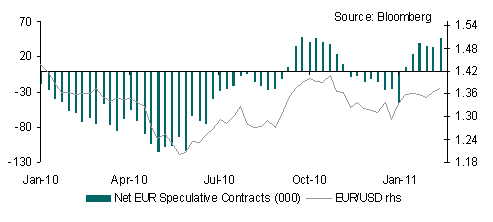
EUR risks are asymmetric and whilst the currency remains a buy on dips (with technical indicators pointing to a move to 1.4000) the bigger risk is if the ECB does not live up to the hawkish market expectations which could hit EUR given long positioning overhang. Other than this, risk aversion remains elevated according to my barometer, supporting JPY and CHF. US numbers remain upbeat as seen in the ADP private sector jobs report yesterday, which will likely lead to an upward revision to non-farm payrolls forecasts in February (currency consensus 195k). However, the USD impact of positive data is limited against the background of a relatively dovish Fed stance.

Risk aversion spikes

Increased risk aversion overnight in the wake of escalating Middle East tensions gave the USD some support but overall the USD index is gradually drifting towards its early November low around 75.631. The antithesis of USD weakness is strength in most other major currencies.

The USD is being undermined by relatively dovish expectations for US interest rates relative to elsewhere and last night’s semi annual testimony by Fed Chairman Bernanke to the US Senate did nothing to alter this tone, with Bernanke maintaining the emphasis on subdued inflation and elevated unemployment.

The USD index itself has a high (0.82) 3-month correlation with US interest rate futures and over recent weeks as the implied yield has dropped, the USD has lost ground. The prospects of higher US bond yields may eventually provide the USD with support, especially given the prospect of substantial short-covering but in the near term the USD is likely to remain under pressure.

The upbeat run of US data highlights another source of USD support over the medium term, given the likely outperformance of the US economy over coming months. Yesterday’s ISM manufacturing survey and vehicle sales data lend support to this view. Moreover, the rise in employment component of the ISM supports the view of at least a 195k increase in February payrolls.

The Fed’s Beige Book tonight and February ADP jobs report will not alter the USD’s trajectory. The Beige Book is unlikely to reveal anything to worry the Fed in terms of inflation risks although will probably reveal further signs of improved activity. The ADP report will give important clues for Friday’s February non-farm payrolls data although it’s worth noting that last month’s report was way off the mark. In any case neither release is likely to prevent a further drop in the USD.

EUR is a clear beneficiary of expectations of tighter monetary policy by the ECB and the widening interest rate (futures implied yield) differential between the US and eurozone has given the EUR plenty of support recently as reflected in the high correlation with EUR/USD. Further support to the hawkish market stance was given by the upward revision to eurozone 2011 growth and inflation forecasts by the EU. The fact that eurozone inflation increased to 2.4% YoY in February also reinforced expectations of ECB tightening sooner than later.

The ECB press conference following the council meeting tomorrow will likely shape such expectations further, the EUR has already priced in a hawkish ECB stance, limiting the prospects of further appreciation. Notably EUR/USD has failed to break resistance at its year high around 1.3861, which will prove to be a formidable cap in the short-term.

In contrast, the RBA has poured cold water over expectations of further policy rate hikes in Australia. The policy statement following yesterday’s decision to keep the cash rate on hold pointed to an extended pause in the months ahead. Despite this and perhaps because markets have already pared back Australian interest rate expectations AUD rebounded quite smartly from its post meeting low and despite some overnight weakness due to increased risk aversion it will soon verge on a break of resistance at 1.0257.

AUD/NZD has continued to charge ahead having hit a multi-year high above 1.3600. NZD underperformance has been exacerbated by the impact of the recent earthquake, with growth expectations for this year having been sharply revised lower and growing speculation of an interest rate cut. Indeed, such speculation was given further fuel by comments by NZ Prime Minister Key who noted he would welcome a policy rate cut. Nonetheless, my quantitative AUD/NZD model suggests that the cross looks over-extended at current levels, whilst relative speculative positioning supports this view.

Losing Your Addiction

An interesting thing happened to me last week. On a business trip to Europe my blackberry broke and failed to work for the rest of the week. I felt like an addict coming off an addiction. The first couple of days were very tough; my usual instinct to constantly check for messages resulted in constant fidgeting and major withdrawal symptoms.

Once this had worn off I must admit I felt liberated. My addiction gone, it felt great to be weaned off my crackberry. The message here is that life goes on without access to mail. It’s an experience I would recommend to all users of such devices.

Back to reality and my view from Hong Kong this week is as follows. The risk-off tone as reflected in related to the turmoil in Libya and the increase in oil prices (as supply concerns intensify), may help to limit the pressure on the USD this week, but the overall tone is set to remain weak.

Much will depend on this week’s key US data releases and a testimony by Fed Chairman Bernanke to the US Senate, to determine whether the USD will find a more stable footing. Clearly the more hawkish tone of the European Central Bank (ECB) and Bank of England (BoE) in contrast to the lack of inclination by the Fed towards a tighter monetary policy stance could undermine the USD.

In this respect, it is doubtful that Bernanke will change his stance of the Fed failing to meet its dual mandate due to too low inflation. The main event is the February US jobs report at the tail end of the week. The consensus expectation of a 190k increase in payrolls will be finalised after gaining more clues from the US February ISM surveys and ADP jobs report earlier in the week. The week’s releases will likely reveal further improvements in US economic data, but given that this will do little to budge the Fed’s stance, the USD may be left somewhat underwhelmed.

The intensification in risk aversion over recent days has also been felt in the Eurozone periphery where bond market pressures have resumed. Nonetheless, the fallout on the EUR has been limited by hawkish ECB jawboning. Thursday’s ECB meeting will surely maintain this stance, and following the release of data on Tuesday likely to show a further increase in inflation in February, upside inflation risks are likely to be highlighted by ECB President Trichet in the press conference.

A likely pre-emptive strike from the ECB cannot be ruled out. Two rate hikes in H2 2011 are now likely even as the Bank maintains liquidity support for weaker peripherals. No change in policy but a hawkish press statement on Thursday will on the face of it play for a firmer EUR but i) the fact that the market has already discounted the possibility of early rate hikes and ii) the proximity of the US payrolls data on Friday and iii) uncertainty over the impact of the Irish election outcome in which the Fine Gael party won a clear victory, suggest that EUR risks are asymmetric. The net long positioning overhang also points to some downside risks to EUR.

There are plenty of other events and data on the calendar this week including Japan’s slate of month end releases, interest rate decisions by the Reserve Bank of Australia and Bank of Canada, UK PMI manufacturing survey data and Swedish Q4 GDP data.

The bottom line is that currencies will be driven by the conflicting influences of improving economic data on the one hand and elevated risk aversion on the other. The main beneficiaries of higher risk aversion will be the CHF and JPY though both have risen far whilst the USD will be restrained by a dovish Fed.

In contrast the EUR and GBP may yet extend gains but in both cases, markets have already shifted policy tightening expectations sharply over recent weeks and we suspect EUR/USD will be capped at resistance around 1.3860, whilst GBP/USD will similarly struggle to break its year high around 1.6279.