Asian currencies vulnerable to equity outflows

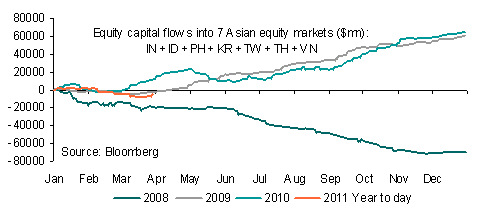
Asian currencies are set to continue to trade cautiously. One big headwind to further appreciation is the fact that there has been a substantial outlook of equity capital over recent weeks. Over the last month to date Asian equity markets have registered an outflow of $3.3 billion in outflows. However, whilst Taiwan, South Korea, Thailand and India have seen outflows Indonesia, Philippines, and Vietnam have registered inflows.

The net result is that equity capital inflows to Asia so far this year are almost flat, a stark contrast from 2009 and 2010 when inflows were much higher at the same point in the year. The odds for further strong inflows do not look good, especially as the Fed ends QE2 by the end of June. While a sharp reversal in capital flows is unlikely, it also seems unlikely that Asia will register anywhere near as strong inflows as the last couple of years.

This will have a significant impact on Asian currencies, whose performance mirrors capital flows into the region. Almost all Asian currencies have dropped against the USD so far this month and could remain vulnerable if outflows continue. Given the relative stability of the USD over recent weeks and imminent end to QE2, the better way to play long Asia FX is very much against the increasingly vulnerable EUR.

The THB has been the worst performing currency this month but its weakness has been attributable to upcoming elections on July 3, which has kept foreign investor sentiment cautious. Thailand has seen an outflow of $812mn from its equity market this month. Polls show the PM Abhisit’s party trailing the opposition and nervousness is likely to persist up to the elections at least. THB weakness is not likely to persist over coming months, with USD/THB forecast at 29.2 by year end.

USD/KRW has been whipsawed over the past week but made up ground despite a continued outflow of equity capital over recent days. KRW has been particularly resilient despite a firmer USD environment and a drop in consumer sentiment in June. Next week the KRW will likely continue to trade positively, helped by a likely firm reading for May industrial production on Thursday. USD/KRW is set to trade in a 1070-1090 range, with direction likely to come from Greece’s parliament vote on its austerity measures.

TWD has traded weaker in June, having been one of the worst performing currencies over the month. USD/TWD does not have a particularly strongly correlation with movements in the USD or risk aversion at present but the currency has suffered from a very sharp outflow of equity capital over recent weeks (biggest outflow out of all Asian countries so far this month). Next week’s interest rate decision on Thursday by the central bank (CBC) will give some direction to the TWD but a 12.5bps increase in policy rates should not come as a big surprise. TWD is likely to trade with a weaker bias but its losses are likely to be capped around the 29.00 level versus USD.
Equity Flow Reversal Supports Asian FX

Asian currencies have rebounded smartly from their post Japan earthquake lows on March 16. The ADXY (Bloomberg-JP Morgan Asia Currency index) is now at its highest level since September 1997 reflecting a sharp rebound in capital inflows to the region. The performance of Asian currencies continues to correspond closely with the movement in capital flows.

Although almost all Asian equity markets have registered outflows so far this year (total equity outflows -$6.2bn), the trend is reversing. Over the past month there has been a major slowing in capital outflows for most countries in Asia whilst India, Thailand and the Philippines have actually registered sizeable inflows. South Korea is notable in that there has been a sharp increase in equity capital inflows over the past week.

Although there has been much focus on a rotation of capital flows out of Asia and into developed economies this year, it is worth noting that the pattern of equity flows in Q1 2011 has not been too different from that witnessed in the past couple of years. In both 2009 and 2010 equity outflows were recorded over the two (2010) or three (2009) months of the year before a reversal took place. This pattern looks like it is repeating itself.

Clearly the environment for Asian equity markets is not as supportive as it was last year given the belated tightening in monetary policies being undertaken by many central banks and prospects of an end to QE2 in the US. Whilst this will result in some reduction in capital flows to the region compared to last year, the overall outlook is positive. Easing risk aversion (our risk aversion barometer has already reversed all of its post Japan earthquake spike and is trending lower), positive growth outlook and maintenance of low US rates point to more inflows.

One currency in particular that will benefit is KRW, with a further drop in USD/KRW likely over coming weeks. KRW has already strengthened by around by around 2.7% since its post Japan earthquake low making it the best performing currency since then. Further gains are likely; a test of USD/KRW 1100 is on the cards in the short-term, with the year end target standing at 1050.

Why buy KRW? 1) Korea has registered the biggest improvement in equity capital flows recently, 2) KRW has been the most sensitive Asian currency to risk over the past month and therefore benefits the most as risk appetite improves, 3) Estimated Price/Earnings ratio for Korean equities looks cheap compared to its historical z-score according to our estimates. As a result our quantitative model on USD/KRW based on commodity prices, risk aversion and equity performance highlights the potential for significantly more KRW strength.

Global Themes

It’s definitely been a strange start to the year, with markets taking plenty of time to get their bearings. Some general themes have developed but none have provided clear direction. As a result, the path over coming weeks and months is likely to remain highly volatile and in this respect, currencies, equities and bonds will continue to see strong gyrations.

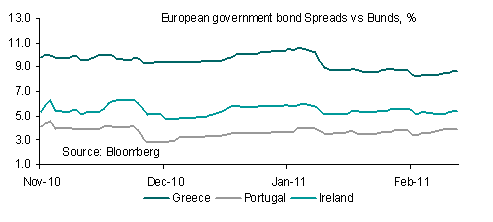
One theme that has been evident since the start of the year is an improvement in sentiment towards the eurozone periphery as hopes of an enlargement/extension of the European Union bailout fund (EFSF) have increased. This is a key reason why the EUR has strengthened this year although nervousness on this front appears to have returned over recent days (note the recent widening in peripheral bond spreads, drop in EUR and European Central Bank purchases of Portuguese debt). It seems that a lot of good news has already been discounted in relation to the eurozone periphery and now markets are in wait and see mode for the EU Council meeting on 24/25 March. There is a strong chance that eventually market expectations will prove overly optimistic and the EUR will drop but more on that later.

The second theme is global inflation concerns, driven by higher food and energy prices. Certainly this has had an impact on interest rate expectations and in some cases resulted in a hawkish shift in central bank language, notably in the eurozone and UK. Although European Central Bank (ECB) President Trichet has toned down his comments on tighter monetary policy compared to the more hawkish rhetoric following the last ECB council meeting, expectations for monetary tightening in the eurozone still look overly hawkish, with a policy rate hike currently being priced in for August/September this year, which looks way too early. The EUR has benefitted from the relative tightening in eurozone interest rate expectations compare to the US but will suffer if and when such expectations are wound down.

Elsewhere in many emerging markets the impact of higher food prices is finding its way even more quickly into higher inflation, forcing central banks to tighten policy. In Asia, the urgency for higher rates is even more significant given that real interest rates (taking into account inflation) are negative in many countries. China has accelerated the pace of its rate hikes over recent months and looks set to continue to tighten policy much further to combat inflation. In India, worries about inflation and the need for further monetary tightening have clearly weighed on equity markets, with more pain to come. Although not the sole cause by any means, in the Middle East and Africa higher food prices are feeding social tensions such as in Egypt.

Another clear theme that has developed is the improvement in US economic conditions. The run of US data over recent months has been encouraging, confirming that the economy is gaining momentum. Even the disappointing January non-farm payrolls report has not dashed hopes of recovery, with many other job market indicators pointing to strengthening job conditions such as the declining trend in weekly US jobless claims. Manufacturing, business and consumer confidence measures have strengthened whilst credit conditions are easing, albeit gradually. The US economy is set to outperform many other major economies this year, especially the eurozone, which will be beset with a diverging growth outlook between northern and southern Europe.

Although the US dollar has not yet benefitted from stronger US growth given the still dovish tone of the Fed and ongoing asset purchases in the form of quantitative easing, the rise in US bond yields relative to other countries, will likely propel the dollar higher over 2011 after a rocky start over Q1 2011. In contrast, the EUR at current levels looks too strong and as noted above, hopes of a resolution of eurozone peripheral problems look overdone. EUR/USD levels above 1.3500 provide attractive levels to short the currency. Other growth currencies that will likely continue to do well are commodity currencies such as AUD, NZD and CAD, whilst the outlook for Asian currencies remains positive even despite recent large scale capital outflows. The JPY however, will be one currency that suffers from an adverse yield differential with the US as US bond yields rise relative to Japan.

Econometer.org has been nominated in FXstreet.com’s Forex Best Awards 2011 in the “Best Fundamental Analysis” category. The survey is available at http://www.surveymonkey.com/s/fx_awards_2011

What QE2 means for currencies

The sweeping gains for the Republican party in the US mid term elections has sharply changed the political dynamic in the US, with the prospects of further fiscal stimulus looking even slimmer than before although the chances of the Bush tax cuts being extended have likely increased.

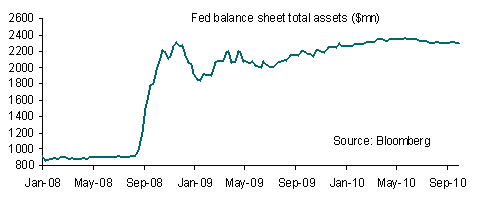
The onus is on monetary policy to do the heavy lifting and the Fed delivered on its end of the bargain, with the announcement of $600 billion of purchases of long-term securities over 8-months through June 2011.

Given the likelihood that the economic impact of the asset purchases is likely to be limited and with little help on the fiscal front the Fed has got a major job on its hands and $600 billion may end up being a minimum amount of purchases necessary for the Fed to fulfil its mandate.

The decline in the USD following the Fed decision is unlikely to mark the beginning of a more rapid pace of USD decline though further weakness over coming months remains likely. The USD remains a sell on rallies for now and an overshoot on the downside is highly probable as the Fed begins its asset purchases.

The bottom line is that the Fed’s program of asset purchases implies more USD supply and in simple economic terms more supply without an increase in demand implies a lower price. The USD will remain weak for some months to come and the Fed’s actions will prevent any USD recovery as the USD solidifies its position as the ultimate funding currency.

Nonetheless, with market positioning close to extreme levels, US bond yields unlikely to drop much further, and the USD already having sold off sharply in anticipation of QE2, (USD index has dropped by around 14% since June) those looking for a further sharp drop in the USD to be sustained are likely to be disappointed.

It is difficult however, to fight the likely further weakness in the USD even if turns out not to be a rapid decline. The path of least resistance to some likely USD weakness will be via the likes of the commodity currencies, scandies and emerging market currencies. There will be less marked appreciation in GBP, CHF and JPY against the USD.

The Fed’s actions will continue to fuel a rush of liquidity into emerging markets, particularly into Asia. This means more upward pressure on Asian currencies but will likely prompt a variety of responses including stronger FX intervention as well as measures to restrict and control such flows.

There have been various comments from central banks in the region warning about the Fed’s actions prompting further “hot money” flows into the region and even talk of a coordinated response to combat such flows.

This suggests more tensions ahead of the upcoming G20 meeting in Seoul. Assuming that at least some part of the additional USD liquidity flows into Asia, the implications of potentially greater FX intervention by Asian central banks to prevent Asian currencies from strengthening, will have a significant impact on major currencies.

Already it is apparent that central banks in Asia have been strongly using the accumulated USDs from FX intervention to diversify into EUR and other currencies including AUD and even JPY. Perversely this could end up exacerbating USD weakness against major currencies.

Currencies At Pivotal Levels

Ahead of today’s highly anticipated Fed FOMC meeting markets are holding their breath to determine exactly what the Fed will deliver. The consensus view is for the Fed to announce a programme of $500 billion in asset purchases spread over a period of 6-months. The reaction in currency markets will depend on the risks around this figure. Should the Fed deliver a bigger outcome, say in the region of $1 trillion or above, the US dollar will likely come under renewed pressure. However, a more cautious amount of asset purchases will be US dollar positive.

It has to be noted that the Fed will likely keep its options open and keep the program open ended depending on the evolution of economic data which it will use to calibrate its asset purchases. The USD will likely trade with a soft tone ahead of the Fed outcome, but with so much in the price, it may be wise to be wary of a sell on rumour, buy on fact outcome.

Whatever the outcome many currencies are at pivotal levels against the USD at present, with AUD/USD flirting around parity following yesterday’s surprise Australian rate hike, EUR/USD holding above 1.4000, GBP/USD resuming gains above 1.600 despite a knock back from weaker than forecast construction data, whilst USD/JPY continues to edge towards 80.00. Also, both AUD and CAD are trading close to parity with the USD. The Fed decision will be instrumental in determining whether the USD continues to remain on the weaker side of these important levels.

Going into the FOMC meeting the USD has remained under pressure especially against Asian currencies as noted by the renewed appreciation in the ADXY (a weighted index of Asian currencies) against the USD this week. Although it appears that the central banks in Asia have the green light to intervene at will following the recent G20 meeting the strength of capital inflows into the region is proving to be a growing headache for policy makers. One option is implementing measures to restrict “hot money” inflows but so far no central bank in the region has shown a willingness to implement measures that are deemed as particularly aggressive.

There has been some concern that Asia’s export momentum was beginning to fade as revealed in September exports and purchasing managers index (PMI) data in the region and this in turn could have acted as a disincentive to inflows of capital, resulting in renewed Asian currency weakness. The jury is still out on this front but its worth noting that Korean exports in October reversed a large part of the decline seen over previous months. Moreover, the export orders component of Korea’s PMI remained firm suggesting that exports will resume their recovery.

Nonetheless, manufacturing PMIs have registered some decline in October in much of Asia suggesting some loss of momentum, with weaker US and European growth likely to impact negatively. However, China’s robust PMI, suggests that this source of support for Asian trade will remain solid. Similarly a rise in India’s manufacturing PMI in October driven largely by domestic demand, highlights the resilience of its economy although with inflation peaking its unlikely that the Reserve Bank of India (RBI) will follow its rate hike on Tuesday with further tightening too quickly.