Greek Saga Rumbles On – Does Anybody Care?

The debate over Greece continues to rumble on. France and Spain requested a separate summit meeting of the 16 heads of eurozone countries immediately before the full 27-member EU summit starting tomorrow but this was met with resistance. Meanwhile, Germany has called for “a substantial contribution” from the IMF towards a Greek aid package, whilst maintaining that no EU deal will be reached for Greece at the summit.

Frankly, the whole Greek saga has become extremely boring, with the lack of agreement about how to fix it doing little to inspire confidence. In particular the fractured opinion amongst EU leaders highlights the difficulties in reaching an agreement in a union made up of so many conflicting interests. At most the summit may agree on the conditions for a rescue package for Greece rather than a package itself. This will leave markets unimpressed,

US new home sales data today is likely to paint a slightly better picture with a small gain expected, albeit following the 11.2% plunge in the previous month. Sales will be helped by the extension of the home buyer tax credit. The US February durable goods orders report is also released today, with a small increase expected. A smaller gain in transport orders suggests that the 2.6% jump last month will not be repeated.

In Europe, the key release is the March German IFO business climate survey and a rebound is likely following February’s decline, helped by warmer weather and a weaker EUR. Flash readings of Eurozone March purchasing managers indices (PMIs) are also released but these are unlikely to extend gains from the previous month. Despite expectations of firmer data the EUR/USD is vulnerable to a further decline, with support around 1.3432 in sight for an imminent test.

Attention in the UK will turn to the pre-election Budget and particularly the government’s plans to cut spending and reduce the fiscal deficit. Failure to provide a credible blue print to restore fiscal credibility will damage confidence, heightening the risks of an eventual sovereign ratings downgrade and more pressure on GBP which appears destined for another drop below 1.50 versus USD.

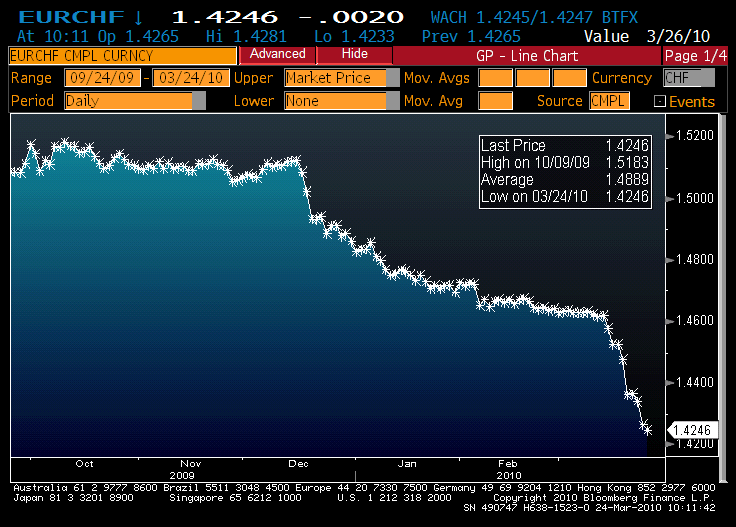
Most currencies have remained within ranges and the most interesting currency pair is EUR/CHF having failed to react to verbal warnings from the Swiss National Bank (SNB) about excessive CHF strength. EUR/CHF looks vulnerable to a further decline unless the SNB follows up rhetoric with action. Even if there is FX intervention by the SNB it may prove to be a temporary barrier to a market with an eye on the psychologically important 1.4000 level.

Despite the pressure on the Japanese government and Bank of Japan (BoJ) to engineer a weaker JPY, export performance has proven resilient, with exports jumping 45.3% on the year in February, helped by the strength of demand from Asia. Unfortunately this is doing little to end Japan’s deflation problem and even if there is less urgency for a weaker JPY to boost exports, JPY weakness will certainly help to reduce deflationary pressures in the economy. USD/JPY is stubbornly clinging to the 90.00 level, with little inclination to move in either direction.
Greek Confusion, India Tightening

It is highly interesting that markets could take fright from a rate hike in India but this appears to be what has happened. India’s surprise 25bps rate hike has provoked another bout of risk aversion whilst the lack of any concrete agreement on a framework for a Greek bail out dealt a further blow to confidence. FX tensions between the US and China have not helped, with China threatening retaliation to any US move to name the country as a currency manipulator in the mid April US Treasury report.

Should we really be worried by a rate hike in India or China? Whilst the India rate move reflects the fact that emerging market central banks are moving far more aggressively to raise rates than their G7 counterparts, global fears that India’s move will dampen recovery prospects are unfounded. Monetary tightening in India and China and other economies is taking place against the backdrop of economic strength not weakness.

As such the global impact on growth should be limited. Rising inflation pressure in Asia is reflection of the much quicker economic recovery, relatively low rates and undervalued currencies in the region. Not only will central banks in Asia have to raise interest rates but will also have to allow further currency appreciation.

There is still plenty of confusion about a bail out for Greece ahead of the 25-26th March EU summit. German Chancellor Merkel dampened expectations of a bailout by stating that it was not even on the agenda for the summit. In contrast, EU President Barroso has pushed EU members to agree on an explicit stand-by aid agreement for Greece as soon as possible.

There is also disagreement about whether there should be any IMF involvement, with Germany favouring some help from the Fund whilst France opposes it. Meanwhile, the Greek Prime Minister has reportedly given an ultimatum that should no aid plan be forthcoming at the EU summit, Greece will turn to the IMF for assistance.

All of this suggests more downside for EUR/USD, with a test of support around 1.3422 looming. In the event that the EU summit offers good news for Greece, EUR/USD sentiment could turn quickly so a degree of caution is warranted. Speculative sentiment for the EUR has improved according to the latest CFTC Commitment of Traders (IMM) data for the week to 16th March, with net short EUR positions at their lowest since the beginning of February. Nonetheless, the short covering seen over the past week could come to an abrupt end should there be no aid package for Greece.

The most volatile currency over the past week was GBP/USD and after hitting a high of around 1.5382 it has slid all the way back to around the 1.5000 level. Much of this was related to the gyrations in EUR/USD but GBP took on a life of its own towards the end of the week and has not been helped by comments by BoE MPC member Sentence who highlighted the risk of a “double-dip” recession in the UK.

GBP is highly undervalued and market positioning is close to a record low but a sustainable recovery looks unachievable at present. Attention this week will centre on the 2010 UK Budget announcement and markets will scrutinise the details of how the government plans to cut the burgeoning budget deficit. Failure to restore some credibility to the government’s plans will dent GBP sentiment further and lead to a sharper decline against both the EUR and USD.

PIIGS fears fuelling risk aversion

Risk aversion has come back with a vengeance over the last 10 days driven by a host of concerns that continue to damage market sentiment. As has been evident over the past year the USD and JPY remain the best currency plays against the background of rising risk aversion and both currencies look well supported.

Market concerns are not going away quickly but some of the fears plaguing markets have at least receded especially on the US political front, with Obama’s State of the Union address, Geithner’s testimony on AIG and Bernanke’s reappointment all passing without too much incident, at least from a market perspective. I still believe that market fears are overblown but it is clearly evident that the market is not in the mood to concur. More pain is likely in the weeks ahead.

Euro-sovereign spreads continue to suffer from the ongoing Greek saga whilst the other major fear remains further monetary tightening in China. Rumours that China is about to imminently revalue the CNY are also running rife. The bigger than expected hike in the reserve ratio in India reflects the fact that Asia is on a faster track to tighten policy than Western economies.

As regular readers probably noticed, my articles on econometer.org have been sporadic recently. This is due to the fact that I have been on the road for the last two weeks giving client seminars across several countries in Asia. Without giving too much away it is evident that pessimism is pervasive and most investors I polled are looking for a “W” or “double dip” profile for economic growth in the G7 economies over coming months. Hardly anyone looked for a “V”.

The other casualty emanating from Greece’s woes, as well as worries that other European PIIGS (Portugal, Italy, Ireland, Greece, Spain) face ratings downgrades, is the EUR. EUR/USD slipped below the psychologically important level of 1.40 this week and is showing no sign of turning around. Warnings by S&P ratings that Portugal faces challenges on the fiscal front show that these sovereign concerns will be with us for a long while yet.

After letting investors believe that the European Commission would offer no support for Greece, there appears to be a growing realization that Greece is not simply a local problem but a Euro wide problem, as noted by European Commission President Barroso. Whilst this may be good for Greek debt the path to recovery is still likely to be a massively painful one, and the EUR may gain little support from this news.

The UK has not escaped the clutches of ratings agencies and warnings by S&P that UK banks are no longer among the “most stable and low-risk” in the world highlights the headwinds faced by GBP at present. The weaker than expected out-turn for Q4 GDP (0.1%) highlights the fact that UK economic recovery is fragile, which in turn plays negatively for the banking sector. This news has put a break on GBP but there appears to be plenty of demand for GBP above 1.600 vs USD.

FX Prospects for 2010

There can be no doubt that for the most part 2009 has been a year for risk trades, not withstanding the sell off into year end. The policy successes in preventing a systemic crisis and the massive flood of USD liquidity injected globally kept the USD under pressure for most of the year and the currency became a victim of this success. Risk appetite is likely to improve only gradually over coming months given the still significant obstacles to recovery in the months ahead.  This will coincide with the declining influence of risk on FX markets. 

2010 will not be as straightforward and whilst risk will dominate early in the year interest rate differentials will gain influence in driving currencies as the year progresses. The problem for the USD is that market expectations for the timing of the beginning of US interest rate hikes is likely to prove premature as the Fed is set to hold off until at least late 2010/early 2011 before raising interest rates. The liquidity tap will stay open for some time, and risk trades will still find further support at least in the early part of 2010, whilst the USD will come under renewed pressure.    

The ECB will be much quicker in closing its liquidity tap than the Fed and arguably an earlier reduction in credit easing and interest rate hikes compared to the Fed would favour a stronger EUR.  However, the EUR is already very overvalued and a relatively aggressive ECB policy is unwarranted. Consequently rather than benefiting from more favourable relative interest rate expectations, the EUR could be punished and the EUR is set to decline over much of 2010 following a brief rally in Q1 2010, with EUR/USD set to fall over the year. 

Japan is moving in the opposite direction to the ECB.  FX intervention is firmly on the table though the risk is limited unless USD/JPY drops back to around 85.00. Even at current levels the JPY is overvalued but for it to resume weakness it will need to regain the role of funding currency of choice, a title that the USD has assumed. Efforts by the BoJ to combat deflation will likely help result in fuelling some depreciation of the JPY and it is likely to be the worst performing major currency over 2010, with a move back up to around USD/JPY in prospect.

The issue of global rebalancing will need to involve currencies but the currency adjustments necessary will not be forthcoming in 2010.  USD weakness early in the year will be mostly exhibited against freely floating major currencies which will bear the brunt of USD weakness.  However, the bulk of adjustment is needed in Asian currencies and there is little sign that central banks in the region will allow a rapid appreciation.  China holds the key and a gradual appreciation in the CNY over 2010 suggests little incentive to allow other Asian currencies to appreciate strongly. 

So in many ways 2010 will be one of two halves for currency markets and this has the potential to reignite some volatility in FX markets.  High beta risk trades including the AUD, NZD, NOK and many emerging currencies will see further upside in H1 as the USD falls further.  Gains in risk currencies will look even more impressive when played against the JPY and/or CHF than vs. USD given that they will succumb to growing pressure in the months ahead as their usage as funding currencies increases.

Ongoing rate hikes in Australia and Norway and the likely beginning of the process to raise rates in New Zealand early next year will mean that these currencies will also have the additional support of yield to drive them higher unlike the JPY.  There is a limit to most things however, and eventually the USD will recover some of its lost ground against risk currencies, as it undergoes a cyclical recovery over H2 2010.

Gold / FX correlations

There is no shortage of cash rich investors in Asia even amidst the current troubles in Dubai. Indeed, sentiment in the gemstones market is particularly upbeat, with a rare five-carat pink diamond selling for a record HK$84.24 million in Hong Kong. Perhaps this is a good reflection of abundant liquidity and of course wealth in Asia and in particular China, with talk that mainland Chinese investors were strong participants in the diamond auction.

It’s not just diamonds that are selling for record prices; gold hit a fresh high above $1,200 and once again at least part of this is attributable to the appetite of Asian central banks as well as demand from China as the country tries to increase its gold reserves. The rise in gold prices has coincided with a bullish announcement from the world’s top gold producer that it has completely eliminated its market hedges earlier than forecast due to the positive outlook on prices and waning supply.

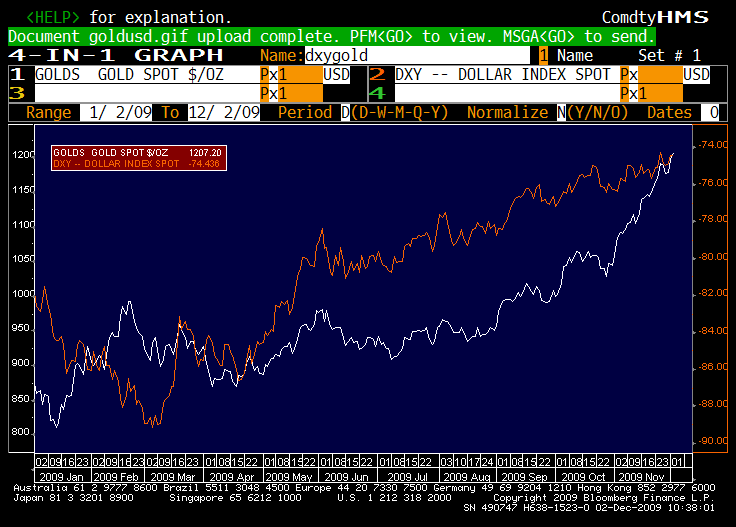
The correlation between gold prices and the USD remains very strong at -0.88 over the last 3-months, with firmer gold prices, implying further USD weakness. In fact, the gold / USD correlation has been consistently strong over the past few months and is showing little sign of diminishing.

Over the past 6-months the correlation has been -0.91 and over the past 1-month it was -0.75.  Assuming that anything above 0.70 can be considered statistically significant, the relationship shows that USD weakness has been well correlated with gold strength and that despite talk of a breakdown in the relationship it appears to remain solid. 

As long as the bullish trend in gold continues, the pressure on the USD will remain in place.  Adding to this pressure is the fact that risk is back on for now. Markets took the news of a fall in the ISM manufacturing index and in particular the drop in the employment component in its stride even though it supports the view of a weaker than consensus drop in payrolls in November when it is published on Friday.

There are still plenty of reasons to be cautious in the weeks ahead and although we appear to be back in a “risk on” environment markets are likely to gyrate between “risk on” and “risk off” over coming weeks. At least for now, the USD looks to remain under pressure but if risk aversion creeps back up as I suspect it may then the USD will see a bit more resilience into year end. 

Moreover, central banks globally are reaching the limits of their tolerance of USD weakness and will be tested once again, with EUR/USD back above 1.5000, EUR/CHF moving back below 1.5100 and the USD/JPY set to re-test 85.00 following the relatively benign measures announced by the BoJ in which the Bank did little to stem deflationary pressure or weaken the JPY.