Japan FX Measures Underwhelm

Currencies continue to show remarkable stability in the face of elevated risk aversion which has prompted huge volatility in other asset markets. Although FX volatility has risen over recent weeks its rise is nothing compared to the jump in the VIX ‘fear gauge’ equity volatility measure. FX markets are in some form of limbo where there are conflicting forces at play and where there is no obvious currency to play. The lack of clarity in markets suggests that this situation will not change quickly.

The USD (index) is trading at the lower end of its recent ranges and verging on a retest of its July 27 low around 73.421, with the currency perhaps suffering from expectations that Fed Chairman Bernanke will announce a desire to embark on more quantitative easing at Friday’s Jackson Hole symposium. Its losses could quickly reverse as such expectations are quickly dashed.

Indeed, while Bernanke will likely keep all options open any hint at QE3 is unlikely as the Fed maintains a high hurdle before any prospect of further quantitative easing is entertained. One option on the table is ‘sterilised’ large scale asset purchases which would not result in an increase in the size of the Fed’s balance sheet. This would be far less negative for the USD than a fresh round of QE and may even prompt a rally in the currency as markets shift away from the idea of QE3.

The USD will benefit from high risk aversion except against safe havens such as the CHF and JPY. In this respect the USD remains a better bet than the EUR which has failed to garner much benefit from renewed ECB peripheral bond buying. Nonetheless, data yesterday failed to feed into negative EUR sentiment despite mixed manufacturing surveys and a sharp drop in the German ZEW investor confidence survey. EUR/USD remains trapped in a broad 1.42-1.45 range.

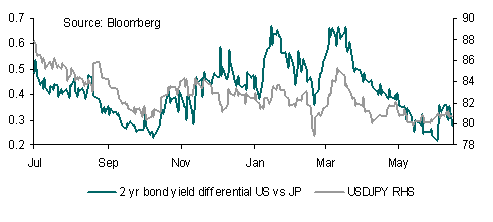
News that Moody’s ratings agency has downgraded Japan’s sovereign ratings by one notch to Aa3 is unlikely to have much impact on the JPY. Moody’s left the outlook stable while unlike the US and Europe around 95% of Japanese debt is held domestically, suggesting little FX and JGB impact. USD/JPY continues to garner some influence from yield differentials and given that the US bond yield advantage versus Japan has continued to narrow, USD/JPY continues to face downward pressure.

Japan announced measures to deal with JPY strength including the creation of a $100 billion emergency credit facility. However, the main impact on the JPY could come from increased monitoring of FX transactions with firms having to report on FX positions held by dealers. The statement made no comment on FX intervention and this is where there will be most disappointment for JPY bears. Overall, the actions are somewhat underwhelming and are unlikely to have much impact on the JPY. If anything, the JPY may actually strengthen given the lack of comment on FX intervention. USD/JPY downside could face strong technical support around 75.93, however.
Which is the ugliest currency?

The contest of the uglies has once again been set in motion in FX markets as last Friday’s weak US jobs report, which revealed a paltry 18k increase in June payrolls, downward revisions to past months and a rise in the unemployment rate, actually left the USD unperturbed. Europe’s problems outweighed the negative impact of more signs of a weak US economy, leaving the EUR as a bigger loser.

The USD’s resilience was even more impressive considering the drop in US bond yields in the wake of the data. However, news over the weekend that talks over the US budget deficit and debt ceiling broke down as Republicans pulled out of discussions, will leave USD bulls with a sour taste in their mouth.

Should weak jobs recovery dent enthusiasm for the USD? To the extent that it may raise expectations of the need for more Fed asset purchases, it may prove to be an obstacle for the USD. However, there is sufficient reason to look for a rebound in growth in H2 2011 while in any case the Fed has set the hurdle at a high level for more quantitative easing (QE).

Fed Chairman Bernanke’s reaction and outlook will be gleaned from his semi-annual testimony before the House (Wed) although he will likely stick to the script in terms of US recovery hopes for H2. This ought to leave the USD with little to worry about. There will be plenty of other data releases this week to chew on including trade data, retail sales, CPI and PPI inflation and consumer confidence as well as the kick off to the Q2 earnings season.

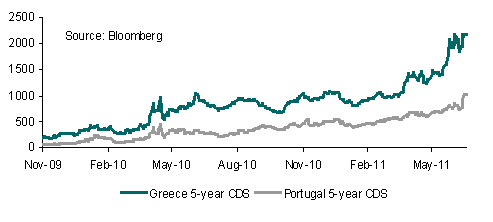
Fresh concerns in Europe, this time with contagion spreading to Italy left the EUR in bad shape and unable to capitalise on the soft US jobs report. In Italy high debt levels, weak growth, political friction and banking concerns are acting in unison. The fact that there is unlikely to be a final agreement on second Greek bailout package at today’s Eurogroup meeting will act as a further weight on the EUR.

Discussions over debt roll over plans, the role of the private sector and the stance of ratings agencies will likely drag on, suggesting that the EUR will not find any support over coming days and will more likely lose more ground as the week progresses. If these issues were not sufficiently worrisome, the release of EU wide bank stress tests on Friday will fuel more nervousness. Against this background EUR/USD looks vulnerable to a drop to technical support around 1.4102.

The Bank of Japan is the only major central bank to decide on interest rates this week but an expected unchanged policy decision tomorrow is unlikely to lead to any JPY reaction. In fact there appears to be little to move the JPY out of its current tight range at present. USD/JPY continues to be the most correlated currency pair with 2-year bond yield differentials and the fact that the US yield advantage has dropped relative to Japan has led to USD/JPY once again losing the 81.0 handle.

However, as reflected in the CFTC IMM data the speculative market is still holding a sizeable long position in JPY, which could result in a sharp drop in the currency should US yields shift relatively higher, as we expect over coming months. In the short-term USD/JPY is likely to be well supported around 80.01.

FX sensitivities to yield differentials

A lot has been made about the hawkish language from a few Federal Reserve FOMC members over recent days and growing speculation about whether quantitative easing (QE2) will end earlier than initially planned. In turn, this has been noted as a positive factor for the USD. Undoubtedly there are a few in the Fed who are becoming more nervous about current policy settings but it is highly unlikely that the Fed will not complete its $600 billion in planned asset purchases by the end of June.

The biggest imponderable is how and when the Fed begins its exit policy and how effectively/efficiently it can be done. Whilst it is likely to be over a year before the Fed Funds rate is hiked, the USD will be sensitive to balance sheet reduction. Moreover, the way in which the Fed reduces the size of the balance will also be important given the likely active approach to liquidity withdrawal required.

For the present, it should be noted that even with the hawkish Fed rhetoric and increase in US bond yields (2 year yields have risen by close to 25bps over the last couple of weeks) the USD is actually lower versus EUR than where it was two weeks ago. The reality is that German bund yields have risen by even more than US yields ahead of the anticipated European Central Bank (ECB) rate hike on 7 April (the case for which appears to have been sealed by the above consensus 2.6% YoY reading for March eurozone CPI).

However, I would be cautious about ascribing general FX moves at present to yield / interest rate differentials given that it is only EUR crosses (including EUR/JPY, EUR/GBP, EUR/CAD, and EUR/USD) that hold a statistically significant relationship with yields. All of this implies EUR crosses look supported ahead of the upcoming ECB meeting, with EUR/USD unlikely to sustain a drop below 1.4000 ahead of the rate decision. What happens after depends on the press conference. Bearing in mind that markets have already priced in 75bps of rate hikes by the ECB it would take an even stronger tone from the ECB to push the EUR higher, something that looks unlikely

Interest rate and FX gyrations

Following a brief rally at the start of the year the USD has found itself under growing pressure in the wake of widening interest rate differentials versus many other currencies. In particular, the contrasting stance between the hawkish rhetoric (bias for tighter monetary conditions) from European Central Bank (ECB) President Trichet and the relatively dovish US Federal Reserve stance as highlighted in the 26th January FOMC statement has provided more fuel to the widening in interest rate expectations between the US and eurozone. Since the end of last year interest rate differentials have widened by around 31 basis points in favour of the EUR (second general interest rate futures contract).

The Fed remains committed to carrying out its full $600 billion of asset purchases by end Q2 2011 whilst the ECB appears to be priming the market for a scaling back of its liquidity operations. Whilst there may be more juice in EUR over the short term based on the move in interest rate differentials as well as improved sentiment towards the eurozone periphery the upside potential for EUR/USD is looking increasingly limited. Even European officials are beginning to inject a dose of caution, with the ECB’s Nowotny stating that markets are too euphoric over a potential enlargement of the European Financial Stability Facility (EFSF) bailout fund. Indeed, it is highly likely that the euphoria fades quickly once it becomes apparent that enlarging the bailout fund is by no means a panacea to the region’s ailments.

GBP is another currency that has undergone sharp gyrations over recent days in the wake of a shift in interest rate expectations. A surprise 0.5% quarterly drop in UK Q4 GDP (which could not all be blamed on poor weather) set the cat amongst the pigeons and gave a GBP a thrashing but much of this was reversed following the release of Bank of England Monetary Policy Committee (MPC) minutes which revealed a hawkish shift within the MPC, with two dissenters voting for a rate hike and most members agreeing that the risks to inflation has probably shifted higher.

Does this imply an imminent rate hike? No, a policy rate hike closer to the end of the year appears more likely. BoE Governor King provided support to this view, in a speech that was interpreted as dovish, with the governor once again highlighting the temporary nature of the current rise in inflation pressure. Consequently UK interest rate expectations have shifted back and forth over recent days, but still remain wider relative to the US since the start of the year. GBP/USD has of course benefitted, but given worries about growth and the dovish message from King, it is unlikely that rate differentials will widen much further. Consequently GBP/USD is unlikely to make much if any headway above 1.6000.

Euro support unwinding

The USD is set to end the year in firm form aided by rising US bond yields. Yesterday’s data supported this trend. The Empire manufacturing survey beat expectations rebounding nearly 22 points in December and industrial production rose 0.4% in November although there was a downward revision to the previous month. This was against the background of soft inflation, with headline and core CPI rising 0.1%, indicating that the Fed will remain committed to its $600 billion program of asset purchases.

EUR/USD dropped below support around 1.3280, weighed down by various pieces of negative news. Moodys downgrade of Spain’s credit ratings outlook dented sentiment but the bigger sell off in EUR followed the move in US bond yields. The prospect of EUR recovery over the short term looks limited. The issue of finding agreement on a permanent debt resolution fund continues to fuel uncertainty and will likely come to a head at the EU summit starting today.

Added to this Ireland’s main opposition party which will likely play a part in forming a new government early next year wants some of the debt burden shared with senior bank debt holders. The good news in Europe was few and far between but at least Ireland’s parliament backed the EU/IMF bailout for the country. Of course the backing could be derailed following elections in January. Perhaps the most surprising aspect of the move in EUR is that it’s not weaker. The next support level for EUR/USD is around 1.3160.

The divergence between the US and Europe on policy is stark, with loose fiscal and monetary policy in the US providing a significant prop to the US economy, whilst the much tighter fiscal stance and less loose monetary policy threatens to result in more pressure on eurozone growth especially against the background of an overvalued EUR. This divergence will manifest itself next year in the form of US growth outperformance and stronger USD vs. EUR.

The resilience of the UK consumer continues to surprise, with the CBI distributive trades survey coming in strong and rising further to +56 in December. The only problem with the survey data is that is has not tracked official data. November retail sales data today will give further clues to the strength of spending heading into Christmas. More worryingly from the Bank of England’s perspective is the fact that inflation continues to rise despite assurances that the increase in inflation is temporary. At the least the likelihood of more quantitative easing QE from the BoE has evaporated though it is still a long way off before interest rates are hiked. In the meantime GBP continues to underperform both EUR and USD though GBP/USD will find strong support around 1.5512.

Upward pressure on US yields and the USD us unlikely be derailed US data releases today. Housing starts are set to bounce back in November, with a 6% gain expected, whilst the trend in jobless claims will likely continue to move lower. The Philly Fed manufacturing survey is set to lose a little momentum reversing some of November’s sharp gain but will still remain at a healthy level.