China Hikes Rates, More On the Cards

In an otherwise unexciting day China livened things up by raising its 1 year deposit and lending rates by 25 basis points. The hike, the third in the last four months, should not have come as a surprise, given the growing emphasis by China’s central bank PBoC, to dampen inflation pressures. Indeed, more hikes are on the cards, with at least another two more in prospect over H1. The other tool to combat inflation is CNY appreciation further gains in the currency over coming months should be expected to around 6.3 by year-end versus USD.

Global markets largely shrugged of China’s move, with generally positive market sentiment continuing. Even in the eurozone, where there was some disappointment at the surprise drop in German December industrial production, market sentiment continued to improve as Egypt and local debt worries eased further. EUR was particularly resilient despite calls from a Belgian think tank that Greece needs to restructure its debt to avoid a long and painful path ahead. Commodity currencies also showed impressive resilience to China’s rate hike, with both the AUD and NZD holding up well.

The overall positive risk background is supportive for Asian currencies and other risk trades. Currencies in Asia remain highly correlated with portfolio capital inflows and so far this year the weakness in the INR and THB has matched the strong equity outflows from India and Thailand. However, this appears to be reversing, especially in the case of India registering positive equity flows this month, helping the INR to reverse some of its losses.

In the absence of key data releases markets will turn their attention to the testimony by Fed Chairman Bernanke to the House budget committee where he will give comments on the economy, jobs and the budget. Dallas Fed’s Fisher stated overnight that whilst he expects the Fed to complete QE2 he would not support another round of quantitative easing. Fisher’s comments on QE were similar to Atlanta Fed’s Lockhart who notes there is a “high bar” for more QE. Bernanke is unlikely to deviate from this tone in his speech today whilst also maintaining his view that there should be a long term commitment to fiscal retrenchment.

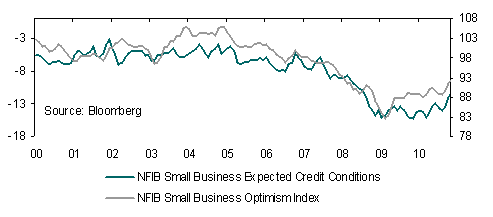
Against the background of improving risk appetite the USD is likely to stay under mild pressure although it is difficult to see a break of recent ranges for most currency pairs. EUR/USD ought to find strong support around its 100-day moving average 1.3535 whilst USD/JPY will be supported around 81.10. Equity sentiment is being supported by US data which remains encouraging. On cue the NFIB Small Business Optimism index duly rose in January to 94.1 as sentiment in this sector continued its improving trend.

Taken together with firmer equities, encouraging data is taking its toll on US bond markets, resulting in a back up in yields. Bond market sentiment wasn’t helped by a relatively poor 3-year auction. For example, US 2-year bond yields have backed up by over 30bps since 28 January. Bad news for bond is good news for the USD however, as higher relative US bond yields will likely help prevent a deeper USD sell-off, with EUR/USD in particular most reactive to relative eurozone / US bond yield differentials.

Econometer.org has been nominated in FXstreet.com’s Forex Best Awards 2011 in the “Best Fundamental Analysis” category. The survey is available at http://www.surveymonkey.com/s/fx_awards_2011
Temporary Euro Relief

Eurozone peripheral country travails continue to garner most market attention. There was at least a semblance of improvement on this front as peripheral bond spreads with German bunds narrowed on Tuesday but this was largely due to European Central Bank (ECB) bond buying than any improvement in sentiment. The fact that German bund yields also rose helped to narrow bund-peripheral spreads further.

A clearer test of sentiment will be today’s debt sales by Portugal followed by actions by Spain and Italy tomorrow. ECB buying of Portuguese bonds has given some relief to other debt, with Spanish and Italian debt spreads narrowing too. Even Greece managed to sell short term debt (EUR 1.95 bn of 26 week T-bills) but at a higher cost than the previous sale.

Perhaps a stronger boost to sentiment will come from the news that European Union (EU) governments are discussing an increase in the EUR 440 billion bailout fund in recognition of the fact that the fund may prove too small to cope if the crisis spreads to Spain. However, don’t expect a decision anytime soon, with next week’s meeting of EU finance ministers unlikely to agree to such a move. Support (or lack) of from Germany may prove to be a sticking point against the background of domestic political pressure.

Other options being considered include the possibility of the EFSF (European Financial Stability Facility) purchasing bonds in the secondary market and lowering interest rates on EFSF bailout loans. News that Japan will buy 20% of EFSF bonds this month as well as recent supportive comments from China suggest that an increase in the size of the EFSF may be easily funded by such investors. The EUR will gain some support against the background of such speculation but its upside may be restrained around its 200-day moving average at EUR/USD 1.3071.

In the US the economic news was not so positive for a change as the National Federation of Independent Business (NFIB) small business optimism survey came in weaker than expected in December, an outcome that will come as a blow given that it suggests some stuttering in the recovery process as well as hiring.

There is only secondary data scheduled today, with most attention on the Fed’s Beige Book later tonight. The survey of Federal Reserve districts will likely reveal a broad based but moderate improvement in economic conditions with the exception of housing activity. A speech by the Fed’s Fisher on Monetary policy will also be in focus. Like the Fed’s Plosser overnight he may highlight some caution about the impact of Fed quantitative easing (QE).

The AUD is increasingly feeling the impact of the flooding in Queensland Australia as the extent of economic damage is revealed. Reserve Bank of Australia (RBA) board member McKibbin estimated that it could knock off at least 1% from economic growth. This may prove too negative and although the flooding will result in a significantly negative impact on growth in Q1 rebuilding and reconstruction will mean that overall growth for 2011 will not be as significantly impacted. Nonetheless, a paring back in RBA policy tightening expectations will see the AUD come under further pressure, with a move down to around AUD/USD 0.9634 on the cards over the short-term.

Positive Data Run Continues

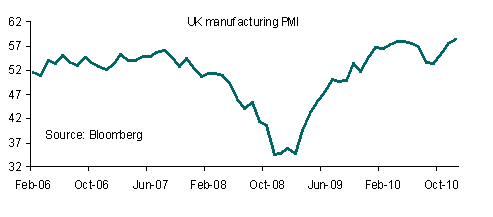
The batch of data releases in Tuesday’s trading session was generally positive. Leading the way was a stronger than expected increase in the UK manufacturing purchasing managers index (PMI) for December at 58.3 which coming in at a 16-year high. The data gave a boost to GBP though GBP/USD is unlikely to gain much of a foothold above 1.5600.

In the US, factory orders surprisingly jumped 0.7% in November and whilst the data is second tier it does maintain the run of generally upbeat US data. Meanwhile eurozone inflation came in higher than forecast at 2.2% YoY, above the European Central Bank (ECB) target level for the first time in two years. The outcome is unlikely to trigger a response from the ECB especially given that core inflation remains well behaved. After hitting a post CPI release high of 1.3433 EUR/USD is likely to drift lower in the short term.

Separately the Fed FOMC minutes of the December 14 meeting revealed little to surprise. Of note, FOMC members highlighted that the improvement in economic conditions was insufficient to warrant any change to the asset purchase program. The bottom line for the Fed is that the dual mandate of maximum employment and price stability is still not in reach and therefore they will keep the pedal to the floor in terms of policy stimulus. Although a further round of quantitative easing seems unlikely the Fed is likely to stick it out in terms of the $600 billion in planned asset purchases whilst an actual rate hike is unlikely until well into 2012.

Commodity prices dropped sharply overnight with soft commodities and energy prices in particular leading the declines. Commodity currencies fell as a result, with the AUD also impacted by growing worries about the impact of the Queensland floods. Initial estimates suggest that total damage from the flooding could reach AUD 6 billion and as Queensland represents around 19% of Australian GDP, the impact on growth could be significant. Growth could drop by a sharp -0.8% YoY in Q1 GDP. This is based on the assumptions that 40% of all exports will experience a 30% reduction

Today’s data slate in the US will be crucial to provide the final clues to Friday’s December payrolls report. The ADP jobs report, ISM non-manufacturing survey and Challenger job cuts data are all scheduled for release. The run of positive US data will help the USD to trade on a firm footing over the short term but clearer direction will await the outcome of the December jobs report whilst the beginning of the Q4 earnings season next week will also be influential. The exception to USD strength will continue to be Asian currencies where more upside is likely, but I prefer to play this via short EUR/Asian FX than the USD.

The Week Ahead

As markets make the last strides towards year end it appears that currencies at least are becoming increasingly resigned to trading in ranges. Even the beleaguered EUR has not traded far from the 1.3200 level despite significant bond market gyrations. Even news that inflation in China came in well above expectations in November (5.1% YoY) and increased prospects of a rate hike is likely to prompt a limited reaction from a lethargic market.

At the tail end of last week US data provided further support to the growing pool of evidence indicating strengthening US economic conditions, with the trade deficit surprisingly narrowing in October, a fact that will add to Q4 GDP growth, whilst the Michigan measure of consumer confidence registered a bigger than expected increase in November to its highest level since June.

The jump in consumer confidence bodes well for retail spending and highlights the prospects that US November retail sales tomorrow are set to reveal solid gains both headline and ex-autos sales driven by sales and promotions over the holiday season. Other data too, will paint an encouraging picture, with November industrial production (Wed) set to reveal a healthy gain helped by a bounce in utility output. Manufacturing surveys will be mixed with a rebound in the Empire manufacturing survey in December likely but in contrast a drop in the Philly Fed expected.

The main event this week is the FOMC decision tomorrow the Fed is expected to deliver few surprises. The Fed funds rate is expected to remain “exceptionally low for an extended period”. Despite some recent encouraging data recovery remains slow and the fact that core inflation continues to decelerate (CPI inflation data on Wednesday is set to reveal a benign outcome with core CPI at 0.6%) whilst the unemployment rate has moved higher means that the Fed is no rush to alter policy including its commitment to buy $600 billion in Treasuries including $105 billion between now and January 11.

In Europe there are also some key releases that will garner plenty of attention including the December German ZEW and IFO investor and manufacturing confidence surveys and flash purchasing managers indices (PMI) readings. The data are set to remain reasonably healthy and may keep market attention from straying to ongoing problems in the eurozone periphery but this will prove temporary at least until the markets are convinced that European Union leaders are shifting away from “piecemeal” solutions to ending the crisis. The EU leaders’ summit at the end of the week will be important in this respect. A Spanish debt auction on Thursday will also be in focus.

Assuming the forecasts for US data prove correct it is likely that US bond markets will remain under pressure unless the Fed says something that fuels a further decline in yield such as highlighting prospects for more quantitative easing (QE). However, following the tax compromise agreement last week this seems unlikely. Higher relative US bond yields will keep the USD supported, and as I have previously noted, the most sensitive currencies will be the AUD, EUR and JPY, all of which are likely to remain under varying degrees of downward pressure in the short term. The AUD will also be particularly sensitive to prospects of further Chinese monetary tightening.

FX sensitivity to yield

It’s all about yield. The back up in US bond yields in reaction to the US tax compromise from the Obama administration has been particularly sharp. US 10 year bond yields jumped around 35bps this week prior to a small correction in yields overnight whilst 2s were up 21bps. US bond yields are now back where they were in June, a fact that makes a mockery out of the Fed’s attempts to drive bond yields lower via quantitative easing (QE). Yields elsewhere increased too but by a smaller degree whilst equity market sentiment has been dampened by the rise in global yields although US stocks still ended higher overnight.

There is plenty of commentary discussing the impact on currencies of the move in bond yields so it’s worth looking in more detail how sensitive FX markets have been to yield. The most sensitive currencies i.e. those with the highest 3-month correlations with relative bond yield differentials (2 year) are the AUD/USD, EUR/USD, and of course USD/JPY. However, there is less sensitivity to gyrations in 10 year yields with no currency pair registering a statistically significant correlation with 10-year bond yield differentials over the past 3-months.

Assuming that US bond yields continue to push higher into 2011, with much lager increases in both nominal and yields expected, this means that AUD, EUR and JPY will face the most pressure relative to the USD. Moreover, the stimulus measures agreed by the US administration will likely lead to many analysts penciling in higher growth forecasts over 2011 whilst reducing the prospects of QE3 from taking place, all of which is USD positive. I still retain a degree of caution in Q1 2011, especially with regard to a potential bounce in EUR, especially if the ECB becomes more aggressive in its bond buying, but even so, any EUR rally is likely to prove termporary.

The impact of higher US yields on the AUD may be more limited however, despite the high correlation with relative bond yields, as Australian bond yields are also likely to rise somewhat given the resilience of its economy. This was clearly demonstrated by Australian November employment data released overnight revealing yet another consensus beating outcome of +54.6k, with all the gains coming from full time employment. Against the background of a generally firm USD, the best way to play AUD resilience is via the NZD, with the currency pair likely break through resistance around 1.3220 (21 October high).