All Eyes On Greece

I remain a skeptic but market sentiment continues to improve, helped by firmer data and expectations that Greece’s woes are on the path to being resolved. Greece is expected to announce further austerity measures including further spending cuts and tax hikes, which will be aimed at appeasing EU concerns and passing the March 16th test set by the EU. This could pave the way for some form of debt guarantee scheme and a better reception to a likely sale of up to EUR 5 billion in 10 year Greek bonds.

These measures will allow the EUR to recover some of its recent losses in the short term after dropping to new 2010 lows against the USD around 1.3435, but gains are likely to be limited given the many uncertainties remaining including fiscal problems in other European countries and weak growth ahead. If EUR/USD can sustain a break above the 20-day moving average level around EUR/USD 1.3630 it will put the next resistance level of 1.3747 into target, which given record short EUR speculative positioning may happen quite quickly. I suggest rebuilding short EUR positions on a move to this level.

Commodity currencies continue to be favoured and despite only a brief spike following the RBA’s decision to hike interest rates yesterday AUD/USD has managed to traverse the 0.90 level and looks well placed to build on its gains helped by a firm 0.9% QoQ reading for Australian GDP in Q4. Nonetheless, AUD/USD 0.9147 looks like a near term cap on the currency. For bullish commodity currency trades the NZD may offer a little better value and short AUD/NZD may be the way to go from here. Note that NZD positioning is below the 3-month average according to positioning data. In contrast to the RBA, the Bank of Canada left interest rates unchanged, but its statement highlighted that the prospect of quantitative easing had receded, which has effectively lifted a weight off the shoulders of the CAD.

All of this leaves the USD on the back foot, with further direction coming from the US February ADP jobs report, ISM non-manufacturing survey and Fed’s Beige Book. The ADP data and ISM employment component will give further clues to Friday’s February US jobs report for a 50k drop in payrolls is expected. Service sector Purchasing Managers’ Indices (PMIs) will also be released across the eurozone and the UK and both are likely to sustain moves into expansion territory.

The rebound in EUR/USD was a trigger for further selling in USD/Asian currencies. Asian currencies remain highly correlated with local equity market performance and have benefited from a strong return of equity portfolio inflows over recent days. Only Vietnam has registered outflows this week, with South Korea and Taiwan registering the biggest inflows. Indeed, South Korea has seen the biggest inflows of portfolio capital compared to other Asian countries so far this year, with inflows of around $933 million.

There is not much data in the region to provide direction for Asian currencies today though the South Korean industrial production report will be closely watched. Despite a small monthly drop expected, output likely expanded at very healthy 40%+ pace annually. Overall, USD/Asians are likely to remain under downward pressure in line with the general pressure on the USD, but direction will continue to come from equity markets.
Fed discount rate move boosts dollar

The Fed’s move to hike the discount rate by 25bps has set the cat amongst the pigeons.   Although the move was signalled in the FOMC minutes yesterday a hike in the discount rate was not expected to happen so soon.  The Fed sees the modifications which also include reducing the typical maximum maturity for primary credit loans to overnight, as technical adjustments, rather than a signal of any change in monetary policy. 

Nonetheless, the market reaction has been sharp, with the USD strengthening across the board and short term interest rate and stock futures falling.  Although the reaction looks overdone and will likely be followed by some consolidation over the short term, the move will be interpreted as the beginning of a move towards monetary policy normalisation despite the Fed’s insistence that this is not the case.  The firm USD tone is set to remain in place for now but the bulk of the strengthening has likely already occurred following the announcement.  

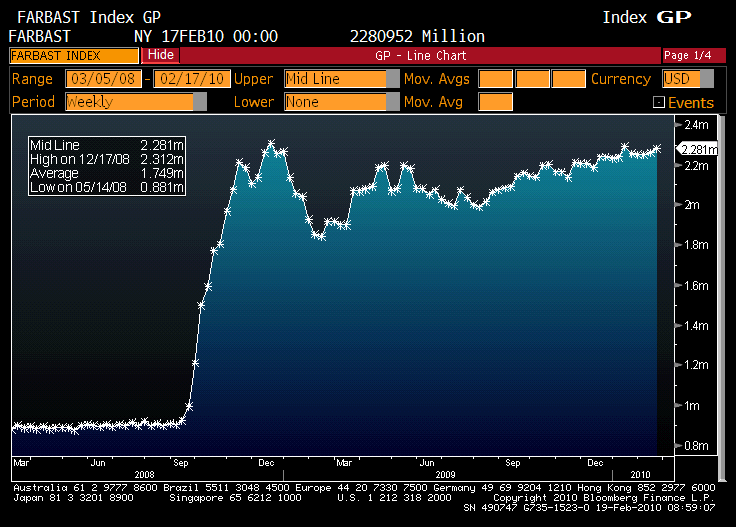
The Fed’s desire to reduce the size of its burgeoning balance sheet, which at $2.3 trillion is roughly around three times its size before the financial crisis began, will imply further measures to reduce USD liquidity over the coming months.   A withdrawal of liquidity could have positive implications for the USD but given that the Fed is still some months away from hiking the Fed Funds rate, interest rate differentials will not turn positive for the USD for a while yet. 

The move has however, changed the complexity of the FX market and likely shifted currencies into new lower ranges against the USD.  There were plenty of reasons to sell EUR even before the Fed move and the discount rate hike inflicted further damage on EUR/USD which dropped below the key psychological level of 1.35.  GBP and commodity currencies were also big losers, with GBP/USD below 1.55.  Key technical support levels to watch will be EUR/USD 1.3422, GBP/USD 1.5374 and AUD/USD 0.884.

US Federal Reserve Balance Sheet ($trillion)

Selling Risk Trades On Rallies

Disappointing earnings as well as a weaker than expected outcome for data on the health of the US service sector (the ISM non-manufacturing index failed to match expectations, coming in at 50.5 in January versus consensus of 51.0) has weighed on markets, undoing the boost received from the generally positive manufacturing purchasing managers (PMIs) indices earlier in the week. It was not all bad news however, as earnings from Cisco Systems beat expectations Meanwhile US ADP jobs data fell less than expected, dropping 22k whilst data for December was upwardly revised. These are consistent with a flat outcome for January non-farm payrolls.

Various concerns are still weighing on confidence. Sovereign ratings/fiscal concerns remain high amongst these and although much has been made of the narrowing in Greek debt spreads, attention now seems to be turning towards Portugal. Greece is also far from being out of the woods, and whilst the European Commission accepted Greece’s economic plans the country would be placed under much greater scrutiny by the EC.

The US has not escaped either, with Moody’s warning that the US AAA credit rating would come under pressure unless more stringent actions were taken to reduce the country’s burgeoning budget deficit. The move follows the US administration’s forecast of a $1.565 billion budget deficit for 2010, the highest as a proportion of GDP since the second world war, with the overall debt to GDP ratio also forecast to rise further.

The current environment remains negative for risk trades and the pullback in high beta currencies has been particularly sharp over recent weeks. Sentiment for the NZD was dealt a further blow from a surprisingly weak Q4 jobs report in New Zealand. Unemployment rose to a decade high of 7.3% over the quarter whilst employment growth contracted by 0.1%. The pull back in wage pressures will also be noted by interest rate markets, as it takes some of the pressure off the RBNZ to raise rates anytime soon.

Data in Australia will not help sentiment for the AUD too. Australian retail sales dropped by 0.7% in December, a worse than expected outcome. The data will only serve to reinforce market expectations that the RBA will no hike interest rates as quickly as previously expected. Nonetheless, I would caution reading too much into the data, with real retail sales volumes rising by a solid 1.1% over Q4 whilst other data showed a strong 2.2% jump in building approvals.

The overall strategy against this background is to sell risk trades on rallies. There are still too many concerns to point to a sustained improve in risk appetite. Moreover, the market is still long in many major risk currencies. Asian currencies have so far proven more resilient to the recent rise in risk aversion however, a reflection of the fact that a lot of concerns are emanating from the US and Europe. However, Asian currencies will continue to remain susceptible to events in China, especially to any further measures to tighten policy.

Further USD strength against this background is likely, which could see EUR/USD testing support around 1.3748, AUD/USD support around 0.8735, and NZD/USD support around 0.6916.

Optimism dissipates

Markets have been highly fickle so far this year. Optimism about strong recovery led by China – recall the fact that disappointment from the surprisingly weak US non-farm payrolls report in December was outweighed by strong Chinese trade data – has dissipated. Instead of rejoicing at China’s robust GDP report last week, which revealed a 10.7% rise in the fourth quarter of 2009, investors began to fret about whether China would have to move more aggressively to tighten monetary policy. Fuelling these fears was the release of Consumer price data which showed inflation rising above expectations to 1.9% YoY in China.

If such fears were not sufficient to hit risk appetite, US President Obama’s plan to limit the size and trading activities of financial institutions dealt another blow to financial stocks. The plan followed quickly after the Democrats lost the state of Massachusetts to the Republicans and managed to shake confidence in bank stocks whilst fuelling increased risk aversion. Meanwhile, rumblings about Greece continue to weigh on markets and Greek debt spreads continued to widen even as global bond markets rallied.

Following the US administration’s plans to restrict banks’ activities the fact that the rise in risk aversion was US led rather than broad based led to an eventual pull back in the dollar which helped EUR/USD to avoid a break below 1.40. Risk trades including the AUD came under pressure as risk appetite pulled back. A drop in commodity prices did not help. The AUD was also hit by news that Australia’s Henry Tax Review would look to tax miners in the country. As a result AUD/USD dropped below 0.90 though this level is likely to provide good buying levels for those wanted to take medium term AUD long positions. The one currency that did benefit was the JPY which managed to drop below sub 90 levels.

The aftermath of the “Volker Plan” will reverberate around markets this week keeping a lid on equity sentiment. Meanwhile Greece will be in the spotlight especially its bond syndication. A bad outcome could be the trigger for EUR/USD to sustain a move below 1.40 though it looks as though it may find a bottom around current levels, with strong support seen around 1.4029. The German IFO business survey for January will be important to provide some direction for EUR and could be a factor that weighs on the currency if as expected it reveals some loss of momentum in the economy.

Aside from the Fed the other G3 central bank to meet this week is the Bank of Japan but unless the Bank is seen to be serious about fighting deflation, USD/JPY may remain under downward pressure against the background of elevated risk aversion. Below 90.0 there does appear to be plenty of USD/JPY buyers however, suggesting that further upside for the JPY will be limited. USD/JPY will find strong support around 88.84.

Much will depend on the key events in the US this week including the Fed FOMC meeting and the President’s State of the Union speech. USD bulls will look for some indication that the US government is serious about cutting the burgeoning budget deficit. Also watch out for the confirmation vote on the renomination of Bernanke as Fed Chairman which could end up being close. There is a heavy slate of data to contend with including new and existing home sales, consumer confidence, durable goods orders, the first glance at Q4 GDP and Chicago PMI.

High yield / commodity currencies take the lead

Although equity markets continue to tread water the appetite for risk looks untarnished. So far into the new-year the winners are commodity / high yield plays as well as emerging market assets. The AUD, NOK, NZD and CAD have been the stars on the major currency front, with only GBP registering losses against the USD so far this year. The move in these currencies has been well supported by resurgent commodity prices; the CRB commodities index is up close to 10% since its low on 9 December.

There is little reason to go against this trend and the USD index is set to continue to lose ground as risk appetite improves further. I highlighted the upside potential in high yield / commodity currencies in a post titled “FX Prospects for 2010” and stick with the view that there is much further upside. I still prefer to play long positions in these currencies versus JPY which I believe will come under growing pressure as the year progresses.

Economic data has also been supportive, especially in Australia, supporting the AUD’s yield advantage. Although comments from the central bank towards the end of last year downplayed expectations of much further tightening, data releases support the case for another rate hike at the 2 February RBA meeting, with a fourth consecutive hike of 25bps to 4.00% likely at the meeting.

There will be some important clues from next week’s jobs data in Australia but judging by the solid gain in November retail sales, which rose 1.4% versus consensus expectations of 0.3%, and 5.9% jump in building approvals, the case for a rate hike has strengthened.  AUD/USD will now set its sights on technical resistance around 0.9326. 

AUD/USD has the highest sensitivity with relative interest rate differentials – correlation of 0.85 with Australia/US interest rate futures differentials over the past month – and so unsurprisingly the AUD rallied further as markets reacted to the strong retail sales data. I believe Australian interest rates will eventually get back up to 6% – pointing to more upside for AUD/USD as this is more than is priced in by the market.

It is fortunate for the USD that the correlation between the USD index and interest rate expectations remains low but nonetheless the December 15 FOMC minutes may have provided another excuse to sell the currency. The minutes were interpreted as slightly dovish by the market, with many latching on to the comments that some members of the FOMC debated the potential to expand the scale of asset purchases and continuing them beyond the first quarter.