Euro pressure mounts

The effects of eurozone peripheral bond concerns are cascading through eurozone markets and hitting risk appetite in the process. The EUR is a clear casualty having dropped further against the USD and versus other currencies. EUR/Asian FX remains a sell in the current environment. Contagion outside Greece, Portugal and Ireland had been limited but Italy and Spain have also seen a growing impact on their bond markets. Having broke below support around 1.3734, EUR/USD will target 1.3508 support.
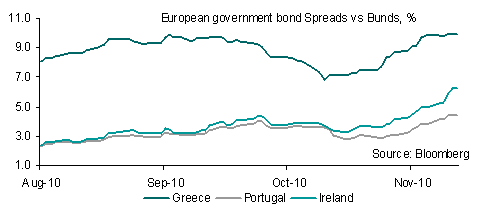
Speculation that Ireland will be forced to follow Greece in seeking international financial support has intensified. Although Ireland has sufficient funds to last until next spring, yields on its debt are already higher than Greek debt before it received funds a few months back. Attention is firmly fixed on the country’s budget on 7 December and the prospects of an agreement between the government and opposition in its austerity plans.

Not helping is the fact that the Irish government has a very slim majority. Even if the budget is passed there is no guarantee that sentiment will improve given the negative impact of even deeper fiscal tightening announced last week will have on economic growth. Moreover, Germany’s insistence that the cost of any Greek style bailout should be borne mostly by private investors has only added to market tension. Even the European Central Bank is unlikely to provide much support, with ECB member Stark suggesting that ECB bond purchases will remain limited.

This leaves eurozone markets in a precarious state and the EUR continues to look heavy as further downside opens up. Moreover, the problems in peripheral Europe are beginning to have a broader impact on risk appetite, with equity markets slipping, although some of this was related to a weaker sales forecast from Cisco in the US. Nonetheless, spreading risk aversion could also dampen sentiment for Asian currencies, which is why selling EUR/Asian FX looks a better bet than selling USD/Asian FX over the short term.

In contrast sentiment for the US is undergoing an improvement. Data releases over recent weeks have generally beaten forecasts and there is even growing speculation that the Fed’s calibrated asset purchases may end up being smaller than planned. Such speculation has boosted the USD but it is premature to suggest that the Fed is on the verge of scaling back asset purchases even as the program of purchases gets going. Although there are clearly some FOMC members who are opposed to significant asset purchases the probability that the Fed remains set to carry out its full $600 billion of planned purchases.

Attention today will focus squarely on day 2 of the G20 meeting and any resolution to disputes over trade imbalances and currencies. Unfortunately none is likely to be forthcoming. Despite a reported 80 minute meeting between US and Chinese leaders little agreement was reached, with plenty of finger pointing remaining in place. It appears that the mantra of moving towards “market-determined exchange rates” and efforts at “reducing excessive imbalances” as agreed at the G20 meeting of finance ministers and central bankers will be as far as any agreement reaches. As a result markets will be left with very little to chew on.

Resisting Asian FX Appreciation

The upward momentum in Asian currencies has continued unabated over recent weeks the gyrations in risk appetite. Most Asian currencies have registered gains against the USD over 2010 with the notable exception of one of last year’s star performers, KRW which after gaining by close to 9% last year has weakened slightly this year. Last year’s best performer the IDR which raked in close to 20% gains over 2009 versus USD has continued to strengthen this year, albeit to a smaller degree. Another currency that has extended gains this year has been the THB, which is on track to beat last year’s 4% appreciation against the USD.

The strength in Asian currencies has in part reflected robust inflows into Asian equity markets. For example Indonesia has been the recipient of around $1.7 billion in equity inflows so far this year. However, India and Korea have registered even larger inflows into their respective equity markets, at around $13 billion and $7.7, respectively, yet both the INR and KRW have underperformed other Asian currencies. The explanation for this is largely due to deteriorating current account positions in both countries. Further deterioration is likely.

The fact that equity flows have had only a small impact on the INR and KRW is reflected in their low correlations with their respective equity market performance. For most other Asian currencies the correlation with equity performance has been quite high, with the THB and MYR having the strongest correlations with their respective equity market indices over the past 3-months although the SGD, PHP and IDR have also maintained statistically significant correlations.

Clearly, for many but not all Asian currencies equity market gyrations are important drivers but at a time when growth is slowing more than many had expected in the US and governments in the eurozone are implementing austerity measures which will likely result in slowing growth and a worsening trade picture in the region, central banks in Asia will become increasingly wary of allowing their currencies from strengthening too quickly.

Increasingly Asian currency strength is being met with intervention by central banks in the region buying USDs against a host of Asian currencies. Over recent weeks this intervention appears to have become more aggressive. Nonetheless, any FX intervention led weakness in Asian FX is likely to prove short lived, with renewed appreciation likely over the coming months unless risk aversion increases dramatically. In other words a drop in Asian currencies will provide better opportunities to go long.

The CNY will play an important role on the pace and pattern of Asian currency movements. Investors in the region will also have one eye on developments on the visit of US National Economic Council director Larry Summers to Beijing. The CNY has firmed over recent days but this appears to be the usual pattern when a senior US official is in town and ahead of a G20 meeting. The fact is however, that the lack of CNY appreciation since the June CNY de-pegging remains a highly sensitive issue.

China is unlikely to yield to US pressure and is set to continue to act at its own pace and comments from officials in China over the past couple of days suggest no shift in FX stance. Although the CNY has not appreciated by as much as many had hoped for or expected since the June de-pegging the path is likely to be upwards, albeit at a gradual pace. For Asian currencies a slow pace of CNY appreciation implies further reluctance to allow a fast pace of appreciation so expect plenty of FX intervention in the weeks and months ahead.

Q2 Economic Review: Double-Dip Recession or Prolonged Recovery?

I was recently interviewed by Sital Ruparelia for his website dedicated to “Career & Talent Management Solutions“, on my views on my view on the Q2 Economic Review: Double-Dip Recession or Prolonged Recovery?

Sital is a regular guest on BBC Radio offering career advice and job search tips to listeners. Being a regular contributor and specialist for several leading on line resources including eFinancial Careers and Career Hub (voted number 1 blog by ‘HR World’), Sital’s career advice has also been featured in BusinessWeek online.

Please see below to read my article

Since we last discussed the economic outlook at the end of quarter 1, much has happened and unfortunately there has not been a great deal of positive news. I retained a cautiously optimistic outlook for economic recovery for the Q1 Economic Review: elections, recovery and underemployment discussion article, but highlighted that recovery would be a long and drawn-out process, with western economies underperforming Asian economies.

The obstacles to recovery discussed then continue to apply now, including consumers paying down debt, high unemployment, tight credit conditions and weak confidence.

Click here to read the rest…

The Week Ahead

As last week progressed there was a clear deterioration in sentiment as growth worries crept back into the market psyche. It all started well enough, with a positive reaction to China’s de-pegging of the CNY but the euphoria faded as it became evident that there was still plenty of two-way risk on the CNY. A change in Prime Minister in Australia, which fuelled hopes of a resolution to a controversial mining tax, and an austere budget in the UK, were also key events. However, sentiment took a hit as the Fed sounded more cautious on the US economy in its FOMC statement.

The US Congress finalised a major regulatory reform bill towards the end of the week and markets, especially financial stocks, reacted positively as the bill appeared to give some concessions to banks and was not as severe as feared. However, equity market momentum has clearly faded against the background of renewed growth concerns including sprouting evidence of a double-dip in the US housing market as well as fresh worries about the European banking sector. As if to demonstrate this US Q1 GDP was duly revised lower once again, to a 2.7% annualised rate of growth.

The US Independence Day holiday and World Cup football tournament will likely keep liquidity thin in the run up to month and half year end. However, there is still plenty to digest this week including the all important employment report and consumer confidence data in the US. In Europe economic sentiment gauges, purchasing managers indices and the flash CPI estimate will be in focus. Elsewhere, Japan’s Tankan survey and usual slate of month end Japanese releases, Switzerland’s KoF leading indicator and Australian retail sales will be of interest.

On balance, economic data this week is unlikely to relieve growth concerns, with Eurozone, US and UK consumer and manufacturing confidence indicators likely to post broad based declines due to a host of factors. The data will further indicate a slowing in growth momentum following Q2 2010, with forward looking surveys turning lower, albeit gradually. Whilst a double-dip scenario still seems unlikely there can be no doubt that austerity measures and the waning of fiscal stimulus measures are beginning to weigh on growth prospects even if there is still plenty of optimism for emerging market and particularly Asian growth prospects.

This suggests that Q3 could turn into a period of heightened uncertainty in which equity markets and risk assets will struggle to gain traction. In addition to growth worries, some tensions in money markets remain in place whilst banking sector concerns seem to be coming back to the fore, especially in Europe and these factors will prevent a sustained improvement in risk appetite from taking place over the coming quarter. Some more clarity may come from the results of European stress tests but much will depend on just how stressful the tests are.

In the near term, the main focus of attention will be on the US June jobs report released at the end of the week. Non-farm payrolls are set to record a decline over the month due to a reversal in census hiring, with a consensus expectation of a 110k fall. Private sector hiring is likely to record a positive reading, however, suggesting some improvement in the underlying trend in jobs growth, albeit a very gradual one. Downside risks to consensus suggest plenty of scope for disappointment.

Interestingly, weaker US data of late, has managed to restrain the USD, suggesting that cyclical factors and not just risk aversion are beginning to play into FX movements. Notably the USD was on the back foot against a number of currencies as last week progressed. Even the beleaguered EUR managed to end the week well off its weekly low and close to where it closed the previous week whilst risk currencies such as the AUD and NZD as well as GBP also posted firm performances.

Perhaps some reversal of the optimism towards US recovery prospects give USD bulls some cause for concern, but pressure is likely to prove temporary, especially given that the US economy is still on course to outperform many other major economies. Over the short-term, especially ahead of the US jobs report markets are set to remain cautious with range trading likely to dominate in the week ahead, suggesting that EUR/USD is unlikely to breach the key level of 1.2500. GBP performance has been robust but even this currency is likely to make much headway above GBP/USD 1.5000, where there are likely to be plenty of sellers.

Euro Rally To Fade

It is not an easy time to forecast currencies. Just as many forecasters fought for the accolade of being the most bearish on the EUR and many others were forced to capitulate or risk falling behind the curve, EUR/USD has started to perk up. Similarly, commodity currencies and many emerging market currencies have bounced.

Perhaps the explanation of these moves is merely position adjustments as traders and investors square positions as they keep one eye on the World Cup or maybe its just fatigue after weeks of selling pressure. Either way, the fact that speculative USD market positioning is at a very high level, suggests there is plenty of scope to take profits on long USD positions.

There are various reasons to expect the calm to give way to renewed tensions, however. Public opposition to austerity plans in Europe, added to the prospects for slowing growth as the plans are implemented, in addition to banking sector concerns, suggest that the outlook for the EUR remains downbeat. These factors also point to the prospects of risk aversion rising over the coming weeks, reversing the recent rally in risk currencies.

Further out, the EUR’s travails will not be over quickly and in the wake of the implementation of austerity plans the EUR will struggle from the impact of relatively slower growth in the eurozone compared to the US and other countries. The EUR will continue to remain under pressure even as risk appetite improves and many risk currencies appreciate.

The interruption of risk as an FX determinant is likely to fade towards the end of the year and investors will then go back to differentiating on the basis of relative growth and interest rate dynamics, which will play well for the USD as US growth strengthens.

Relative growth differentials will also bode well for commodity currencies and there will be scope for plenty of upside in the AUD and NZD as growth strengthens. Both countries have benefited from firm demand in Asia and China in particular and this source of support will likely continue to be beneficial.

Funding currencies including JPY and CHF will likely weaken this year against the USD based on the likely improvement in risk appetite later this year. The outlook for the JPY will be particularly interesting in the wake of the change in Prime Minister in Japan, especially given the new PM’s preference for a weaker JPY and reflationary policies. USD/JPY will likely reach 100 by the end of the year.

GBP should not be seen in the same context as the EUR. Although the UK has got its own share of fiscal problems the new government appears to be moving quickly to mollify both investor and ratings agency concerns. The test will come with the reaction of the emergency budget on June 22nd but I suspect that the downside risk to GBP will be limited.

Unlike the EUR which is trading around “fair value”, GBP is highly undervalued. Arguably past GBP weakness puts the UK economy on a stronger recovery footing. Moreover, problems that Europe will face in implementing multi country austerity plans and widening growth divergence, will not be repeated in the UK. Overall, there is likely to be significant outperformance of GBP versus EUR over coming months