Temporary Euro Relief

Eurozone peripheral country travails continue to garner most market attention. There was at least a semblance of improvement on this front as peripheral bond spreads with German bunds narrowed on Tuesday but this was largely due to European Central Bank (ECB) bond buying than any improvement in sentiment. The fact that German bund yields also rose helped to narrow bund-peripheral spreads further.

A clearer test of sentiment will be today’s debt sales by Portugal followed by actions by Spain and Italy tomorrow. ECB buying of Portuguese bonds has given some relief to other debt, with Spanish and Italian debt spreads narrowing too. Even Greece managed to sell short term debt (EUR 1.95 bn of 26 week T-bills) but at a higher cost than the previous sale.

Perhaps a stronger boost to sentiment will come from the news that European Union (EU) governments are discussing an increase in the EUR 440 billion bailout fund in recognition of the fact that the fund may prove too small to cope if the crisis spreads to Spain. However, don’t expect a decision anytime soon, with next week’s meeting of EU finance ministers unlikely to agree to such a move. Support (or lack) of from Germany may prove to be a sticking point against the background of domestic political pressure.

Other options being considered include the possibility of the EFSF (European Financial Stability Facility) purchasing bonds in the secondary market and lowering interest rates on EFSF bailout loans. News that Japan will buy 20% of EFSF bonds this month as well as recent supportive comments from China suggest that an increase in the size of the EFSF may be easily funded by such investors. The EUR will gain some support against the background of such speculation but its upside may be restrained around its 200-day moving average at EUR/USD 1.3071.

In the US the economic news was not so positive for a change as the National Federation of Independent Business (NFIB) small business optimism survey came in weaker than expected in December, an outcome that will come as a blow given that it suggests some stuttering in the recovery process as well as hiring.
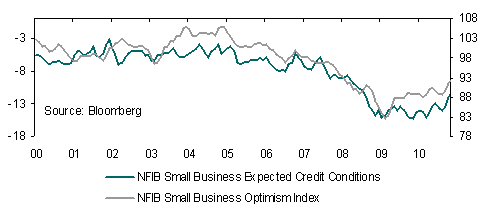
There is only secondary data scheduled today, with most attention on the Fed’s Beige Book later tonight. The survey of Federal Reserve districts will likely reveal a broad based but moderate improvement in economic conditions with the exception of housing activity. A speech by the Fed’s Fisher on Monetary policy will also be in focus. Like the Fed’s Plosser overnight he may highlight some caution about the impact of Fed quantitative easing (QE).

The AUD is increasingly feeling the impact of the flooding in Queensland Australia as the extent of economic damage is revealed. Reserve Bank of Australia (RBA) board member McKibbin estimated that it could knock off at least 1% from economic growth. This may prove too negative and although the flooding will result in a significantly negative impact on growth in Q1 rebuilding and reconstruction will mean that overall growth for 2011 will not be as significantly impacted. Nonetheless, a paring back in RBA policy tightening expectations will see the AUD come under further pressure, with a move down to around AUD/USD 0.9634 on the cards over the short-term.
All eyes on G20

Although we move from feast to famine this week in terms of data there are still a few events that are noteworthy. In the US the September trade balance (Wed) will be of interest with a narrowing expected. Net exports negatively impacted GDP in Q3 but this is likely to reverse in Q4. Michigan confidence at the end of week is also likely to reveal better news with a rebound expected in October in the wake of firming equities, whilst the October budget statement is likely to reveal a sharp narrowing compared to October last year. Several Fed speakers over the week will be also be in focus as markets try to gauge the level of support within the FOMC for the QE2 announced last week.

There are a few data releases of interest in the eurozone including the preliminary estimate of Q3 GDP. Worryingly the divergence across the eurozone between healthier northern Europe and weaker performing in Southern Europe is becoming increasingly stark, a big headache for the Eurozone Central Bank with its one size fits all policy. Elsewhere, in the UK the Bank of England Quarterly Inflation Report will be scrutinized to determine whether recently firmer data and sticky inflation has pushed the BoE away from following the Fed into QE2. Japan’s volatile machinery orders data marks the highlight of its calendar, with a sharp drop expected in September following two strong months.

The main event of the week is the G20 leaders meeting in Seoul at the tail end of the week. Rhetoric going into the meeting suggests little support for the US plan to limit current account surpluses to 4% of GDP and even US officials appear to have cooled on the idea. Moreover the G20 meeting will probably elicit further reaction to the Fed’s QE2 announcement. Reaction was highly critical initially but seems to have softened lately. Currencies will nonetheless, remain the major topic of discussion although expectations of a global agreement are likely to be disappointed.

The Fed’s QE2 announcement helped provide a prop to risk assets and weighed on the USD last week despite the amount of asset purchases being within expectations. The USD will remain a sell on rallies this week and once again the best way to play USD weakness is likely via the higher yielding commodity currencies, especially AUD and NZD. Scandinavian currencies also offer a good way to capitalize on USD weakness.

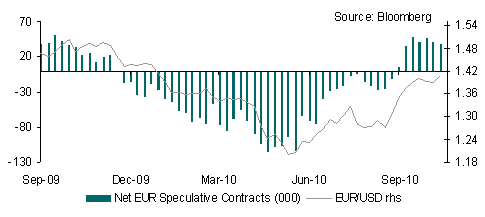
The EUR may also struggle this week given worries about peripheral Europe and widening in peripheral bond spreads. Ireland’s budget cuts announced last week have so far failed to shore up confidence whilst political uncertainties are also rising. Greece’s regional elections revealed that the ruling socialist party narrowly retained control allowing the government to continue with reforms suggesting a modicum of support for its debt. Nonetheless, with Irish and Portuguese sovereign worries continuing, the EUR will continue to lag. Notably the CFTC IMM data revealed that speculative EUR sentiment deteriorated in the latest week to its lowest in over a month. EUR/USD is likely to target 1.3864 after dropping swiftly below the 1.4000 level.

Perhaps best way to play EUR vulnerability is versus the AUD, with a further decline through 1.3800 likely to pave the way for a drop below the 13 September low around 1.3660. AUD/JPY may also be another cross worth exploring especially as Japan’s new fund begins buying JGBs today, which could limit JPY upside. A test of AUD/JPY 83.65 is on the cards shortly. If Australia’s October employment report on Thursday reveals another strong reading it will likely give the currency further support into the end of the week.

Ready for Fed QE2

The USD was already under pressure ahead of the Fed FOMC decision last night, with the EUR benefiting in particular from successful debt auctions in Ireland and Spain. The Fed statement resulted in a further lurch lower for the USD index as it fell through the 81.00 level on its way to testing the August low of 80.09. EUR/USD broke important technical resistance levels moving above its 200-day moving average (1.3215). In contrast, gold prices continued to surge hitting a new record high whilst 2-year Treasury yields fell to an all-time low.

The US Federal Reserve confirmed that it was ready to ease if needed. Although the decision to leave the Fed funds target rate at 0% to 0.25% unchanged and commitment to maintain exceptionally low levels of the rate for an “extended period” came as no surprise there was a subtle change in the language of the statement regarding further easing. The Fed noted that it was “prepared to provide additional accommodation if needed” a shift from the previous wording that it “will employ its tools as necessary”.

It appears to be a case of not if but when the Fed embarks on further quantitative easing and/or other policy accommodation. Once again the Fed offered no guideposts to determine the timing of easing and the decision will ultimately be data dependent. Nonetheless, the bias has clearly shifted towards more balance sheet expansion.

We expect core inflation to decline further over the coming months although we do not forecast a drop to as low as 0.5%. Nonetheless, declining core CPI could lead to the Fed’s disinflation concerns intensifying. Indeed, providing further rationale for the Fed’s conditional easing bias was the particularly dovish stance on inflation in the FOMC statement.

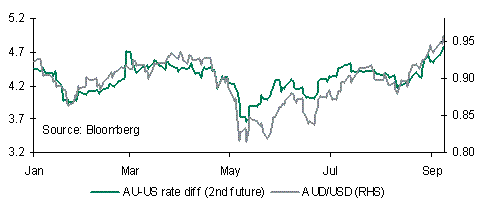
If it wasn’t obvious before it has become increasingly clear now that the USD will not relinquish its role as the ultimate funding currency for a long time to come. Although interest rate differentials are not yet the main driver for most currency pairs, with risk aversion retaining this role for now, there is a very high correlation between certain high yielding currencies and their respective interest rate differentials against the USD.

For instance, there is a high and significant correlation between interest rate differentials between Japan, Australia, Canada and the US and their respective currency pairs. AUD/USD is one to watch as the currency hit a fresh 25 month high overnight. Although the AUD looks rich at current levels, the shift in relative yield with the US overnight provides a further underpinning to the currency, with parity being talked about once again.

Even USD/JPY moved lower in the wake of the Fed statement dropping just below 85.00 although the threat of further official Japanese FX intervention will likely prevent a sharp drop in the currency pair. It will be interesting to see how far the market is prepared to go, with further threats of FX intervention by Prime Minister Kan overnight. Despite the threats the narrowing in US / Japan bond yields overnight suggests more downside pressure on USD/JPY and a fresh challenge for the Japanese authorities.

Follow The Oracle

Many investors are probably wishing they had the psychic abilities of Paul the octopus. The mollusc once again gave the correct prediction, by picking Spain to beat the Netherlands to become the winner of the World Cup. This ability would have been particularly useful for currency forecasters, many of which have been wrong footed by the move higher in EUR/USD over recent weeks.

Confidence appeared to return to markets over the past week helped by a string of rate hikes in Asia from India, South Korea and Malaysia, and firm data including yet another consensus beating jobs report in Australia. An upward revision to global growth forecasts by the International Monetary Fund (IMF) also helped, with the net result being an easing in double-dip growth concerns.

The good news culminated in a much stronger than forecast June trade surplus in China. However, China’s trade numbers will likely keep the pressure on for further CNY appreciation, and notably US Senators are still pushing ahead with legislation on China’s FX policy despite the US Treasury decision not to name China as a currency manipulator.

Political uncertainty on the rise again in Japan following the loss of control of the upper house of parliament by the ruling DPJ party. The JPY has taken a softer tone following the election and will likely remain under pressure. CFTC IMM speculative JPY positioning has increased but this has been met with significant selling interest by Japanese margin accounts who hold their biggest net long USD/JPY position since October 2009 according to Tokyo Financial Exchange (TFX) data.

In the absence of the prodigious abilities of an “oracle octopus” data and events this week will continue to show slowing momentum in G3 country growth indicators but not enough to warrant renewed double-dip concerns. Direction will be largely driven by US Q2 earnings. S&P 500 company earnings are expected to have increased 27% from a year ago according to Thomson Reuters.

There are several data releases of interest in the US this week but the main release is the retail sales report for June which is likely to record another drop over the month. Data and events in Europe include the Eurogroup finance ministers meeting, with markets looking for further insight into bank stress tests across the region. Early indications are positive but the scope of the tests remains the main concern. The July German ZEW survey will garner some interest and is likely to show a further slight decline in economic sentiment.

EUR/USD gains looked increasingly stretched towards the end of last week, as it slipped back from a high of around 1.2722. Technical resistance around 1.2740 will prove to be tough level to crack over coming days, with a pullback to support around 1.2479 more likely. CFTC IMM data reveals that short covering in EUR has been particularly sharp in the last week, with net short positions cut by over half, highlighting that the scope for further short covering is becoming more limited.

Conversely aggregate net USD long positions have fallen by over half in the last week as USD sentiment has soured, with longs at close to a three-month low. The scope for a further reduction in USD positioning is less significant, suggesting that selling pressure may abate.

The Week Ahead

As last week progressed there was a clear deterioration in sentiment as growth worries crept back into the market psyche. It all started well enough, with a positive reaction to China’s de-pegging of the CNY but the euphoria faded as it became evident that there was still plenty of two-way risk on the CNY. A change in Prime Minister in Australia, which fuelled hopes of a resolution to a controversial mining tax, and an austere budget in the UK, were also key events. However, sentiment took a hit as the Fed sounded more cautious on the US economy in its FOMC statement.

The US Congress finalised a major regulatory reform bill towards the end of the week and markets, especially financial stocks, reacted positively as the bill appeared to give some concessions to banks and was not as severe as feared. However, equity market momentum has clearly faded against the background of renewed growth concerns including sprouting evidence of a double-dip in the US housing market as well as fresh worries about the European banking sector. As if to demonstrate this US Q1 GDP was duly revised lower once again, to a 2.7% annualised rate of growth.

The US Independence Day holiday and World Cup football tournament will likely keep liquidity thin in the run up to month and half year end. However, there is still plenty to digest this week including the all important employment report and consumer confidence data in the US. In Europe economic sentiment gauges, purchasing managers indices and the flash CPI estimate will be in focus. Elsewhere, Japan’s Tankan survey and usual slate of month end Japanese releases, Switzerland’s KoF leading indicator and Australian retail sales will be of interest.

On balance, economic data this week is unlikely to relieve growth concerns, with Eurozone, US and UK consumer and manufacturing confidence indicators likely to post broad based declines due to a host of factors. The data will further indicate a slowing in growth momentum following Q2 2010, with forward looking surveys turning lower, albeit gradually. Whilst a double-dip scenario still seems unlikely there can be no doubt that austerity measures and the waning of fiscal stimulus measures are beginning to weigh on growth prospects even if there is still plenty of optimism for emerging market and particularly Asian growth prospects.

This suggests that Q3 could turn into a period of heightened uncertainty in which equity markets and risk assets will struggle to gain traction. In addition to growth worries, some tensions in money markets remain in place whilst banking sector concerns seem to be coming back to the fore, especially in Europe and these factors will prevent a sustained improvement in risk appetite from taking place over the coming quarter. Some more clarity may come from the results of European stress tests but much will depend on just how stressful the tests are.

In the near term, the main focus of attention will be on the US June jobs report released at the end of the week. Non-farm payrolls are set to record a decline over the month due to a reversal in census hiring, with a consensus expectation of a 110k fall. Private sector hiring is likely to record a positive reading, however, suggesting some improvement in the underlying trend in jobs growth, albeit a very gradual one. Downside risks to consensus suggest plenty of scope for disappointment.

Interestingly, weaker US data of late, has managed to restrain the USD, suggesting that cyclical factors and not just risk aversion are beginning to play into FX movements. Notably the USD was on the back foot against a number of currencies as last week progressed. Even the beleaguered EUR managed to end the week well off its weekly low and close to where it closed the previous week whilst risk currencies such as the AUD and NZD as well as GBP also posted firm performances.

Perhaps some reversal of the optimism towards US recovery prospects give USD bulls some cause for concern, but pressure is likely to prove temporary, especially given that the US economy is still on course to outperform many other major economies. Over the short-term, especially ahead of the US jobs report markets are set to remain cautious with range trading likely to dominate in the week ahead, suggesting that EUR/USD is unlikely to breach the key level of 1.2500. GBP performance has been robust but even this currency is likely to make much headway above GBP/USD 1.5000, where there are likely to be plenty of sellers.