Greek tensions hit EUR, Aussie jobs boost AUD

Eurozone tensions continue to act as a weight on global market sentiment and the EUR. Talk of a delay of part or all of the second Greek bailout until after elections in April has intensified speculation of a disorderly Greek default. Chinese support for Europe expressed yesterday has done little to alleviate the strain. Attention will now turn to the meeting of the Eurogroup in Brussels on Monday.

Relatively positive US economic data including a jump in the NAHB homebuilders survey to its highest level since May 2007 and hints by Federal Reserve officials of support for more quantitative easing in the minutes of the Jan 24-25 FOMC meeting have failed to outweigh negative developments in Europe.

A ‘risk off’ tone will filter through markets today. Data wise, US Philly Fed and housing starts will continue the positive tone of US releases, while in Europe bond auctions in France and Spain will be watched closely.

Australian jobs data for January came in stronger than forecast, rising by 46.3k compared to consensus of 10k. The unemployment rate surprisingly dropped to 5.1%. The increase in jobs more than made up for last month’s disappointment and highlights some signs of stability in job market conditions. Moreover, the data supports last week’s decision by the Reserve Bank of Australia (RBA) to keep rates on hold.
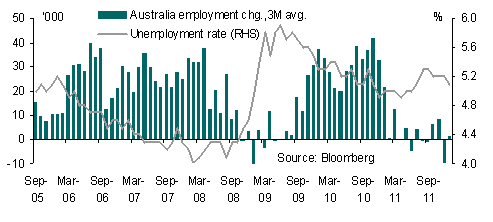

AUD jumped on the data but I expect the follow through to be limited especially given the fact that the AUD remains one of the most sensitive currencies to risk aversion. Upside will be restrained to resistance around 1.0788 versus USD today.

Modest growth in the G3 economies

A few themes are already becoming evident into 2010. Firstly, the dominance of China and any news on the Chinese economy is becoming increasingly apparent as reflected in the market reaction to trade data and hike in reserve requirements this week. Despite the odd setback the second theme that is developing this year is the “risk on” environment for asset markets. Another theme is the problems and concerns about sovereign debt and ratings, which will likely intensify further.

I could add one more to the list; the underperformance of the Eurozone economy, a theme that is likely to become more apparent as the year progresses. As markets become increasingly bullish about the prospects for China’s economy the opposite is true for the eurozone. Growth over Q4 2009 appears to have lost momentum according to recent data. There is however, expected to be a rebound in November industrial production but this will follow a weak October reading, leaving overall output in Q4 looking lacklustre.

Economic conditions in Japan do not seem to be improving any more quickly, especially in the manufacturing sector as reflected in the surprisingly sharp 11.3% MoM drop in machinery orders in November. Orders have dropped by a whopping 20.5% annually sending a very negative signal for capital spending in the months ahead. Uncertainty over demand conditions has likely restrained capital spending plans whilst the strong JPY has not helped.

The US economy is showing more signs of life but even here the improvements are “modest” as reflected in the Fed’s Beige Book. Consumer spending showed some, limited improvement, whilst manufacturing performance was said to be mixed. In particular, the Beige Book noted that labour market conditions remained soft, with wage pressures subdued. Overall, the report highlighted the likely lack of urgency in a prospective Fed reversal of monetary policy.

In contrast to the modest growth improvements seen in the G3 economies, Australia seems to be powering ahead. Australian jobs data revealed a bigger than expected 35.2k increase in employment and surprise drop in the unemployment rate to 5.5% in December. The only slight negative about the jobs data was that many of the jobs (27.9k) were due to temporary hiring. Nonetheless, the report will give a boost to the AUD aiming for a test of resistance around 0.9326, and solidify expectations for a rate hike next month, when the RBA is set to hike by 25bps.