Euro still looks uglier than the dollar

Currency markets continue to vacillate between US debt ceiling concerns and eurozone peripheral debt worries. Despite a lack of agreement to raise the debt ceiling, with House Republicans failing to back a proposal by House speak Boehner, the USD actually strengthened towards the end of the week as eurozone peripheral issues shifted back into focus.

The resilience of the USD to the lack of progress in raising the debt ceiling is impressive and reveals that the EUR looks even uglier than the USD, in many investors’ eyes.

Much in terms of direction for the week ahead will depend on the magnitude of any increase in the debt ceiling and accompanying budget deficit reduction measures. Assuming that a deal is reached ahead of the August 2 deadline it is not obvious that the USD and risk currencies will enjoy a rally unless the debt ceiling deal is a solid and significant one.

Given the limited market follow through following the recent deal to provide Greece with a second bailout, the EUR remains wholly unable to capitalise on the USD’s woes.

A reminder that all is not rosy was the fact that Moody’s ratings agency placed Spain’s credit ratings on review for possible downgrade while reports that the Spanish parliament will be dissolved on September 26 for early elections on November 20 will hardly help sentiment for the EUR. Compounding the Spanish news doubts that the EFSF bailout fund will be ready to lend to Greece by the next tranche deadline in mid-September and whether Spain and Italy will participate, have grown.

Some key data releases and events will also likely to garner FX market attention, with attention likely to revert to central bank decisions including the Bank of Japan, European Central Bank, Bank of England, Reserve Bank of Australia and US July jobs report. None of the central banks are likely to shift policy rates, however.

The risk for the USD this week is not only that there is disappointing result to the debt ceiling discussions, but also that there is a weak outcome to the US July jobs report. An increase of around 100k in payrolls, with the unemployment rate remaining at 9.2%, will fixate market attention on weak growth and if this increases expectations for a fresh round of Fed asset purchases the USD could be left rather vulnerable.

The RBA is highly unlikely to raise interest rates but the tone of the accompanying statement is unlikely to be dovish. The RBA noted the strong emphasis on the Q2 CPI inflation data and in the event it came in higher than expected, a fact that supports my expectation that the Bank will hike policy rates at least once more by the end of this year.

Markets have largely priced out expectations of a rate cut but there is still scope for a more hawkish shift in Australian interest rate markets, which will give the AUD a boost. However, AUD remains vulnerable to developments in the US and Europe as well as overall risk aversion, and a preferable way to play a positive AUD view in the current environment is via the NZD.
Risk Aversion to remain elevated

It remains a tumultuous time for markets, gripped by a cacophony of concerns ranging from the lack of resolution to the Eurozone debt crisis to the failure to reach agreement on raising the US debt ceiling and associated deficit reduction plans. Mingled among these is the growing evidence that economic growth is turning out weaker than expected. Meanwhile Europe’s crisis appears to be shifting from bad to worse, as reflected in a shift in attention towards the hitherto untouched Italy although Italian concerns have eased lately.

The release of the EU bank stress test results at the end of last week have not helped, with plenty of criticism about their severity and rigour following the failure of only 8 banks out of the 90 tested. Expectations centred on several more banks failing, with much more capital required than the EUR 2.5 billion shortfall revealed in the tests. Answering to this criticism officials note that there has already been a significant amount of capital raised over recent months by banks, but this will be insufficient to stem the growing disbelief over the results.

Attention is still very much focussed on Greece and reaching agreement on a second bailout for the country, with further discussions at the special EU summit on July 21. The contentious issue remains the extent of private sector participation in any debt restructuring. The decision to enhance the flexibility of the EFSF bailout fund to embark on debt buybacks has not helped. Consequently contagion risks to other countries in the Eurozone periphery are at a heightened state. Despite all of this the EUR has shown a degree of resilience, having failed to sustain its recent drop below 1.40 versus USD.

One explanation for the EUR’s ability to avoid a steeper decline is that the situation on the other side of the pond does not look much better. Hints of QE3 in the US and the impasse between Republicans and Democrats on budget deficit cutting measures tied to any increase in the debt ceiling are limiting the USD’s ability to benefit from Europe’s woes. Moreover, more weak data including a drop in the Empire manufacturing survey and a drop in the Michigan consumer sentiment index to a two-year low, have added to the worries about US recovery prospects.

Against this background risk aversion will remain elevated, supporting the likes of the CHF and JPY while the EUR and USD will continue to fight it out for the winner of the ugliest currency contest. Assuming that a deal will eventually be cobbled together to raise the US debt ceiling (albeit with less ambitious deficit cutting measures than initially hoped for) and that the Fed does not embark on QE3, the EUR will emerge as the most ugly currency, but there will be plenty of volatility in the meantime.

Data and events this week include more US Q2 earnings, June housing starts and existing home sales. While housing data are set to increase, the overall shape of the housing market remains very weak. In Europe, July business and investor surveys will be in focus, with a sharp fall in the German ZEW investor confidence survey likely and a further softening in July purchasing managers indices across the eurozone. The German IFO business confidence survey is also likely to decline in July but will still point to healthy growth in the country. In the UK Bank of England MPC minutes will confirm no bias for policy rate changes with a 7-2 vote likely, while June retail sales are likely to bounce back.

Global Themes

It’s definitely been a strange start to the year, with markets taking plenty of time to get their bearings. Some general themes have developed but none have provided clear direction. As a result, the path over coming weeks and months is likely to remain highly volatile and in this respect, currencies, equities and bonds will continue to see strong gyrations.

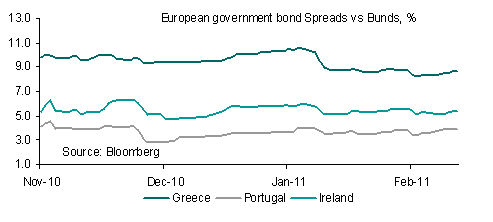
One theme that has been evident since the start of the year is an improvement in sentiment towards the eurozone periphery as hopes of an enlargement/extension of the European Union bailout fund (EFSF) have increased. This is a key reason why the EUR has strengthened this year although nervousness on this front appears to have returned over recent days (note the recent widening in peripheral bond spreads, drop in EUR and European Central Bank purchases of Portuguese debt). It seems that a lot of good news has already been discounted in relation to the eurozone periphery and now markets are in wait and see mode for the EU Council meeting on 24/25 March. There is a strong chance that eventually market expectations will prove overly optimistic and the EUR will drop but more on that later.

The second theme is global inflation concerns, driven by higher food and energy prices. Certainly this has had an impact on interest rate expectations and in some cases resulted in a hawkish shift in central bank language, notably in the eurozone and UK. Although European Central Bank (ECB) President Trichet has toned down his comments on tighter monetary policy compared to the more hawkish rhetoric following the last ECB council meeting, expectations for monetary tightening in the eurozone still look overly hawkish, with a policy rate hike currently being priced in for August/September this year, which looks way too early. The EUR has benefitted from the relative tightening in eurozone interest rate expectations compare to the US but will suffer if and when such expectations are wound down.

Elsewhere in many emerging markets the impact of higher food prices is finding its way even more quickly into higher inflation, forcing central banks to tighten policy. In Asia, the urgency for higher rates is even more significant given that real interest rates (taking into account inflation) are negative in many countries. China has accelerated the pace of its rate hikes over recent months and looks set to continue to tighten policy much further to combat inflation. In India, worries about inflation and the need for further monetary tightening have clearly weighed on equity markets, with more pain to come. Although not the sole cause by any means, in the Middle East and Africa higher food prices are feeding social tensions such as in Egypt.

Another clear theme that has developed is the improvement in US economic conditions. The run of US data over recent months has been encouraging, confirming that the economy is gaining momentum. Even the disappointing January non-farm payrolls report has not dashed hopes of recovery, with many other job market indicators pointing to strengthening job conditions such as the declining trend in weekly US jobless claims. Manufacturing, business and consumer confidence measures have strengthened whilst credit conditions are easing, albeit gradually. The US economy is set to outperform many other major economies this year, especially the eurozone, which will be beset with a diverging growth outlook between northern and southern Europe.

Although the US dollar has not yet benefitted from stronger US growth given the still dovish tone of the Fed and ongoing asset purchases in the form of quantitative easing, the rise in US bond yields relative to other countries, will likely propel the dollar higher over 2011 after a rocky start over Q1 2011. In contrast, the EUR at current levels looks too strong and as noted above, hopes of a resolution of eurozone peripheral problems look overdone. EUR/USD levels above 1.3500 provide attractive levels to short the currency. Other growth currencies that will likely continue to do well are commodity currencies such as AUD, NZD and CAD, whilst the outlook for Asian currencies remains positive even despite recent large scale capital outflows. The JPY however, will be one currency that suffers from an adverse yield differential with the US as US bond yields rise relative to Japan.

Econometer.org has been nominated in FXstreet.com’s Forex Best Awards 2011 in the “Best Fundamental Analysis” category. The survey is available at http://www.surveymonkey.com/s/fx_awards_2011