Fed discount rate move boosts dollar

The Fed’s move to hike the discount rate by 25bps has set the cat amongst the pigeons.   Although the move was signalled in the FOMC minutes yesterday a hike in the discount rate was not expected to happen so soon.  The Fed sees the modifications which also include reducing the typical maximum maturity for primary credit loans to overnight, as technical adjustments, rather than a signal of any change in monetary policy. 

Nonetheless, the market reaction has been sharp, with the USD strengthening across the board and short term interest rate and stock futures falling.  Although the reaction looks overdone and will likely be followed by some consolidation over the short term, the move will be interpreted as the beginning of a move towards monetary policy normalisation despite the Fed’s insistence that this is not the case.  The firm USD tone is set to remain in place for now but the bulk of the strengthening has likely already occurred following the announcement.  

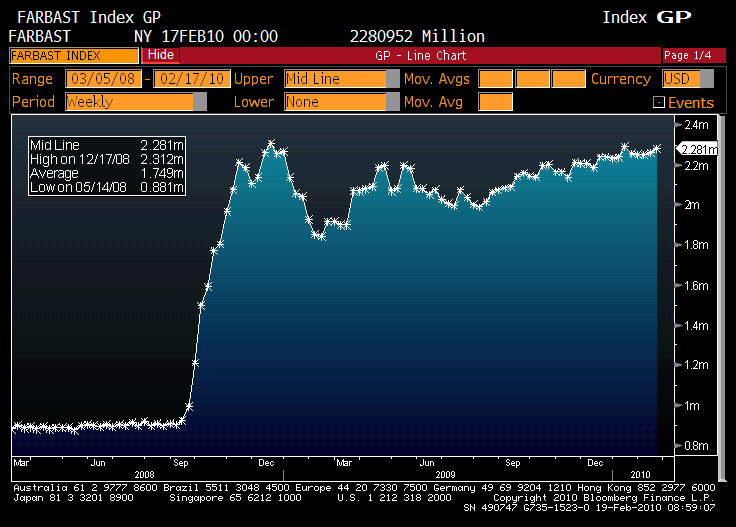
The Fed’s desire to reduce the size of its burgeoning balance sheet, which at $2.3 trillion is roughly around three times its size before the financial crisis began, will imply further measures to reduce USD liquidity over the coming months.   A withdrawal of liquidity could have positive implications for the USD but given that the Fed is still some months away from hiking the Fed Funds rate, interest rate differentials will not turn positive for the USD for a while yet. 

The move has however, changed the complexity of the FX market and likely shifted currencies into new lower ranges against the USD.  There were plenty of reasons to sell EUR even before the Fed move and the discount rate hike inflicted further damage on EUR/USD which dropped below the key psychological level of 1.35.  GBP and commodity currencies were also big losers, with GBP/USD below 1.55.  Key technical support levels to watch will be EUR/USD 1.3422, GBP/USD 1.5374 and AUD/USD 0.884.

US Federal Reserve Balance Sheet ($trillion)
Is the Fed trying to support the dollar?

Did Fed Chairman Bernanke really provide any real support to the dollar when he said at the Board of Governors conference on Thursday that the Fed will be prepared to tighten monetary policy when the outlook for the economy “has improved sufficiently”. Various newswires report that these comments have given the dollar some relief but the reality is that Bernanke only stated the obvious. Of course the Fed has to raise interest rates at some point and most likely this will be when the economic recovery looks sustainable. There is indication when this point in time will be, however.

In fact there was unsurprisingly no sign from Bernanke that the Fed was preparing to raise rates any time soon. As was noted in the September 23 Fed FOMC statement Bernanke reiterated that the Fed “believe that accommodative policies will likely be warranted for an extended period”. An extended period could mean at the least some months but even years and this is no exaggeration.

In 2001 the Fed did not begin to hike rates until around 2 ½ years after the end of the recession whilst in 1990-91 rates did not go up until close to 3 years after recession ended. Arguably this recession was worse in terms of depth and breadth suggesting that it will take a long time before the Fed even contemplates reversing policy. In any case the first step is to reduce the size of the Fed’s balance sheet.

Admittedly there has been some suggestions from other Fed members that when interest rates are raised it may be done “with greater force” as stated by Fed Governor Warsh recently but others such as NY Fed President Dudley have said that the pace of recovery “is not likely to be robust”, suggesting a more cautious tone and also highlighting that there is some debate within the Fed about the timing of exit strategies and raising interest rates.

There is no doubt that some Fed members are becoming more nervous about holding policy at such an accommodative level but it could still be several months before policy is reversed given the massive excess capacity in the product and labour markets and benign outlook for inflation. Judging by past history markets have little to be nervous about in terms of an early rate hike.

For the dollar this is bad news and as noted in my previous post the dollar will suffer from a growing yield disadvantage as other countries raise interest rates ahead of the Fed. The dollar may have benefited from some short covering at the end of the week and this could have been provoked by Bernanke’s comments but if so, the dollar’s gains are likely to be short-lived as investors take the opportunity of better levels to take short positions in the currency.