Japanese FX Intervention

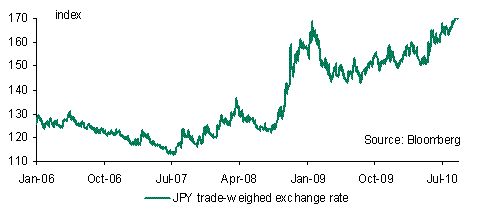
The Bank of Japan acting on the behest of the Ministry of Finance intervened to weaken the JPY, the first such action since 2004. The intervention came as the USD was under broad based pressure, with the USD index dropping below its 200-day moving average. USD/JPY dropped to a low of around 82.88 before Japan intervened to weaken the JPY. The move follows weeks of verbal intervention by the Japanese authorities and came on the heels of the DPJ leadership election in which Prime Minister Kan retained his leadership.

One thing is for certain that Japanese exporters had become increasingly concerned, pained and vocal about JPY strength at a time when export momentum was waning. However, the move in USD/JPY may simply provide many local corporates with better levels to hedge their exposures.

Time will tell whether the intervention succeeds in engineering a sustainable weakening in the JPY but more likely it will only result in smoothing the drop in USD/JPY over coming months along the lines of what has happened with the SNB interventions in EUR/CHF. As many central banks have seen in the past successful intervention is usually helped if the market is turning and in this case USD/JPY remains on a downward trajectory.

Although the BoJ Governor Shirakawa said that the action should “contribute to a stable foreign exchange-rate formation” it is far from clear that the BoJ favoured FX intervention. Indeed, the view from the BoJ is that the move in USD/JPY is related less to Japanese fundamentals but more to US problems.

Now that the door is open, further intervention is likely over coming days and weeks but for it to be effective it will require 1) doubts about US growth to recede, 2) speculation of Fed QE 2 to dissipate, 3) and consequently interest rate differentials, in particular bond yields between the US and Japan to widen in favour of the USD. This is unlikely to happen quickly, especially given continued speculation of further US quantitative easing. A final prerequisite to a higher USD/JPY which is related to the easing of some of the above concerns is for there to be an improvement in risk appetite as any increase in risk aversion continues to result in JPY buying.

When viewed from the perspective of Asian currencies the Japanese intervention has put Japan in line with other Asian central banks which have been intervening to weaken their currencies. However, Asian central bank intervention has merely slowed the appreciation in regional currencies, and Japan may have to be satisfied with a similar result. Japan’s intervention may however, give impetus to Asian central banks to intervene more aggressively but the result will be the same, i.e. slowing rather then stemming appreciation.

As for the JPY a further strengthening, with a move to around 80.00 is likely by year end despite the more aggressive intervention stance. Over the short term there will at least be much greater two-way risk, which will keep market nervous, especially if as is likely Japan follows up with further interventions. USD/JPY could test resistance around 85.23, and then 85.92 soon but eventually markets may call Japan’s bluff and the intervention may just end up putting a red flag in front of currency markets to challenge.
US Dollar Tensions

There was considerable relief, most acutely in the US administration, that the US August jobs report revealed a better than expected outcome. To recap, private sector payrolls increased by 67k vs. an upwardly revised 107k in July whilst total non farm payrolls dropped 54k. The data sets the market up for a positive start to the week in terms of risk appetite despite Friday’s drop in the August US non-manufacturing ISM index, deflating some of the market’s upbeat mood.

Once again I wonder how long positive sentiment can be sustained with so many doubts about recovery prospects and limited ammunition on the fiscal front as well as some reluctance on the monetary front, to provide further stimulus should a double dip become a reality.

Markets will be treated to several major central bank decisions including from the Bank of Japan, Bank of England, Bank of Canada and Reserve Bank of Australia this week. These meetings are set to prove uneventful, with unchanged decisions across the board expected although the Bank of Canada decision is a tough call.

The main US release this week is the Fed’s Beige Book on Wednesday, a report which will help the Fed to prepare for the FOMC meeting on September 21. The evidence contained within it is unlikely to be positive reading, with consumer spending set to be relatively soft and evidence of recovery likely to remain patchy.

On Thursday the US July trade deficit is set to reveal some narrowing and as usual the deficit with China will be of interest given the renewed tensions over FX policy. FX tension seems to be intensifying once again due to the relatively slow pace of CNY appreciation since the June de-pegging as well as political posturing ahead of November US mid-term elections. A deterioration in US trade data, a factor that largely contributed to the soft Q2 GDP outcome in contrast to a strengthening in China’s trade surplus will have added fuel to the fire.

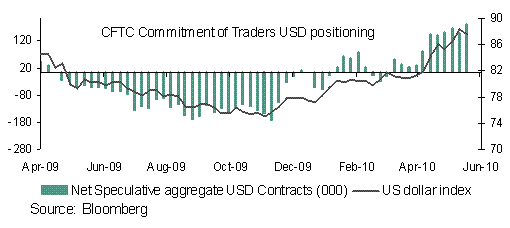
The firmer risk backdrop has put the USD on the back foot, with the USD index dropping sharply overnight. Nonetheless, speculative USD positioning as reflected in the CFTC IMM data reveals further short covering up to the end of August, implying USD speculative sentiment is actually turning less negative.

Another country which has a different sort of tension regarding the USD is Japan. Improving risk appetite will likely prevent the JPY from visiting previous highs against the USD but will do little to reduce FX intervention speculation. Indeed, there was more jawboning over the weekend on the subject, with Japan’s finance minister Noda reiterating that Japan would take decisive action to stem the JPY’s appreciation but adding that coordinated FX intervention was a difficult option. Clearly Japan us unlikely to succeed with unilateral FX intervention.

Political events have added to the debate on FX policy as focus turns to the election for leader of the ruling DPJ party next week, with a battle looming between current Prime Minister Kan and challenger Ozawa. Although Ozawa is unpopular with the electorate he yields plenty of political power, and appea rs to be more inclined towards FX intervention. Having failed to sustain a move above 85.00 the pull back in USD/JPY suggests little appetite to extend gains, likely leaving USD/JPY in a relatively tight range, with strong support around 83.55 and resistance around 85.23.

Stressing About European Stress Tests

Equities and risk appetite were bolstered by the relative success of the Spanish bond auction on Thursday. The results of the auction in which Spain sold EUR 3 billion in 10 year notes helped to stem some of the pressure on eurozone bond spreads, which despite the generalized improvement in market sentiment over recent days, had been continuing to widen.

Another key indicator that has been suggested that all is not well moving in the opposite direction to the improvement in many risk indicators is the Baltic Dry Index which has dropped by around a third since 26th May 2010.

Perhaps more significant in terms of providing sustainable support for markets was the news that the European Union agreed to publish the results of bank stress tests, slated for the second half of July. This could turn out to be a key stepping stone towards increasing the transparency of the eurozone banking sector.

However, doubts will remain until there is some clarity on the terms of the tests such as whether they include details of sovereign debt exposure. Also, if the stress tests reveal shortcomings in the banks in question it is unclear if government funding will be provided for them. Although the publishing of stress test results is a step in the right direction until these and other questions are answered it is difficult to see markets getting too excited.

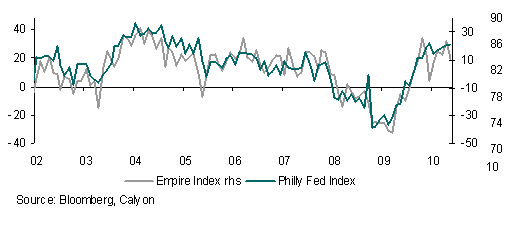
It’s not all plain sailing for equity markets despite the relatively positive news in Europe as disappointing US data in the form of a surprise jump in weekly jobless claims and a bigger than expected drop in the June Philly Fed survey weighed in on the side of those expecting both a slow and jobless recovery in the US.

The CHF has been a key mover following the Swiss National Bank policy decision. The decision to leave interest rates unchanged was no surprise, but the change in rhetoric towards a less aggressive stance towards CHF strength opens up the floodgates for CHF buyers. will look to test its all time low around 1.3720.

Another central bank that has shown concern about a strengthening currency is the Bank of Japan but unlike the SNB Japan’s central bank has not intervened for several years. The BoJ in the minutes of its May meeting noted that it will “watch if Europe’s crisis strengthens JPY”, indicating some concern about JPY strength.

This sentiment that was echoed by the Japanese government in the release of Economic Growth Strategy aimed at avoiding an excessive rise in the JPY via fiscal and monetary steps to beat deflation. The JPY barely reacted to both the minutes and the growth strategy, with market players likely sceptical until concrete measures are actually implemented.

It still look like an environment of sell on rallies for the EUR and other risk currencies, with their gains likely to run out of steam over coming days. The next key technical level for EUR/USD is around 1.2454, a level that will prove a tough nut to crack.

World Cup FX Positioning/Data Highlights

The market tone felt decidedly better over the course of the last week although it was difficult to tell if this was due to position squaring ahead of the World Cup football or a genuine improvement in sentiment. There was no particular event or data release that acted as a catalyst either, with the European Central Bank (ECB) and Bank of England (BoE) meetings passing with little fanfare.

US data ended the week mixed, with retail sales disappointing in May but in contrast June consumer confidence beating expectations. Although questions about the pace of recovery remain, other data such as the Fed’s Beige Book suggest that recovery remains on track, sentiment echoed, albeit cautiously by Fed Chairman Bernanke last week.

Attention this week will centre on inflation data. Expected benign CPI readings will support the view that the Fed will take its time to raise interest rates. Speeches by the Fed’s Bullard, Plosser and Bernanke this week will be eyed for further clues on Fed thinking.

Central banks in Brazil and New Zealand hiked rates last week but this is not likely to be echoed this week. No change is likely from both the Bank of Japan and Swiss National Bank although there will be plenty of attention on the SNB’s comments on the CHF following recent data showing a surge in FX reserves due to currency intervention. The BoJ is unlikely to announce anything new but perhaps some further detail on the loan support plan could be forthcoming.

Manufacturing data will also garner some attention, with the US June Empire and Philly Fed surveys and May industrial production on tap. All three reports will confirm the improving trend in manufacturing activity in the US. Housing data will look weaker, with starts set to pull back in starts in May following the expiry of government tax incentive programmes though permits are set to rise.

In Europe, the June German ZEW (econ sentiment) investor sentiment survey will likely slip slightly due to ongoing fiscal/debt worries but this will be countered by stronger domestic data. In any case the index remains at a high level and a slight drop is unlikely to derail markets.

GBP may find some support form upgrade of UK growth forecasts by the CBI to 1.3% for 2010 and relatively hawkish comments from the BoE’s Sentance in the weekend press warning that inflation is higher than expected, indicating that the Bank may need to hike rates sooner than expected.

Further GBP/USD direction will come from CPI and retail sales data this week as well as public borrowing figures and a report by the new Office of Budget Responsibility on the UK’s fiscal position ahead of the June 22 budget. A break above GBP/USD resistance around 1.4760 is unlikely to materialise.

Despite the many data releases this week, the overall tone is likely to be one of consolidation and reduced volatility in the days ahead. This may allow EUR/USD to gain some ground due to short covering, with the CFTC commitment of traders (IMM) report revealing a further increase in net short speculative positions last week, close to the record set a few weeks back, though we suspect that there will be strong resistance around 1.2227.

The fact that the IMM data revealed that net aggregate net USD long positions reached an all time high last week, highlights the potential for profit taking this week. USD/JPY will look to take out resistance around 92.55 but this looks unlikely unless the BoJ dishes up anything particularly dovish from its meeting.

Will the ECB intervene to support the Euro? (Part 2)

Click here to read Part 1

The last official intervention by the European Central Bank (ECB) in the currency markets took place in November 2000 and at the time the Bank stated that “the external value of the EUR does not reflect the favourable conditions of the euro area”. The ECB also noted the impact of a weaker EUR on price stability, with inflation at the time running above the ECB’s 2% threshold. This followed intervention a couple of months earlier in September 2000 when the ECB jointly intervened with the US Federal Reserve, Bank of Japan and other central banks in a concerted manner due to “shared concerns about the potential implications of recent movements in the euro exchange rate for the world economy”.

Conditions in the euro area could hardly be described as favourable at present, suggesting that this rationale would be very unlikely to be used to justify intervention. Conversely, a weaker EUR may actually contribute to making conditions in the eurozone more favourable. The rationale used for the September 2000 intervention holds more sway in the current environment. Nonetheless, the move in the EUR is very unlikely to do any serious damage to the world economy even if some Japanese exporters are suffering.

In the past the ECB has given various verbal warnings about the volatility of the EUR being too high, and this could potentially be utilized as rationale for FX intervention. However, implied volatility in EUR/USD is not particularly high when compared to the levels it reached during the recent financial crisis. Currently 3-month implied volatility is at its highest level since June 2009 but well below the peak in volatility recorded in December 2008. Clearly if EUR/USD volatility continues to rise there will be a greater cause for concern but at current levels the ECB is unlikely to even crank up verbal intervention let alone actual FX intervention.

One of the main benefits of the decline in the EUR is the support that it will provide to the eurozone economy. At a time when growth in Europe is slowing EUR weakness will be particularly welcome. Germany and other countries in Northern Europe will be major beneficiaries of EUR weakness given their export dependence. Given such benefits and the currently limited risks to inflation, the ECB is highly unlikely to intervene to strengthen the EUR.

Given the current very negative mood in the market, officials in Europe would do better to rectify some of the structural issues that markets are concerned about. This may provoke a more sustainable rally in the EUR but until there are concrete signs of progress on the fiscal front sentiment towards the EUR will remain negative. Against this background FX intervention to prop up the EUR would face more of a risk of failure, and in turn damage to the credibility of the ECB. This is perhaps as good a reason as any not to expect intervention.