Risk appetite remains fragile

The stabilisation in risk appetite over recent days looks highly fragile and markets will look to upcoming events in Europe and data releases to determine whether a rally in risk assets is justified. Discussions over the weekend between German Chancellor Merkel and French President Sarkozy delivered little in substance apart from a promise that a concrete response to the crisis will be delivered by the end of the month ahead of the 3 November G20 summit.

Both leaders agreed on the need for European banking sector recapitalisation and this issue along with whether or how to leverage the EFSF bailout fund and the extent of private sector participation in any Greek bailout is likely to take growing prominence for markets over coming weeks ahead of the EU summit on 17-18 October. In the meantime, markets may give Eurozone officials the benefit of the doubt but patience will run thin if no progress is made on these fronts.

The US jobs report at the end of last week which revealed a bigger than expected 103k increase in payrolls and upward revisions to previous months will have helped to allay fears about a renewed recession in the US and global economy. Indeed, recent surveys reveal that analysts expected weak US growth rather than recession. This week’s data will help to shore up such expectations with US data including retail sales and consumer confidence likely to outshine European data, including likely declines in industrial production in the region.

Overall, this will help to buoy risk appetite which may leave the USD with less of a safe haven bid but at the same time it will also reduce expectations of more quantitative easing (QE3) in the US, something that will bode well for the USD. Markets are set to begin the week in relatively positive mood but we remain cautious about the ability of risk appetite to be sustained. On balance, firmer risk appetite will play negatively for the USD early in the week but any drop in the USD will be limited by the fragility of risk appetite and potential for risk aversion to intensify again.
Switching risk on and off

There are several words that can be used to describe current highly risk averse market dynamics including panicked, nervous, fickle, tense, jittery, risky, volatile etc, all of which spark negative thoughts in the minds of investors. Aside from real worries such as renewed banking sector concerns, especially in Europe and in particular with regard to Spanish savings banks, there are also plenty of rumours afflicting market sentiment. In this environment deriving fact from fiction is not particularly easy whilst battling against the heavy weight of negative sentiment.

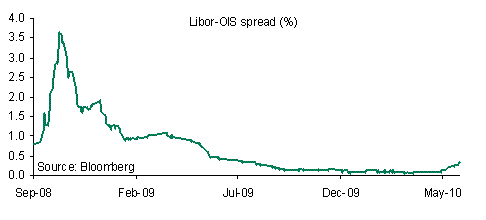
Although the pull back in risk appetite over recent weeks looks small compared to the peak in risk aversion during the financial crisis, the pace of the drop in markets has been dramatic and the withdrawal of risk seeking capital has been particularly aggressive. For example, in less than one month Asian equity markets have registered an outflow of around half of the total equity capital flows so far this year. Worryingly and despite the backstop in terms of central bank liquidity provision there are signs of renewed tensions in the money markets, with the libor-OIS spread and TED spread widening over recent days.

One of the most interesting observations in the current environment is that risk aversion has been increasing despite encouraging economic data. Not only has economic data been positive but in general has been coming in above consensus, showing that the market has underestimated the bounce in growth in the second quarter. Why is positive data not soliciting a more positive market reaction? Recent data is perhaps being seen as backward looking, and there is growing concern about the likely downdraft on economic activity in H2 2010, especially in Europe as deficit cutting measures bite.

News on the budget front in Europe has been relatively positive too, with Greece registering a sharp decline in its deficit, as well as announcing plans to tighten tax administration procedures. Meanwhile, the Italian cabinet reportedly approved a package of measures to reduce its deficit. On the flip side budget cuts across Europe are leading to growing public opposition, testing the resolve of eurozone governments to pass austerity measures. The public opposition means that the real test is in the implementation and execution of austerity measures. Signs of progress on this front will be key to turn confidence in the EUR around.

The USD remains king in the current environment and any pull back is likely to be bought into though Moody’s ratings agency’s warnings that the US AAA sovereign rating may come under pressure if there was no improvement in the US fiscal position, highlights the risks over the medium term to this currency. The EUR is set to remain under pressure though it is worth noting that the pace of its decline appears to be slowing, leaving open the potential for some consolidation. Near-term technical support for EUR/USD is seen at 1.2142 but a broader range of around 1.18.23-1.2520 is likely to develop over coming weeks.

Q1 Economic Review: Elections, Recovery and Underemployment

I was recently interview by Sital Ruparelia for his website dedicated to “Career & Talent Management Solutions“, on my views on Q1 Economic Review: Elections, Recovery and Underemployment.

Sital is a regular guest on BBC Radio offering career advice and job search tips to listeners. Being a regular contributor and specialist for several leading on line resources including eFinancial Careers and Career Hub (voted number 1 blog by ‘HR World’), Sital’s career advice has also been featured in BusinessWeek online.

As you’ll see from the transcript of the interview below, I’m still cautiously optimistic about the prospects for 2010 and predicts a slow drawn out recovery with plenty of hiccups along the way.

Sital: Mitul, when we spoke in December to look at your predictions for 2010, you were cautiously optimistic about economic recovery in 2010. What’s your take on things after the first quarter?

Click here to read the rest…