The Dust Settles

As the dust settles on the massive “shock and awe” package announced over the weekend it is become painfully apparent that markets are not at all convinced that underlying issues surrounding Europe’s woes are on the path to being resolved. Undoubtedly the EUR 750 billion provided by the European Union (EU) and International Monetary Fund (IMF) will go a long way towards fixing the symptoms of the crisis but it will take a lot more action to convince markets that the measures to cut budget deficits, improve productivity and enact structural reforms are being carried out.

As a result of ongoing skepticism EUR/USD dropped to its lowest level since March 2009. The currency pair shows little sign of turning around and over the short-term EUR/USD is likely to test its 2010 low around 1.2510. Market positioning remains heavily short EUR suggesting some scope for short covering but any rebound in EUR/USD is being met with plenty of sellers and the upside is likely to be restricted to around 1.2885.

The size of the EU/IMF package means that financing issues for eurozone peripheral countries will not be a major concern and spreads are likely to continue to narrow against core debt. However, attention has turned to the next step in the process, in particular the path of fiscal consolidation necessary in the months ahead and the negative impact on the economies in Europe that this will entail. As US Fed Chairman Bernanke noted, the package from the EU/IMF is “not a panacea”.

Overall, the measures may have cheapened the long term value of the EUR rather than boost it as it has highlighted the many problems in having a single currency to encompass a wide variety of countries. The stark reality in having differing fiscal policies across the euro region whilst maintaining a single monetary policy has proven to be highly problematic.

At least for now, the economic data in the eurozone is providing some support, though it is questionable how long this will continue. Eurozone GDP grew by 0.2% in the first quarter of 2010 compared to the previous quarter, which was stronger than expected and growth in the second quarter actually looks like it will have picked up from this pace based on the indications from recent monthly data.

Further out, the real damage will begin and in particular economic activity in southern European countries will slow sharply even as the German economy remains resilient due to relatively strong export performance. Deficit cutting measures in Portugal, Spain and Italy will begin to bite into growth later this year and into 2011. The weakness in growth in Europe relative to the US economy, which is likely to perform relaitvely better, will provide further rationale to sell EUR/USD, though at some point markets may just shift their attention back to the burgeoning US fiscal deficit.
Shaping up to be a “risk on” week

It’s most definitely turning into a “risk on” week. On the earnings front both JP Morgan Chase and Intel beat forecasts whilst data releases did not disappoint either. In particular, US retail sales came in much stronger than expected. The Fed’s Beige Book also gave markets some good news to chew on. The reports from the twelve Federal Reserve Districts noted that economic activity “increased somewhat” since the March 3rd report.

The positive tone will continue today with the release of the March industrial production data, expected to show a strong gain over the month (consensus 0.7%), whilst both the Empire State and Philly Fed manufacturing surveys are set to post small gains in April, consistent with strengthening manufacturing activity in the months ahead.

Fed speakers have also been helpful for market sentiment. Fed Chairman Bernanke sounded a little more upbeat on the economy but highlighted the “significant restraints” remaining in the US economy. Bernanke maintained the “extended period” of low rates statement despite some speculation that the Fed was verging on removing this. The net impact of the testimony, improved data and earnings and firmer risk appetite is to keep the USD on pressure. In contrast, commodity currencies including AUD, NZD and CAD, will benefit, both from firmer risk appetite and an upturn in commodity prices.

Despite the positive reception to Greece’s debt auction there is not a lot of faith in the ability of Greece to weather the storm. Reports that Greece will need far more funding than has been initially promised by the EU/IMF – potentially as high as EUR 90 billion over coming years – together with worries about selling the loan package to the public in Germany and other eurozone countries, as well EU comments that Portugal will need further fiscal consolidation, have not done much good for confidence. Technically EUR/USD will see plenty of resistance around 1.3692.

After Singapore’s move to tighten monetary policy via the SGD revaluation, and following close on the heels of India, Malaysia and Vietnam, attention has turned to who’s next in line. South Korea must be a prime candidate, especially following data yesterday revealing a drop in the unemployment rate. Of course, China is very much in the spotlight and is set to embark on monetary tightening measures as well as CNY revaluation soon.

India is set to move again as early as next week, with inflation data today likely to seal the case for another hike (consensus 10.37% in March). The risk remains however, that many Asian central banks are moving too slowly to curb building inflation pressures and may find that they ultimately need to tighten more than they otherwise would have done.

China’s heavy slate of data released will if anything fuel greater expectations of an imminent CNY revaluation as well as monetary tightening. China’s economy grew a very strong 11.9% in Q1, above already strong consensus expectations, whilst CPI rose 2.4% YoY in March.

The growth data alongside further evidence of accelerating real estate prices highlight the risks of overheating in the economy and the need to act quickly to curb inflation threats. Given this expectation, firm risk appetite, and more follow through from Singapore’s FX move, the outlook for other Asian currencies remains positive.

Risk Appetite Puts Dollar On The Back Foot

Markets look somewhat calmer going into this week helped by comments by Fed members who noted that the discount rate hike did not signal a shift in monetary policy, something which is likely to be repeated by Fed Chairman Bernanke in his testimony to Congress on Wednesday and Thursday.  A tame US January CPI report last Friday helped too, giving further support to the view that the Fed will not hike the Fed Funds rate for some time yet; a rate hike this year seems highly unlikely in my view.  

Data this week will be conducive to a further improvement in risk appetite and despite the lingering concerns about Greece the EUR may find itself in a position to extend gains.  In Europe all eyes will be on the February German IFO survey and eurozone sentiment indicators, which following the surprising strength in the manufacturing Purchasing Managers Indices (PMIs), are likely to reveal solid gains. 

The main highlights in Japan this week includes January trade data and industrial production. The trade numbers will be particularly important to determine whether the rebound in exports due in large part to robust Asian demand, has continued whilst the bounce back in exports will be a key factor in fuelling a further gain in industrial output. 

In the US aside from the testimonies by Fed Chairman Bernanke there are plenty of releases on tap including consumer confidence, new and existing home sales, durable goods orders and a likely upward revision to Q4 GDP.  For the most part the data will show improvement and play for a further improvement in risk appetite. 

FX direction will depend on whether markets focus on the potentially positive USD impact of a reduction in USD liquidity or on the likely firmer tone to risk appetite this week.  Given expectations of firmer data and the soothing tone of the Fed, risk currencies will likely perform better, with crosses such as AUD/JPY favoured.  The USD will likely be placed on the back foot, especially given the very long market positioning in the currency.

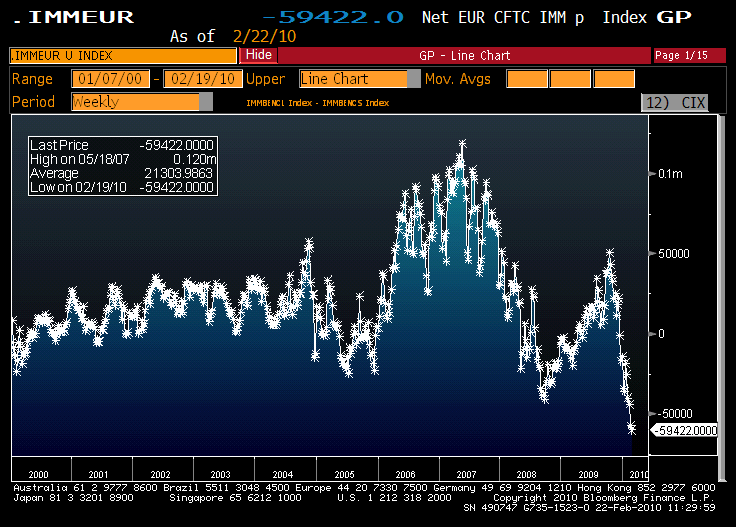
The EUR will be helped by the fact that speculative market, according to the CFTC IMM data, holds record short positions in the EUR (as of the week ended 16 February) giving plenty of potential for short-covering.   The more timely Tokyo Financial Exchange (TFX) data also reveals that positioning in EUR/JPY has continued to be scaled back.  

CFTC Commitment of Traders (IMM) data – Net EUR speculative positioning

EUR/USD bounced smartly from its lows around 1.3444 on Friday, partly reflecting some short covering and the drop in FX volatility suggests the market is more comfortable with EUR/USD around these levels.  A positive IFO survey and improved risk appetite could see EUR/USD test resistance around 1.3774, its 20 day moving average, over coming days.  Ongoing Greek concerns suggest that any EUR bounce will be limited, however. 

USD/JPY looks well supported and although data this week will suggest that exports are improving despite JPY strength, the relatively more aggressive stance of the Fed compared to the BoJ, long JPY positioning, and improved risk appetite, give plenty of scope for the JPY to extend losses, with technical USD/JPY support seen around 91.28.

Calming the Tiger

As markets enter the year of the Tiger a somewhat calmer tone appears to be ensuing, with risk appetite edging higher helping equities and the beleaguered EUR to recover some lost ground.  US stocks were helped by a firmer than expected reading for the Empire manufacturing survey (to 24.91 in Feb) and a slight uptick in the US NAHB (National Association of Home Builders) index (to 17 in Feb) but consumer confidence remained weak as indicated by the decline in the weekly reading of ABC Consumer Confidence (-49).  

On the other side of the pond the better than expected February ZEW survey (a survey of investor confidence) in Germany (45.1) helped sentiment although it still recorded a decline from the previous month as Greek fiscal/debt concerns weighed on financial market participants’ confidence.  The bigger impetus came from comments by Greek Finance Minister Papaconstantinou who said there would be no need to for a bailout of the country.

Tensions over Greece eased further following news that tax collectors in the country called off a planned strike, helping to allay some concerns that unions will block planned spending cuts.   On the policy front, the EU Council ratified Greece’s plans but with strings attached, giving the country one month to present a report on the timetable for implementing budget cuts for 2010 and three months to outline policy measures required to cut the deficit below 3% by 2012.

Meanwhile, commodity prices have pushed higher helping currencies such as the AUD and NZD to strengthen.  Moreover, the AUD was boosted by more hawkish interest rate expectations following the release of the minutes of the latest RBA policy meeting which indicated that the Reserve Bank was merely pausing in its rate cycle.  Expectations of a rate hike in March increased as a result.

Overall, the recent rally in the USD is looking increasingly overdone and some reversal is likely over coming weeks.  The fact that market positioning has reached extreme levels in particular in the case of the EUR highlights scope for some recovery in the currency, especially now that the worst case scenario of a Greek default has passed.  The outlook for commodity currencies is even more bullish as risk appetite improves further.     

If anything, data today is likely to give further support to the recovery story, with US industrial production and housing starts expected to post healthy gains.  The Fed FOMC minutes may offer some additional insight into the debate over the implementation of exit strategies but there is unlikely to be much elaboration from the recent comments by Fed Chairman Bernanke in his speech to the US Senate in which he hinted that a rise in the discount rate is not far off.  

Risk currencies including many Asian currencies are likely to benefit from the improvement in risk appetite over the short term.  EUR/USD will likely strengthen as more short positions are covered but will face strong technical resistance around 1.3839.   Asian currencies have been resilient to the recent rise in risk aversion and this is likely to continue over the coming weeks.  As risk appetite recovers currency plays including long AUD/JPY , and even some further upside in EUR/USD look favourable.

PIIGS fears fuelling risk aversion

Risk aversion has come back with a vengeance over the last 10 days driven by a host of concerns that continue to damage market sentiment. As has been evident over the past year the USD and JPY remain the best currency plays against the background of rising risk aversion and both currencies look well supported.

Market concerns are not going away quickly but some of the fears plaguing markets have at least receded especially on the US political front, with Obama’s State of the Union address, Geithner’s testimony on AIG and Bernanke’s reappointment all passing without too much incident, at least from a market perspective. I still believe that market fears are overblown but it is clearly evident that the market is not in the mood to concur. More pain is likely in the weeks ahead.

Euro-sovereign spreads continue to suffer from the ongoing Greek saga whilst the other major fear remains further monetary tightening in China. Rumours that China is about to imminently revalue the CNY are also running rife. The bigger than expected hike in the reserve ratio in India reflects the fact that Asia is on a faster track to tighten policy than Western economies.

As regular readers probably noticed, my articles on econometer.org have been sporadic recently. This is due to the fact that I have been on the road for the last two weeks giving client seminars across several countries in Asia. Without giving too much away it is evident that pessimism is pervasive and most investors I polled are looking for a “W” or “double dip” profile for economic growth in the G7 economies over coming months. Hardly anyone looked for a “V”.

The other casualty emanating from Greece’s woes, as well as worries that other European PIIGS (Portugal, Italy, Ireland, Greece, Spain) face ratings downgrades, is the EUR. EUR/USD slipped below the psychologically important level of 1.40 this week and is showing no sign of turning around. Warnings by S&P ratings that Portugal faces challenges on the fiscal front show that these sovereign concerns will be with us for a long while yet.

After letting investors believe that the European Commission would offer no support for Greece, there appears to be a growing realization that Greece is not simply a local problem but a Euro wide problem, as noted by European Commission President Barroso. Whilst this may be good for Greek debt the path to recovery is still likely to be a massively painful one, and the EUR may gain little support from this news.

The UK has not escaped the clutches of ratings agencies and warnings by S&P that UK banks are no longer among the “most stable and low-risk” in the world highlights the headwinds faced by GBP at present. The weaker than expected out-turn for Q4 GDP (0.1%) highlights the fact that UK economic recovery is fragile, which in turn plays negatively for the banking sector. This news has put a break on GBP but there appears to be plenty of demand for GBP above 1.600 vs USD.