EUR slides as summit hopes fade

Any boost to confidence following the recent EU Summit is fading fast. Policy easing from the European Central Bank, Bank of England, and PBoC in China, have done little to turn things around. Moreover, the weaker than expected US June jobs report has added to the calls for the Federal Reserve to inject more monetary stimulus via another round of quantitative easing but this is unlikely anytime soon.

Admittedly the jobs data which reported an 80k increase in payrolls and unemployment rate remaining at 8.2%, was disappointing but it was not weak enough to trigger imminent Fed action. Congressional testimony by Fed Chairman Bernanke on July 17 and 18 will provide the next key clues to whether the Fed is moving closer to more QE.

This leaves markets in a miserable state of being. It was hoped that the recent EU Summit would provide much needed breathing space and relief to Eurozone peripheral bond markets. However, renewed policy implementation doubts, concerns that the Summit did not go far enough and opposition from Finland and the Netherlands who appear to have taken an even tougher stance than Germany, have resulted in Spanish and Italian bonds facing significant pressure once again with yields higher than pre summit levels.

A delay in the ESM permanent bailout fund, timing of the setting up of a banking supervisory authority and doubts about the size of the bailout fund given that the ECB appears to have ruled out a banking license as a means of leveraging up the ESM, are just a few of the concerns afflicting markets. Meanwhile, added to this list is the fact that Greece’s next bailout tranche has been delayed to mid September. Many of these issues as well as the bailout of Spanish banks will be discussed at today’s Ecofin meeting but the chances of much progress remain limited.

The EUR which is of course not uncrorrelated with peripheral bond yields has itself fallen sharply. Thin trading conditions have helped to exacerbate the drop in the EUR while the realisation that the EU summit has been no game changer is increasingly weighing on the currency. I had thought that the Summit may have helped to at least provide a floor under the EUR but this now looks like a case of misplaced optimism.

The only supportive factor for the currency is that it looks heavily oversold, with market positioning extremely short. However, if a break below the 2012 EUR/USD low around 1.2288 can be sustained markets will quickly latch onto 1.20 as the next target. Given the lack of major events or data releases over coming days there looks like little to offer the EUR any support.
US dollar could stall as QE hopes rise

Growth concerns are increasingly accompanying Eurozone tensions as major weights on market sentiment. US jobs data at the end of last week which revealed a disappointing 69k increase May payrolls added to other data including weaker than expected Chinese purchasing managers index (PMI) and even more disappointing Eurozone data highlighting intensifying downside risks to economic activity.

Combined with the lack of traction towards solutions to the Eurozone crisis it has led to an acceleration in the demand for safe haven assets. The weak US data has also reopened the debate about more US quantitative easing, with Fed Chairman Bernanke’s congressional testimony on the economic outlook on Thursday likely to garner plenty of attention.

Another central bank under pressure to act is the European Central Bank (ECB) but action such as restarting its Securities Market Purchases program and/or a third Long Term LTRO are unlikely to take place at least until after the Greek election on June 17 if at all. Until then investors will have to put up with more procrastination, prevarication and inaction from policy makers in Europe as the ECB continues its game of chess with European politicians.

Other central banks in focus this week include the Reserve Bank of India (RBA) and Bank of England (BoE) but while the ECB may still cut policy interest rates this week it is not obvious that the other central banks will follow suit despite growing pressure for easier policy. Against this background risk measures will remain highly elevated while core bond yields will remain suppressed and the USD will remain on the front foot.

The weaker than forecast US May jobs report has really set the cat among the pigeons. The prospects of more Fed quantitative easing is firmly back on the table and while Fed Chairman Bernanke is unlikely to countenance such action in his testimony this week, the market will still speculate on this option. Consequently the USDs one way bet is not longer so clear cut despite the elevated level of risk aversion providing some support for the currency.

Ahead of Bernanke’s testimony on Thursday the USD will struggle to make too much headway leaving the currency to consolidate its gains in the short term. Other US data releases this week are inconsequential for FX markets although the Fed’s Beige Book will be watched for clues ahead of the Fed’s 19-20 June FOMC meeting.

EUR/USD is well off its lows and will consolidate ahead of Thursday’s ECB meeting. Event risk is high and various rumours have resulted in a cautious tone for EUR bears. Talk of a ‘secret master plan’ consisting of structural reforms, banking union, fiscal union and political union to save the EUR as well as of the ECB buying sovereign bonds will keep markets wary of aggressively selling EUR from current levels. Attention is centred on Spain and its banking sector and debate about the country is next in line for a bailout.

Worries about Spain and of course the outcome of Greek elections on June 17 will limit any bounce in the EUR. Nonetheless, speculative positioning in EUR/USD reached another all time low in the latest week according to the CFTC IMM data, suggesting that scope for short covering is growing. EUR/USD will find technical support around its 2012 low around 1.2287 while upside potential will be restricted to resistance around 1.2505.

JPY pullback risks, GBP to slip versus USD

A combination of market friendly comments by Fed Chairman Bernanke, a better than expected outcome for the German IFO business confidence survey in March and hopes of a bolstering of the Eurozone bailout fund, have managed to lift risk assets while pressuring the USD. Markets appear to have shaken off, at least for now, growth worries emanating from weaker manufacturing confidence surveys in China and Europe last week.

Nonetheless, while Bernanke maintained that accommodative monetary policy is still required especially given concerns about the jobs market, he did not hint at more quantitative easing, suggesting that market optimism may be tempered in the days ahead. Data and events today include US and French consumer confidence as well as bill auctions in Spain and Italy. US consumer confidence is likely to slip slightly while the bill auctions are likely to be well received.

While I remain bearish on the JPY in the medium term (beyond 1 month), over the near term I believe there is scope for a pull back. The move in USD/JPY has gone beyond what would be expected by the shift in relative yields. This is corroborated by my short term quantitative model which shows that USD/JPY should be trading around 80.

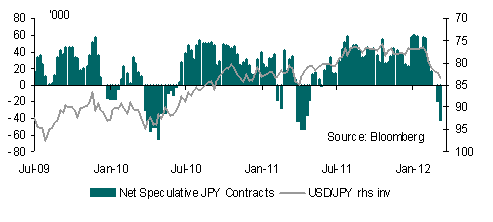
The speculative market is positioned for JPY weakness but also points to some scope for short covering; both CFTC IMM data and Japanese TFX data (a gauge of local margin trading positioning) reveal significant short JPY positions. If as I expect, USD/JPY does pull back it will offer better levels for investors to initiate medium term JPY bearish trades.

Ultimately the JPY will regain its attraction as a funding currency for carry trades and the bigger the shift in relative yield with the US, the more the potential for capital outflows from Japan into higher yielding assets.

GBP has failed to sustain gains above 1.59 against the USD over recent weeks let alone manage to test the psychologically important 1.60 level. The current bounce above 1.59 is unlikely to last. It will require a renewed downtrend in the USD in general provoked by a sharp improvement in risk appetite and/or a drop in US bond yields for GBP to move much higher. Neither seems likely.

Indeed, GBP will be vulnerable to a general firmer USD over the remainder of the year. While I would not suggest playing a bullish call on GBP versus the USD I think there is much more juice in holding GBP versus EUR, with downside risks to this currency pair likely to open up. Indeed, my quantitative models reveal that GBP is mispriced against both EUR and AUD.

JPY retracement, CHF pressure

Risk assets rallied overnight, the USD weakened and US Treasury yields rose. There was little new in terms of economic news, with only NAHB March homebuilders confidence of note, which came in slightly weaker than expected. The bigger driver for markets was the news that Apple Inc. will pay around USD 45 billion in dividends and share buybacks over the next 3-years.

Today sees a crop of second tier releases including housing starts and building permits in the US and inflation data in the UK while there will also be attention on a speech by Fed Chairman Bernanke. Risk assets will remain supported but I continue to see consolidation for markets in the near term.

USD/JPY has retraced lower as warned last week. My quantitative models suggest scope for even more of a correction lower, with a drop below 83.00 on the cards in the short term. While the upward move in the currency pair was built on a widening in the US yield advantage over Japan, the move looks overdone. Nonetheless, any pullback will offer better levels to initiate long USD/JPY medium term positions.

Clearly the market believes that the JPY will weaken further given the build up in JPY short positions over recent weeks, with shorts at their highest since April 2011. February trade data to be released on Thursday will provide further fuel for JPY bears given the persistence of a trade deficit and weakness in exports.

Following the bounce in EUR/CHF last week the currency pair has dropped back into its recent tight range around the 1.2050-1.2070 area. Strong warnings by the Swiss National Bank at its policy meeting did not lead to any follow through on the CHF. I expect a gradual drift higher in EUR/CHF over coming weeks in line with the incremental change in sentiment for the Eurozone as Greece slips from the radar.

Official pressure for CHF weakness will remain intense given the deterioration in economic data as likely to be revealed in today’s release of Q4 industrial production. Nonetheless, the SNB will be wary of confronting the market in terms of FX intervention to weaken the CHF despite its verbal warnings. Meanwhile USD/CHF remains highly sensitive to gyrations in the USD index given its strong correlation, suggesting some consolidation in the short term as the USD pulls back.

Euro slides as Greek worries intensify

The USD ended last week on high a note having overcome speeches by Fed Chairman Bernanke and President Obama. Bernanke’s lack of detail on potential further Fed stimulus offered the USD a lifeline as there was no mention of QE3 but nervousness may mount ahead of the September 21 FOMC meeting.

This week’s data releases (including retail sales, inflation, industrial production and regional manufacturing surveys may offer some direction to the USD and it is likely that the data over coming days will look less negative than in past weeks, giving the USD some support. Having broken above its 200 day moving average around 76.1986 for the first time in a year the USD index is set to begin the week in positive mode and will likely extend its gains over coming days.

In sharp contrast, EUR/USD crumbled at the end of last week dropping through its 200 day moving average despite positive news from Germany (rejection of bills in the constitutional court) and Italy (passage of austerity measures). The European Central Bank (ECB) did not help the EUR’s cause however, with the change in its stance to a more balanced assessment of risks from its more hawkish stance previously.

However, the real damage occurred as speculation of a Greek default intensified and ECB hawk Stark resigned from the ECB council, highlighting the divisions within the governing board. This week attention will remain on Greece as negotiations between the Troika (ECB, EU and IMF) and Greek officials resume.

Ahead of the talks Greece approved a further EUR 2 billion in austerity measures over the weekend but nonetheless, despite denials by Greek officials speculation of a debt default will continue to hammer the EUR lower. Near term technical support is seen around 1.3525 for EUR/USD.

GBP found some relief last week following the decision by the Bank of England to leave policy unchanged though it is unlikely to be able to make much if any headway against the USD over coming sessions as expectations of further UK quantitative easing may simply have been pushed back to the November meeting.

Inflation data this week will give further clues to policy but once again there is likely to be no sign of any easing in inflation pressure, limiting the room for maneuver for the BoE. Moreover, a weak outcome for UK retail sales in August will maintain the trend of soft UK data keeping up the pressure for more BoE action. As a result GBP will struggle against the USD but given that problems in Europe look even worse, GBP will likely extend gains against the EUR this week.