Shock and Awe

The Greek crisis spread further last week, not only to Portugal and Spain, but in addition to battering global equity markets, contagion spread to bank credit spreads, OIS-libor and emerging market debt. In response, European Union finance ministers have rushed to “shock and awe” the markets by formulating a “crisis mechanism” package with the International Monetary Fund (IMF). The package includes loan guarantees and credits worth as much as EUR 750 billion. The support package can be added to the EUR 110 billion loan package announced last week.

In addition, the US Federal Reserve (Fed) announced the authorisation of temporary currency swaps through January 2011 between the Fed, European Central Bank (ECB), Bank of Canada (BoC), Bank of England (BoE) and Swiss National Bank (SNB) in order to combat in the “the re-emergence of strains” in European markets. Separately, the ECB will conduct sterilised interventions in public and private debt markets, a measure that was hoped would be announced at the ECB meeting last week, but better late than never. The ECB did not however, announce direct measures to support the EUR.

The significance of these measures should not be underestimated and they will go a long way to reducing money market tensions and helping the EUR over the short-term. Indeed, recent history shows us that the swap mechanisms work well. The size of the package also reduced default and restructuring risks for European sovereigns. However, the risk is that it amounts to a “get out of jail free card” for European governments. A pertinent question is whether the “crisis mechanism” will keep the pressure on governments to undertake deficit cutting measures.

The Greek crisis has gone to the heart of the euro project and on its own the package will be insufficient to turn confidence around over the medium term. In order to have a lasting impact on confidence there needs to be proof of budget consolidation and increasing structural reforms. Positive signs that the former is being carried out will help but as seen by rising public opposition in Greece, it will not be without difficulties whilst structural reforms will take much longer to implement. Confidence in the eurozone project has been shattered over recent months and picking up the pieces will not be an easy process.

Some calm to markets early in the week will likely see the USD lose ground. There was a huge build up of net USD long positioning over the last week as reflected in the CFTC IMM data, suggesting plenty of scope for profit taking and/or offloading of USD long positions. In contrast, EUR positioning fell substantially to yet another record low. Some short EUR covering is likely in the wake of the new EU package, but EUR/USD 1.2996 will offer tough technical resistance followed by 1.3114.

The EU/IMF aid package will help to provide a strong backstop for EUR/USD but unless the underlying issues that led to the crisis are resolved, EUR/USD is destined to drop further. Perhaps there will be some disappointment for the EUR due to the fact that the package of support measures involves no FX intervention. This could even limit EUR upside given that there was speculation that “defending the EUR” meant physically defending the currency. In the event the move in implied FX volatility over the last week did not warrant this.
The Good, The Bad And The Ugly

GOOD: Positive earnings. The biggest earnings news of the day was from Goldman Sachs reporting that profits almost doubled in Q1. Apple also beat estimates and its shares surged. 82% of US earnings have beaten expectation so far. There is still a long way to go in the earnings season but the growth/earnings story is helping to maintain the positive bias to risk trades. There will be plenty of attention on earnings, including AT&T, eBay, Morgan Stanley, Starbucks, Boeing and Wells Fargo.

Data releases remain upbeat, with the April German ZEW investor confidence survey beating consensus, whilst central banks delivered hawkish messages across the board including the Reserve Bank of Australia policy meeting minutes, which pointed to another interest rate hike in May. However, the biggest impact came from the Bank of Canada which unsurprisingly left rates at 0.25%, but removed the conditional commitment to keep policy on hold until the end of Q2, leaving a rate hike on June 1 very likely.

The CAD jumped on the back of the outcome, with USD/CAD dropping below parity. I continue to like CAD alongside the AUD and NZD and believe they will be the star performers over the coming months despite lofty valuations.    Near term targets for CAD, AUD and NZD vs USD are 0.9953, 0.9407, and 0.7195, respectively. 

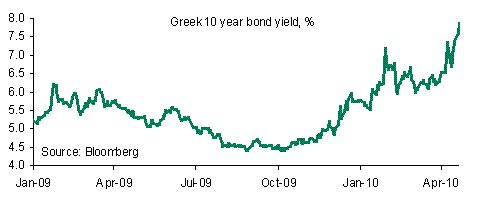
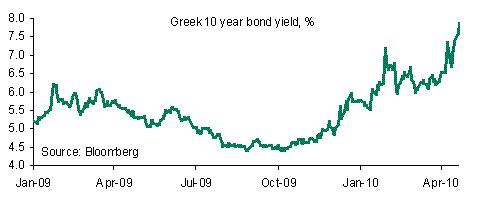
BAD: Talks between Greek officials and the IMF, ECB and EU on the conditions for a EUR 45 billion bailout loan will also be of interest although completion of talks could take weeks and in the meantime the situation is unlikely to improve, with Greece needing around EUR 10 billion to cover obligations by end May. Greek bond yields jumped to fresh record highs around 7.84% yesterday whilst the spread over German bunds also widened. Moreover, although Greece’s sale of EUR 1.95 billion in 13-week paper yesterday was heavily oversubscribed the, the yield was high at 3.65% which was far higher than the 1.67% yield at a similar sale in January.

In contrast to the likes of the CAD, AUD and NZD, the EUR is set to continue to suffer and as reflected in the widening in Greek bond spreads and high funding costs, Greek woes will keep plenty of pressure on the currency, with EUR/USD set to fall to support around 1.3300 in the short-term.

UGLY: UK regulator FSA will conduct a formal investigation of Goldman Sachs. The FSA will work closely with the US Securities and Exchange Commission SEC, which has accused the bank of Fraud though this has vehemently denied by Goldman Sachs. Although the negative market impact of the fraud case has been outweighed by good earnings and data the fallout is spreading. Some European politicians have even called for governments to stop working with the bank.

Earnings in focus

The majority of US Q3 earnings have beaten market expectations resulting in a boost to risk appetite and further pressure on the US dollar. At the time of writing, 61 companies have reported earnings in the S&P 500 and an impressive 79% have beaten forecasts according to Thomson Reuters. This week there are plenty of earnings on tap and although a lot of positive news appears to be priced in the overall tone to risk appetite remains positive. This implies a weaker US dollar bias given the strong negative correlation between US equities and the USD index.

Aside from the plethora of earnings there are plenty of data releases on tap this week including housing data in the US in the form of building permits and starts as well as existing home sales. The data will likely maintain the message of housing market stabilisation and recovery in the US. There will also be plenty of Fed speakers this week and markets will once again scrutinize the speeches to determine the Fed’s exit strategy.

Highlights this week also include interest rate decisions in Canada and Sweden. Both the BoC and Riksbank to leave policy unchanged and expect a further improvement in the German IFO in October though at a more gradual pace than in recent months. There will be plenty of interest in the UK MPC minutes given conflicting comments from officials about extending quantitative easing. RBA minutes will be looked at for the opposite reason, to determine how quickly the Bank will raise interest rates again.

The USD index managed a slight rebound at the end of last week but is likely to remain under pressure unless earnings disappoint over coming days. US dollar Speculative sentiment became more bearish last week according to the CFTC IMM data, with dollar bloc currencies including the AUD, NZD and CAD benefiting the most in terms of an increase in speculative appetite. GBP short positions increased to a new record but the rally towards the end of last week may have seen some of these short positions being covered. Overall any recovery in the USD this week may just provide better levels to go short.