In the eye of the storm

The rout in global markets continues as the bad news mounts up. Failure to achieve concrete results from the meeting of eurozone finance ministers yesterday together with intensifying banking sector concerns and weaker global manufacturing surveys left a sour taste for investors. Aside from the selloff in global stocks the EUR fell to an eight month low and looks on track to test psychological support around 1.30 versus USD.

Attention continues to be focussed on the Greece. Greece’s failure to meet its deficit targets did not appear to derail the prospects of the country receiving it’s next loan tranche but discussions between the Troika and Greek officials are ongoing and payment to Greece may not now be made until November. European officials have indicated that they will reassess Greece’s deficit targets combining 2011 and 2012 targets, suggesting some leeway for Greece to be able to qualify for the next loan tranche.

One reason that markets are reacting negatively is the hints from Eurozone officials that the agreement reached in July on a second bailout for Greece may need “technical” revisions which has been perceived to imply bigger write downs for Greek bond holders compared to the haircuts of 21 percent agreed back in July.

There seems to be no end to the problems for the EUR and markets are clearly running out of patience. Over the near tem there appears to be little to prevent sentiment from deteriorating further. What is needed is a clear plan and this is clearly not forthcoming. Greece remains in the eye of the storm but as yet there is no plan to ring fence the country and avoid a deeper fallout globally.

Elsewhere risk currencies in general continue to be hit, with the AUD in particular facing pressure as the RBA hinted at prospects of interest rate cuts in the weeks ahead. The outright winner is the USD and further gains are likely as risk aversion continues to intensify despite the fact that the US has it’s own problems to deal with. As we move further into October the potential for more volatility remains high.

Week Ahead

The market mood can be characterised as uncertain and somewhat downbeat, as reflected by the downdraft in US equity markets which posted their second weekly loss last week. Conversely, there has been a bullish run in government bonds, with the notable exception of peripheral debt. Over the last week markets had to contend with more data disappointment, in the wake of soft Japanese Q2 GDP, and a plunge in the August Philly Fed into negative territory, its first contraction since July 2009. Additionally a jump in jobless claims, which hit 500k highlighted the slow improvement in US job market conditions currently underway.

Despite all of this, the USD proved resilient and instead of the usual sell-off in the wake of soft data it benefited instead from increased risk aversion. The USD is set to retain some of this resilience though range-trading is likely to dominate over much of the weak. Reflecting the USD’s firmer stance, speculative positioning in the form of the CFTC IMM data revealed a reduction in aggregate USD short positioning in the latest week and although positioning is well below the three-month average, the improvement over the latest week and current magnitude of short positioning, highlights the potential and scope for further short-covering.
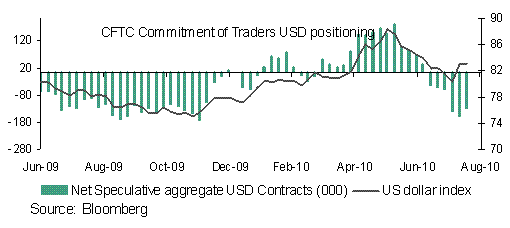
Negative data surprises have forced many to downgrade their forecasts for growth and policy implications, especially in the US. Markets will look for further clarity on the economic outlook this week but it is not clear that anything conclusive will be delivered. At the end of the week Q2 GDP will be revised sharply lower and whilst the data is backward looking it will reveal the weaker momentum of growth going into the second half of the year.

US Housing data will be mixed, with existing home sales set to drop in July as the impact of the expiration of home buyers tax credits continues to sink in whilst new home sales will likely increase but only marginally and will remain well below the April levels. Overall the picture of housing market activity remains bleak and this week’s data will do little to shake this off. On a more positive note July durable goods orders and August Michigan confidence will rise, the latter only marginally though. There will be plenty of attention on Fed Chairman Bernanke’s speech at the Jackson Hole Fed conference at the end of the week, especially given speculation of more quantitative easing in the pipeline.

The European data slate kicks off today with the release of manufacturing and service sector PMIs. Both are likely to register small declines, albeit from high levels. Nonetheless, taken together with a likely drop in the August German IFO survey on Wednesday and weaker June industrial orders tomorrow, the data will highlight that the momentum of growth in the region is coming off the boil, with the robust GDP outcome registered in Q2 2010 highly unlikely to be repeated. Against this background EUR/USD will find it difficult to make any headway. Technically further donwnside is likely over the short-term, with a test of 1.2605 support on the cards

Japan releases its slate of month end releases including jobs data, household spending and CPI. A slight improvement in job market conditions and increased spending will be insufficient to allay growth and deflation concerns, especially with CPI remaining firmly in negative territory. The onus will remain on the authorities to try to engineer a weaker JPY, which remains stubbornly around the 85.00 level versus USD. Talk of a BoJ / MoF meeting today has been dismissed, suggesting the prospect of imminent action is small. Meanwhile, speculative JPY positioning has dropped slightly in the last week but remain close to historical highs.

Aside from various data releases this week markets will digest the outcome of Australia’s federal elections. From the point of view of markets the outcome was the worst possible, with no clear winner as both the incumbent Prime Minister of the ruling Labour Party and opposition Liberal-National Party leader Tony Abbot failed to gain an outright majority. The outcome of a hung parliament will likely keep the AUD on the back foot, with trading in the currency likely be somewhat volatile until a clear outcome is established as both candidates try to garner the support of a handful of independents. However, it is notable that apart from an initial drop the AUD has managed to hold its ground. Nonetheless, the given the fluidity of the political situation there will be few investors wanted to take long positions at current levels around 0.8900 versus USD.

Better Levels To Sell

It is questionable how long the slight improvement in risk appetite at the beginning of this week lasts given the fickle nature of market sentiment at present and propensity for more disappointment. More than likely any relief will be short-lived given 1) there are still major concerns about fiscal/debt problems in Greece, Spain, Portugal, etc 2) the sharp decline in economic activity that various austerity plans will lead to and 3) rising social/labour unrest due to cuts in spending and hikes in taxes that need to be implemented.

Attention remains firmly fixed on Greece’s woes whilst global growth concerns have reappeared following some disappointing data releases in the US last week as well the decline in China’s manufacturing purchasing managers’ index (PMI) in February, released overnight, which although obscured by the timing of Chinese Lunar New Year holidays, suggests that China’s economy is losing some of its recent strong momentum.

Speculation of a rescue plan for Greece will likely give some support to the beleaguered EUR though it may only end up providing better levels to sell the currency. EU Monetary Affairs Commissioner Rehn is scheduled to meet with Greek Prime Minister Papandreou today against the background of talks about the possibility of EUR 25 billion in aid to Greece using state owned lenders to buy Greek debt. Any aid will likely come with demands for more action to reduce Greece’s yawning budget deficit which will fuel further weakness in economic activity.

A key test of sentiment towards Greece’s austerity plans will be the market reception to an upcoming sale of as much as EUR 5 billion in 10-year Greek bonds. Given the reassurances given by the EU the sale of bonds will likely not be too problematic. As an indication, Greek 10-year bond yields dropped sharply on Friday as sentiment improved.

The bounce in Greek debt was accompanied by a firmer EUR/USD which rebounded to a high of around 1.3667 as markets covered short positions. It’s probably way too early to suggest that the EUR has began a sustainable rally however, and more likely it has settled into a new range, with support around the 2010 low of 1.3444. The latest CFTC Commitment of Traders’ (IMM) data revealed a further increase in net short EUR positioning to a new record low in the week to 23rd February. This highlights both the weight of pessimism on the currency as well as significant potential to rebound.

Conversely, the IMM data reveals that net USD positions are at their highest in almost a year and well above their three-month average, suggesting that USD positioning is looking a bit stretched though its worth noting that positioning is still well off its record high. Nonetheless, with a bailout for Greece in the offing, risk appetite could gain a stronger foothold this week, in turn keeping the USD capped.

As for the EUR, although a lot of bad news is in the price, for the currency to rebound on a sustainable basis it will require fiscal/growth worries to recede. Despite talk of Greek aid, there is a long way to go before Europe’s fiscal/debt problems are resolved.

Post US Jobs Data FX Outlook

The massive upside surprise to US payrolls could prove to be a significant indicator for the USDs fortunes in the months ahead.  To summarize, payrolls dropped by 11k, much less than expected. Net revisions totaled +148k, the workweek rose and the unemployment rate fell to 10%, also better than forecast and likely a surprise to the US administration who hinted at a rise in the unemployment rate.

Equity and bond market reaction was as would be expected; equities rallied and bonds sold off.  Gold prices dropped sharply too.  However, and this is what was most interesting, the dollar strengthened. Why is this odd? Well, over the past 9 months any news that would have been perceived as positive for risk appetite was associated with dollar weakness.  This reaction clearly did not take place following the jobs data. 

It’s worth noting that going into the payrolls data markets were very short USDs as reflected in the CFTC Commitment of Traders IMM data which revealed the biggest aggregate net short USD position since 25 March 2008. The bounce in the USD could have reflected a strong degree of short covering especially against the JPY where net long JPY positions had jumped to close to its all time high.  Going into year end expect to see more position adjustment, perhaps indicating a return of the JPY funded carry trade is back on the cards.

The dollar’s reaction to the payrolls data was reminiscent of its pre-crisis relationship of buying dollars in anticipation of a more aggressive path for US interest rates and indeed markets brought forward expectations of higher rates following the data.  It is probably too early to believe that the dollar’s movements are once again a function of interest rate differentials but it is a taste of things to come. In any case, markets will be able to garner further clues from a speech by Fed Chairman Bernanke today.

The post payrolls dollar reaction could have also reflected the fact that EUR/USD failed to break above the 1.5145 high over the week resulting in a capitulation of stale long positions, especially as the move towards reducing liquidity provision by the ECB also failed to push the EUR higher. If the S&P 500 stays above 1100 EUR/USD could retrace higher for the most part a broad 1.48-1.51 range is likely to dominate over the week.  Nonetheless, a break below 1.4820 could provoke an accelerated stop loss fuelled drop in EUR/USD.  ECB President Trichet speaks today and may reiterate that the ECB’s measures to begin scaling back its liquidity provision should not be taken as a step towards monetary tightening.

USD/JPY proved interesting last week pushing higher in the wake of strong rhetoric by the Japanese authorities threatening intervention to prevent JPY strength. The BoJ’s attempt to provide more liquidity to banks also helped on the margin to weaker the JPY but the impact of the move is likely to prove limited. Nonetheless, exporters and Japanese officials may be more relaxed this week, if USD/JPY can hold above 90.00.  However, a likely sharp revision lower to Japanese Q3 GDP tomorrow will help maintain calls for a weaker JPY.

The best funding currency

The dollar was beaten up over the past week, finally breaking through some key levels against many major currencies; the dollar index touched 76.457, the lowest since September 25, 2008.  The usual explanation for dollar weakness over recent months has been an improvement in risk appetite.  However, this explanation fails to adequately explain the drop in the currency over recent days.   

Although we have seen a multi month trend of improving risk appetite it is not clear that there was any further improvement last week.  On the one hand the ongoing rise in equity markets points to a continued improvement in risk appetite; the S&P 500 recorded its biggest weekly gain since July.  Equity volatility has also declined, reflected by the decline in the VIX index.   

On the other hand, other indicators reveal a different picture.  The ultimate safe haven and inflation hedge, namely gold, registered further gains above $1000 per troy ounce. That other safe haven, US Treasuries underwent the strongest demand in almost 2 years (bid-cover ratio 2.92) for the $12 billion 30-year note auction, whilst the earlier 10 year note auction also saw solid demand (bid-cover ratio 2.77) as well as strong interest from foreign investors.  

The massive increase in bond issuance to fund the burgeoning fiscal deficit continues to be well absorbed by the market for now, whilst the drop in the dollar does not appear to be putting foreign investors off US assets.  The strong demand for Treasuries could reflect a lack of inflation concerns but may also reflect worries about recovery, quite a contrast to the move in equities.

The fact that the Japanese yen and Swiss franc strengthened against the dollar also contrasts with the view that risk appetite is improving.  The yen was the biggest beneficiary currency during the economic and financial crisis but has continued to strengthen even as risk appetite improves.  USD/JPY dropped close to the psychologically important level of 90 last week which actually indicates a drop in risk appetite.  Perhaps the move is more of an indication of general dollar pressure rather than yen strength.  

A likely explanation for the drop in the dollar is that it is increasingly becoming a favoured funding currency, taking over the mantle from the Japanese yen; investors borrow dollars and then use it to take short positions against higher yielding currencies.  US dollar 3-month libor rates fell below those of the yen and Swiss franc for the first time since November, effectively making the dollar the cheapest funding currency and fuelling broad based weakness in the currency.

Although the historically strong relationship between currencies and interest rates has yet to establish itself to a significant degree, ultra low interest rates suggests that the dollar will remain under pressure for a while yet, especially as the Fed continues to highlight that US interest rates are not going to go up in a hurry.