The Italian Job

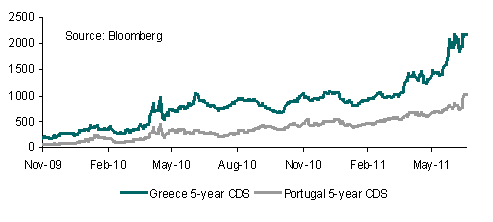
Italy looks too big to rescue yet is too big to fail. The country has around EUR 1.9 trillion in public debt (around 5 times that of Greece) and is the third largest country in the eurozone. Therefore it cannot be as easily dealt with as Greece.

Italy needs to raise around EUR 18 billion per month to cover its budget deficit and bond redemptions and with a continued increase in yields (hitting close to 7.5% for 10 year bonds) borrowing costs are rising sharply and fast becoming unsustainable. Higher collateral haircuts on Italian debt are adding to the pressure.

Although Italian Prime Minister Berlusconi has said he will step down in the wake of reform measures to be voted on by the Italian parliament the vote on the measures may not take place for weeks. Moreover, Berlusconi may attempt to seek re-election after stepping down, which could bring the situation back to square one.

In the meantime speculation that Italy may be the next country to need to a bailout will intensify. However, with only around EUR 270 billion remaining in the EFSF bailout fund and details of how the fund will be leveraged to a planned EUR 1 trillion still lacking, doubts about whether it will have sufficient resources will grow. Press reports that Germany and France have begun talks to break up the eurozone due to fears that Italy will be too big to rescue will only add to the malaise.

Focus over the short term will turn to today’s 12 month auction of EUR 5 billion in Italy. Last month’s 12 month auction saw an average yield of 3.57% but this time around yields could rise above 6%. Worryingly it appears that even with the European Central Bank (ECB) buying Italian debt it has been insufficient to prevent yield rising.

In any case, given the ECB’s reluctance to become lender of the last resort to European peripherals, any support from this direction will be limited. Against this background the EUR remains highly vulnerable to a further drop. Indeed, the EUR’s recent resilience looks all the more misplaced. A test of the 4 October low around EUR/USD 1.3146 is on the cards over coming days.
Japan FX Measures Underwhelm

Currencies continue to show remarkable stability in the face of elevated risk aversion which has prompted huge volatility in other asset markets. Although FX volatility has risen over recent weeks its rise is nothing compared to the jump in the VIX ‘fear gauge’ equity volatility measure. FX markets are in some form of limbo where there are conflicting forces at play and where there is no obvious currency to play. The lack of clarity in markets suggests that this situation will not change quickly.

The USD (index) is trading at the lower end of its recent ranges and verging on a retest of its July 27 low around 73.421, with the currency perhaps suffering from expectations that Fed Chairman Bernanke will announce a desire to embark on more quantitative easing at Friday’s Jackson Hole symposium. Its losses could quickly reverse as such expectations are quickly dashed.

Indeed, while Bernanke will likely keep all options open any hint at QE3 is unlikely as the Fed maintains a high hurdle before any prospect of further quantitative easing is entertained. One option on the table is ‘sterilised’ large scale asset purchases which would not result in an increase in the size of the Fed’s balance sheet. This would be far less negative for the USD than a fresh round of QE and may even prompt a rally in the currency as markets shift away from the idea of QE3.

The USD will benefit from high risk aversion except against safe havens such as the CHF and JPY. In this respect the USD remains a better bet than the EUR which has failed to garner much benefit from renewed ECB peripheral bond buying. Nonetheless, data yesterday failed to feed into negative EUR sentiment despite mixed manufacturing surveys and a sharp drop in the German ZEW investor confidence survey. EUR/USD remains trapped in a broad 1.42-1.45 range.

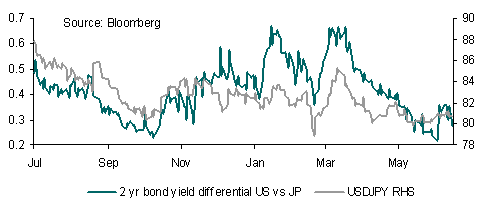
News that Moody’s ratings agency has downgraded Japan’s sovereign ratings by one notch to Aa3 is unlikely to have much impact on the JPY. Moody’s left the outlook stable while unlike the US and Europe around 95% of Japanese debt is held domestically, suggesting little FX and JGB impact. USD/JPY continues to garner some influence from yield differentials and given that the US bond yield advantage versus Japan has continued to narrow, USD/JPY continues to face downward pressure.

Japan announced measures to deal with JPY strength including the creation of a $100 billion emergency credit facility. However, the main impact on the JPY could come from increased monitoring of FX transactions with firms having to report on FX positions held by dealers. The statement made no comment on FX intervention and this is where there will be most disappointment for JPY bears. Overall, the actions are somewhat underwhelming and are unlikely to have much impact on the JPY. If anything, the JPY may actually strengthen given the lack of comment on FX intervention. USD/JPY downside could face strong technical support around 75.93, however.

Which is the ugliest currency?

The contest of the uglies has once again been set in motion in FX markets as last Friday’s weak US jobs report, which revealed a paltry 18k increase in June payrolls, downward revisions to past months and a rise in the unemployment rate, actually left the USD unperturbed. Europe’s problems outweighed the negative impact of more signs of a weak US economy, leaving the EUR as a bigger loser.

The USD’s resilience was even more impressive considering the drop in US bond yields in the wake of the data. However, news over the weekend that talks over the US budget deficit and debt ceiling broke down as Republicans pulled out of discussions, will leave USD bulls with a sour taste in their mouth.

Should weak jobs recovery dent enthusiasm for the USD? To the extent that it may raise expectations of the need for more Fed asset purchases, it may prove to be an obstacle for the USD. However, there is sufficient reason to look for a rebound in growth in H2 2011 while in any case the Fed has set the hurdle at a high level for more quantitative easing (QE).

Fed Chairman Bernanke’s reaction and outlook will be gleaned from his semi-annual testimony before the House (Wed) although he will likely stick to the script in terms of US recovery hopes for H2. This ought to leave the USD with little to worry about. There will be plenty of other data releases this week to chew on including trade data, retail sales, CPI and PPI inflation and consumer confidence as well as the kick off to the Q2 earnings season.

Fresh concerns in Europe, this time with contagion spreading to Italy left the EUR in bad shape and unable to capitalise on the soft US jobs report. In Italy high debt levels, weak growth, political friction and banking concerns are acting in unison. The fact that there is unlikely to be a final agreement on second Greek bailout package at today’s Eurogroup meeting will act as a further weight on the EUR.

Discussions over debt roll over plans, the role of the private sector and the stance of ratings agencies will likely drag on, suggesting that the EUR will not find any support over coming days and will more likely lose more ground as the week progresses. If these issues were not sufficiently worrisome, the release of EU wide bank stress tests on Friday will fuel more nervousness. Against this background EUR/USD looks vulnerable to a drop to technical support around 1.4102.

The Bank of Japan is the only major central bank to decide on interest rates this week but an expected unchanged policy decision tomorrow is unlikely to lead to any JPY reaction. In fact there appears to be little to move the JPY out of its current tight range at present. USD/JPY continues to be the most correlated currency pair with 2-year bond yield differentials and the fact that the US yield advantage has dropped relative to Japan has led to USD/JPY once again losing the 81.0 handle.

However, as reflected in the CFTC IMM data the speculative market is still holding a sizeable long position in JPY, which could result in a sharp drop in the currency should US yields shift relatively higher, as we expect over coming months. In the short-term USD/JPY is likely to be well supported around 80.01.

Euro Sentiment Jumps, USD Sentiment Dives

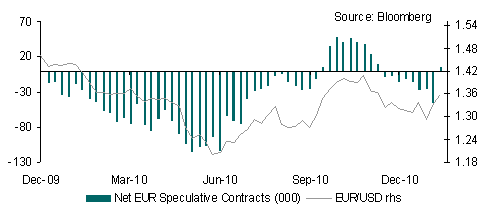
The bounce in the EUR against a broad range of currencies as well as a shift in speculative positioning highlights a sharp improvement in eurozone sentiment. Indeed, the CFTC IMM data reveals that net speculative positioning has turned positive for the first time since mid-November. A rise in the German IFO business confidence survey last week, reasonable success in peripheral bond auctions (albeit at unsustainable yields), hawkish ECB comments and talk of more German support for eurozone peripheral countries, have helped.

A big driver for EUR at present appears to be interest rate differentials. In the wake of recent commentary from Eurozone Central Bank (ECB) President Trichet following the last ECB meeting there has been a sharp move in interest rate differentials between the US and eurozone. This week’s European data releases are unlikely to reverse this move, with firm readings from the flash eurozone country purchasing managers indices (PMI) today and January eurozone economic sentiment gauges expected.

Two big events will dictate US market activity alongside more Q4 earnings reports. President Obama’s State of The Union address is likely to pay particular attention on the US budget outlook. Although the recent fiscal agreement to extend the Bush era tax cuts is positive for the path of the economy this year the lack of a medium to long term solution to an expanding budget deficit could come back to haunt the USD and US bonds.

The Fed FOMC meeting on Wednesday will likely keep markets treading water over the early part of the week. The Fed will maintain its commitment to its $600 billion asset purchase program. Although there is plenty of debate about the effectiveness of QE2 the program is set to be fully implemented by the end of Q2 2011. The FOMC statement will likely note some improvement in the economy whilst retaining a cautious tone. Markets will also be able to gauge the effects of the rotation of FOMC members, with new member Plosser possibly another dissenter.

These events will likely overshadow US data releases including Q4 real GDP, Jan consumer confidence, new home sales, and durable goods orders. GDP is likely to have accelerated in Q4, confidence is set to have improved, but at a low level, housing market activity will remain burdened by high inventories and durable goods orders will be boosted by transport orders. Overall, the encouraging tone of US data will likely continue but markets will also keep one eye on earnings. Unfortunately for the USD, firm US data are being overshadowed by rising inflation concerns elsewhere.

Against the background of intensifying inflation tensions several rate decisions this week will be of interest including the RBNZ in New Zealand, Norges Bank in Norway and the Bank of Japan. All three are likely to keep policy rates on hold. There will also be plenty of attention on the Bank of England (BoE) MPC minutes to determine their reaction to rising inflation pressures, with a slightly more hawkish voting pattern likely as MPC member Posen could have dropped his call for more quantitative easing (QE). There will also be more clues to RBA policy, with the release of Q4 inflation data tomorrow.

Both the EUR and GBP have benefitted from a widening in interest rate futures differentials. In contrast USD sentiment has clearly deteriorated over recent weeks as highlighted in the shift in IMM positioning, with net short positions increasing sharply. It is difficult to see this trend reversing over the short-term, especially as the Fed will likely maintain its dovish stance at its FOMC meeting this week. This suggests that the USD will remain on the back foot.

What To Watch This Week

The end of last week proved to be a calmer affair than the preceding few days. There was some encouraging news on the Greek front, with Germany finally approving its share of the European Union (EU) aid package whilst Greece appeared to be on track with its budget deficit reduction as the country recorded a cash deficit of EUR 6.3billion in the first four months of the year, a 42% reduction compared to a year earlier. EU officials also agreed on tougher sanctions for countries breaching austerity rules.

There were plenty of negatives to offset the good news however, as European business surveys including the German IFO index and flash eurozone purchasing managers indices (PMIs) revealed some loss of momentum in growth as well as increased divergence. European banking sector concerns intensified as the Bank of Spain was forced to take control of CajaSur, a small savings bank holding 0.6% of total Spanish banking assets, which faced difficulties due to distressed real estate exposure. Its woes highlighted the problems faced by many Spanish savings banks due to property market exposure.

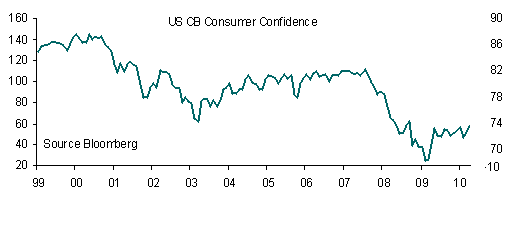
US data releases this week will confirm that economic recovery gathered steam in Q2. May consumer confidence data is likely to record a small gain, due in large part to improving job market conditions, whilst the Chicago PMI is set to retrace slightly in May, albeit from a healthy level. Both new and existing home sales are set to record gains in April, the former following a sizeable gain in March although the drop in house prices likely to be revealed by the Case-Shiller index will continue to fuel doubts about the veracity of the turnaround in the US housing market.

In Europe there is not much in terms of first tier releases and highlights include sentiment data such as German Gfk and French consumer confidence indices, and the May French business confidence indicator. The data are likely to be mixed, and as indicated by last week’s surveys will reflect a relatively healthy Q2 2010, but a worsening outlook for the second half of the year.

In the absence of UK data today there will be plenty of attention on the details of plans by Chancellor Osborne to cut GBP 6 billion from the budget deficit. The measures will be small change ahead of the emergency budget package on June 22nd when much bigger cuts are expected. Nonetheless, the first step today will be a crucial test of the new government’s ability to convince ratings agencies and markets that it is serious about reducing the burgeoning fiscal deficit.

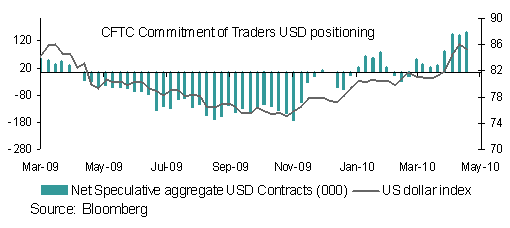
Following the massive positioning adjustments of the last week markets will look somewhat calmer over coming days but risk aversion is likely to remain elevated, suggesting little respite for most currencies against the USD. The recent moves have left net aggregate USD positioning registering an all time high according to the CFTC Commitment of Traders data, in the latest week, but after the slight retracement lower in the USD index, it is set to make further gains over coming days.

It was notable that EUR and GBP looked more composed at the tail end of the week whilst attention turned to the liquidation of long positions in CHF, AUD, NOK and SEK. These risk currencies are set to remain under pressure but there will be little respite for EUR which is set to drift lower, albeit a less aggressive pace than over recent weeks and a re-test of EUR/USD technical support around 1.2296 is likely. GBP/USD has showed some resilience over recent days but remains vulnerable to further downside pressure, with 1.4310 immediate support.