What Stress?

Fed Chairman Bernanke has inadvertently fuelled an increase in risk aversion in the wake of his testimony to the Senate. Although Bernanke noted that he did not see the prospects of a double-dip as a high probability event he stated that the economic outlook is “unusually uncertain”. Nonetheless, although such measures would be implemented if the situation deteriorated further, the Fed was not planning on extending its non-traditional policy options in the near term.
USD benefits as Bernanke does not indicate more quantitative easing.

A combination of caution about growth prospects and disappointment that Bernanke stopped short of indicating that the Fed would embark on further non-conventional policy measures left equities weaker, but the USD was stronger, both due to higher risk aversion as well as less risk of the Fed turning the USD printing press back on again. Bernanke is back at Congress today, with a speech to the House Panel. Although this is effectively a repeat of yesterday’s testimony, the Q&A session may throw up additional clues to Fed thinking and potential for extending quantitative easing but I suspect the USD will retain its firmer tone.

In Europe, most attention remains on the upcoming release of EU bank stress test results. Leaks suggest most banks will likely pass the EU bank stress tests, with the notable exceptions of a few Spanish Cajas and German Landesbanks. Already governments in Germany, France, Greece and Belgium have said their banks are likely to pass. We should all be bracing ourselves for relief to flow through European financial markets, but somehow this does not feel like an environment that will welcome such a result. More likely questions will be asked about why did so few banks fail and why the tests were not rigorous enough?

For example, the test for “sovereign shock” is said to affect only the value of government bonds that banks mark to market, but what about the far larger proportion of government debt that is held in banking books? There are also question marks over the capital hurdle, with the most adverse scenario that banks need to reach a maximum Tier 1 capital ratio of at least 6% by end 2011. Moreover, there have also been reported divisions within European Union (EU) members about how much information to divulge. EUR has also ready lost ground over recent days but the currency could face much more selling pressure into next week if the tests are found to lack credibility.

Please note that econometer.org will take a break until the week of 16th August. Good Luck.
Volatility Within Ranges

Most investors will likely be happy to see the tail end of May given the sharp losses in many asset classes over the month. At least over the last few days there was a sense of some healing, particularly in risk assets though it is questionable how long this can continue given the still many and varied uncertainties afflicting markets. A reminder of this came late on Friday, with Fitch downgrading Spain’s sovereign credit ratings despite the passage of austerity measures.

The Fitch decision highlights that Spain is rapidly becoming the new epicenter of the crisis; focus on the savings banks or Cajas is intensifying ahead of the June 30 deadline for mergers to qualify for government money, the minority government’s popularity is in further decline, whilst unions are threatening more strikes across the country. Unions in Greece and Italy are also pushing for coordinated strikes, highlighting the difficulties in pushing through austerity measures.

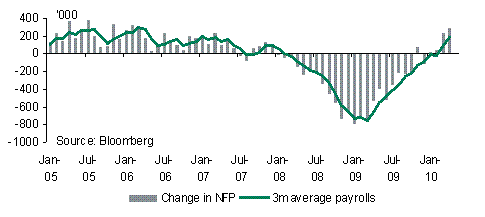
At least economic data is providing some solace to markets. Releases last week in the US highlighted the fact that consensus expectations are underestimating the pace of recovery; consumer confidence, durable goods orders and new home sales all came in above expectations. The same story is likely this week, but there is really only one piece of data that attention will focus on and that’s the May jobs report. The consensus is for a strong 508k increase in non-farm payrolls following a 290k increase in April, though around three-quarters of this will be related to census hiring. The unemployment rate is likely to dip slightly to 9.8%.

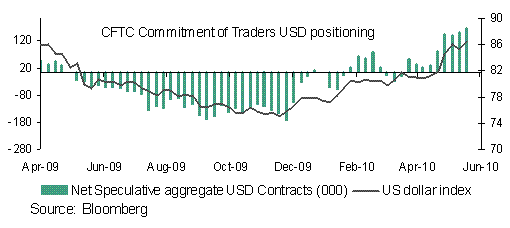
Markets are likely to be in limbo, with volatility in ranges likely this week. USD sentiment remains strong as reflected in the CFTC IMM data where net aggregate positioning is at an all time high, but further USD gains may be harder to come by ahead of the US jobs report and G20 meeting this weekend. Stretched USD positioning has proven no barrier to USD strength over recent weeks but the fact that markets are very long USDs could at the least result in a slower pace of further appreciation.

EUR speculative sentiment remains close to all time lows although there are signs of some relative stability over recent weeks. EUR/USD is likely to range between 1.2134 and 1.2475 this week. There was a sharp drop in net short JPY positions over the week (ie short-covering) though this appears at odds with the fall in the JPY. GBP speculative positions showed little improvement, languishing close to all time lows, whilst net longs in commodity currencies were pared back sharply, especially in AUD where net longs were cut by around half though sharp declines in positioning were also registered for NZD and CAD.

GBP could suffer due to worries about the UK government’s plans to reduce its burgeoning budget deficit following the resignation of Treasury Minister David Laws, following an expense scandal. The resignation hits the coalition just three weeks before the emergency budget and could result in complications on the negotiations between the Liberal Democrats and Conservatives on the substance of the deficit cutting measures. GBP/USD is likely to find support around 1.4260 and resistance around 1.4612 this week.