Fed’s status quo fuels caution

The Fed’s status quo did little to stir markets overnight although there was a decidedly negative tone to equities and commodities, perhaps spurred by the downgrading of US growth forecasts. The fact that the Fed did not indicate that it is considering further asset purchases but instead will keep its balance sheet at around $,2800 billion also acted as a drag on markets.

The major concern for markets remains the depth and length of the current ‘soft patch’. The Fed believes it will be temporary and we concur, but clearly the slide in equity markets over recent weeks, suggests that there has been a divergence between stock market expectations and reality. The USD however, may actually be finding a medium term bottom, with the fact that the Fed is not considering QE3,

The downbeat Fed stance combined with a cautious reaction to the Greek government’s passage of a confidence motion indicates that markets will remain cautious over the near term. Indeed, comments by the Greek opposition that they will not support further austerity measures dashed any hopes of unity and will add another obstacle towards an easing in Greek tensions.

As it is the continued wrangling between European officials over private sector participation in any debt rollover as well as uncertainty over how ratings agencies will react, threatens to keep sentiment under pressure. The EUR has remained surprisingly resilient but its muted reaction to the passage of the confidence motion has given way to some weakness and the currency remains a sell on rallies.

GBP was a major underperformer weighed down by the relatively dovish Bank of England MPC minutes in which some members were even discussing further asset purchases. The currency faces further risks from a the CBI reported sales data for June where a decline in sales is likely to be reported. GBP/USD looks vulnerable to a drop below its 200 day moving average around 1.6027.
US Dollar Ugly But Not Hideous

The USD has strengthened by around 5% since the beginning of the month. The move has been particularly sharp this week as higher risk aversion and intensifying fears about the eurozone periphery have given the currency a boost, albeit with the USD remaining one of the least ugly currencies amongst a fairly hideous bunch.

Eurozone country and overall ‘flash’ May purchasing managers indices (PMI) managed to further sour an already fragile mood yesterday, with the data revealing bigger than expected declines, albeit still at levels that are high in absolute terms. Data today is unlikely to result in any improvement in sentiment for eurozone assets, with the Germany IFO Business Climate index likely to slip, albeit from a relatively high level.

The EUR doesn’t need much of an excuse to sell off at present, with a softer IFO likely to provide further reason for investors to offload long positions in the currency. Against this background EUR/USD is likely to sustain a drop below the 1.4000 level, with the 100 day moving average level of 1.3972 likely to be breached shortly.

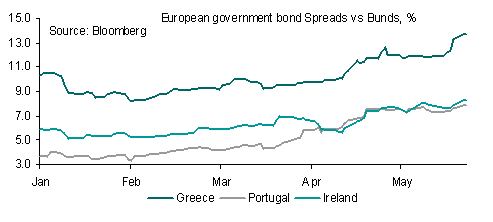
More importantly in terms of sentiment drivers the malaise in the eurozone periphery especially Greece remains the biggest risk for the EUR. As much as officials in Europe and Greece deny speculation of debt restructuring the market is far from convinced as reflected in the widening in peripheral debt spreads.

Greece’s Prime Minister Papandreou’s attempt to push through austerity measures in the Greek parliament yesterday by announcing accelerated asset sale plan and EUR 6 billion in budget cuts have done little to turn market sentiment despite the fact that at the least it shows a willingness to stick to the plan in the face of growing domestic resistance.

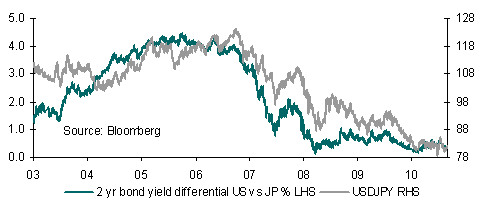
The USD has also edged higher against the JPY over recent days despite a rise in risk aversion. As revealed in the latest IMM data markets have been net long JPY over the past couple of weeks, with positioning well above the 3-month average, suggesting some scope for a liquidation of long positions. Nonetheless, the rise in USD/JPY has occurred despite 2-year US / Japan yield differentials remaining at a relatively low level suggesting that the USD may lose momentum, with USD/JPY resistance around 82.74 likely to cap gains.

GBP has also slid suffering in the wake of a resurgent USD and unconfirmed reports that Moody’s ratings agency is expected to announce that is placing 14 out of 18 UK banks on review for a downgrade. GBP is likely to trade nervously ahead of UK data releases today including public finances and CBI data, with further downside risks opening up. A drop below GBP/USD 1.6000 could see the currency pair test support around 1.5972.

World Cup FX Positioning/Data Highlights

The market tone felt decidedly better over the course of the last week although it was difficult to tell if this was due to position squaring ahead of the World Cup football or a genuine improvement in sentiment. There was no particular event or data release that acted as a catalyst either, with the European Central Bank (ECB) and Bank of England (BoE) meetings passing with little fanfare.

US data ended the week mixed, with retail sales disappointing in May but in contrast June consumer confidence beating expectations. Although questions about the pace of recovery remain, other data such as the Fed’s Beige Book suggest that recovery remains on track, sentiment echoed, albeit cautiously by Fed Chairman Bernanke last week.

Attention this week will centre on inflation data. Expected benign CPI readings will support the view that the Fed will take its time to raise interest rates. Speeches by the Fed’s Bullard, Plosser and Bernanke this week will be eyed for further clues on Fed thinking.

Central banks in Brazil and New Zealand hiked rates last week but this is not likely to be echoed this week. No change is likely from both the Bank of Japan and Swiss National Bank although there will be plenty of attention on the SNB’s comments on the CHF following recent data showing a surge in FX reserves due to currency intervention. The BoJ is unlikely to announce anything new but perhaps some further detail on the loan support plan could be forthcoming.

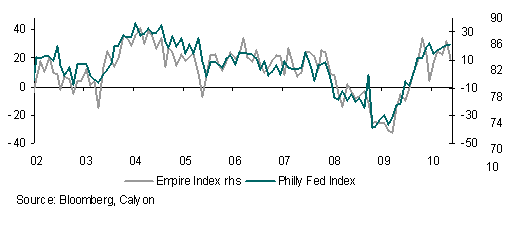
Manufacturing data will also garner some attention, with the US June Empire and Philly Fed surveys and May industrial production on tap. All three reports will confirm the improving trend in manufacturing activity in the US. Housing data will look weaker, with starts set to pull back in starts in May following the expiry of government tax incentive programmes though permits are set to rise.

In Europe, the June German ZEW (econ sentiment) investor sentiment survey will likely slip slightly due to ongoing fiscal/debt worries but this will be countered by stronger domestic data. In any case the index remains at a high level and a slight drop is unlikely to derail markets.

GBP may find some support form upgrade of UK growth forecasts by the CBI to 1.3% for 2010 and relatively hawkish comments from the BoE’s Sentance in the weekend press warning that inflation is higher than expected, indicating that the Bank may need to hike rates sooner than expected.

Further GBP/USD direction will come from CPI and retail sales data this week as well as public borrowing figures and a report by the new Office of Budget Responsibility on the UK’s fiscal position ahead of the June 22 budget. A break above GBP/USD resistance around 1.4760 is unlikely to materialise.

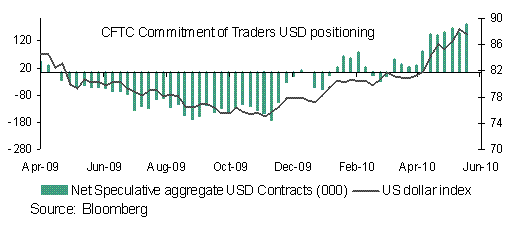
Despite the many data releases this week, the overall tone is likely to be one of consolidation and reduced volatility in the days ahead. This may allow EUR/USD to gain some ground due to short covering, with the CFTC commitment of traders (IMM) report revealing a further increase in net short speculative positions last week, close to the record set a few weeks back, though we suspect that there will be strong resistance around 1.2227.

The fact that the IMM data revealed that net aggregate net USD long positions reached an all time high last week, highlights the potential for profit taking this week. USD/JPY will look to take out resistance around 92.55 but this looks unlikely unless the BoJ dishes up anything particularly dovish from its meeting.