Asian currencies running into resistance

As the US Q3 earnings season gets underway caution is prevailing as reflected in the losses in US and European equity markets overnight. The VIX jumped as risk aversion increased in the wake of lower revised growth estimates from the IMF and worries that earnings will be far less flattering than in previous quarters. Nonetheless, stronger than forecast earnings from Alcoa helped to kick of the earnings season in positive mode.

In Europe the visit by Chancellor Merkel to Athens was accompanied by reassuring statements from the German leader but this was to little avail as demonstrations in the Greek capital continued. Reports that lenders are discussing extending Greece’s bailout program by two years may provide some relief, however.

Spain remains the major focal point and in this regard there is no progress in the country moving forward with a bailout request much to the chagrin of peripheral debt markets and the EUR. There are few data releases of interest today of which the Fed’s Beige Book will be the main highlight. The market tone will continue to remain cautious but we don’t expect a major relapse in risk appetite.

The USD continues to make good headway in an environment of higher risk aversion, as the USD index continues to maintain a strong correlation with risk. We see little reason for this to reverse although EUR/USD may run into some support around the 1.2824 area. Our preferred crosses include playing short EUR/AUD given that our model indicators show that AUD is oversold at current levels.

Asian currencies will run into some resistance against the background of a firmer USD and the ADXY index is struggling to break higher. The PHP and THB have been the major outperformers so far this month, with most other Asian currencies have weakening.

India has been the biggest beneficiary of renewed portfolio flows to the region, unsurprising in the wake of recent reform announcements registering around $1.3 billion of equity flows month to date. USD/KRW looks like it will struggle to break below 1110 having failed on its attempts to break through this level. Equity capital inflows to Asia are on par with the inflows registered in 2009 and 2010.
Euro gives up its gains, GBP tracks lower

Although attention may briefly turn to the Fed FOMC outcome tomorrow the lack of progress to resolve’s Europe’s crisis threatens to inflict much more severe damage onto global markets. Against this background the European summit at the end of the week will be particularly important but the scope for disappointment remains high.

As with news of Spain’s banking bailout the positive EUR reaction to the Greek elections has faded even more quickly than I anticipated. EUR/USD’s inability to build on gains above 1.2700 despite extreme short market positioning, highlights the lack of confidence in resolving the crisis. EUR/USD appears to be increasingly following the moves in peripheral bond spreads and the news here is not good either especially in Spain, with spreads continuing to widen out.

The G20 communiqué offered no support to the EUR, with little by way of concrete measures while Germany continues to stick to its stance of no renegotiation of Greece’s bailout terms. The EU finance ministers summit in a couple of days time may provide some relief but only if concrete measures are outlined. In the meantime EUR/USD will continue to remain under pressure. As noted yesterday, I look for a test of EUR/USD 1.2515 which could happen as early as today.

Considering that the prospects of a further round of Bank Of England quantitative easing has grown as hinted at by BoE Governor King, GBP has shown some resilience. Indeed, it is not clear that GBP will weaken if and when the BoE expands its balance sheet again. My analysis reveals that the reaction of GBP has been mixed both to the announcement and implementation of asset purchases.

Inflation data will provide some clues to the room for further monetary stimulus while the minutes of the last MPC meeting two weeks ago will provide some inkling of the support within the Committee for fresh QE. CPI is likely edge higher but this will be due to seasonal factors, while the minutes will likely reveal two dissenters.

GBP meanwhile, will continue to track the EUR with the currency pair trading in a 0.80-0.81 range. EUR’s drop overnight has taken the wind out of GBP’s sails, but strong technical support will be found around GBP/USD 1.5601.

Euro looking rich at current levels

Markets continue to be rumour driven with little concrete news to provide direction. The news that a comprehensive deal by European officials at this Sunday’s EU Summit is now very unlikely has come as a further blow to hopes of a swift resolution to the crisis.

So it seems that Sunday’s meeting will provide a forum to thrash out ideas before a second summit next Wednesday. As a reminder the issues at hand are leveraging the EFSF, banking sector recapitalisation and the extent of private sector participation in Greek debt write downs.

The main disagreement appears to be between Germany and France on method of additional funding the EFSF bailout fund (which has EUR 280billion of firepower left), with Germany and the European Central Bank (ECB) opposed to French demands to utilise the ECB to help back the EFSF with France wanting the facility being turned in a bank. In terms of write downs for Greek bond holders there is a push for at least a 50% reduction compared to the 21% agreed in July.

Separately speculation of the amount of new capital needed for banking sector recapitalisation now revolves around a figure of EUR 80 billion. One spanner in the works is that Chancellor Merkel will have to gain approval from the German parliament before agreeing on further changes to the EFSF, which may delay the process further.

Clearly as this week has gone on the air has continued to seep out of the balloon as the market braces for disappointment. Surprisingly the EUR has held up well and while it has failed to extend gains, hitting a high earlier in the week around 1.3915 but still pricing in some scope for success, at current levels.

Helping the EUR was the fact that the market was very short, and while it could still move higher next week if European officials agree on a plan it still looks like a sell on rallies, with the scope for further gains limited from current rich levels. Good news from Europe next week could see a test of EUR/USD 1.40 but this will prove to be a good selling area further out.

At least there was some good news from Greece for a change as the Prime Minister won a vote to pass further austerity measures to help secure the next tranche (delayed from September) of the bailout despite ongoing protests in the country. The near term focus will be on a meeting of Finance Ministers today ahead of Sunday’s summit.

No QE3 but Bernanke gives some hope

Not only did Federal Reserve Chairman Bernanke not discuss the potential for more quantitatiive easing QE3 but he also did not discuss many other options for Fed policy at Jackson Hole last Friday. The onus has now shifted to the 2-day Fed FOMC meeting on September 21 where markets are looking (hoping) for fresh policy measures. Such hopes helped US equity markets bounce back after initially reacting negatively to Bernanke’s speech.

Bernanke provided some hope to markets that the US economy wasn’t sliding into the abyss while offering the potential for further Fed stimulus even if QE3 wasn’t quite on the cards. This hope was sufficient to spur markets higher. However, importantly Bernanke noted the limitations of monetary policy in stimulating growth over the medium term.

In this respect there will be plenty of attention on President Obama’s speech on September 5 in which markets will be looking for a response from the administration at a time when the economy is becoming an increasingly important issue for the electorate.

In the meantime there are plenty of data releases to contend with this week including the August US jobs report, ISM manufacturing survey, US consumer confidence and various confidence surveys in Europe. Unfortunately the news will not be positive as the data releases are set to reinforce concerns of economic slowdown. The US jobs report is likely to reveal a limited, around 75k increase in non-farm payrolls according to consensus while the ISM manufacturing survey is set to drop into contraction territory.

Consequently markets may start the week in risk on mood but this is unlikely to last given renewed economic worries. Moreover, Eurozone peripheral country travails continue to exasperate markets, with concerns that some members of German Chancellor Merkel’s coalition plan to vote against the revamped EFSF bailout fund and news that two German banks have yet to commit on Greece’s bailout plan. Against this background the EUR continues to defy gravity around the 1.45 level versus USD but may yet come down to earth with a bang.

Euro’s Teflon Coating Wearing Thin

EUR has suffered a setback in the wake some disappointment from the European Union summit at the end of last week and the major defeat of German Chancellor Merkel and her ruling Christian Democratic Union party in yesterday’s election in Baden-Wuerttemberg. The EUR had been fairly resistant to negative news over recent weeks but its Teflon like coating may be starting to wear thin.

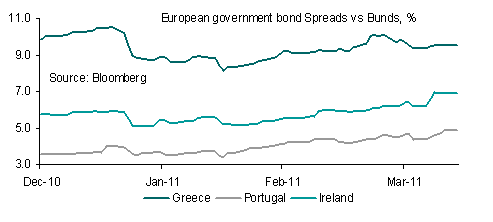
The setbacks noted above + others (see previous post) follow credit rating downgrades for Portugal by both S&P and Fitch ratings and growing speculation that the country is an imminent candidate for an EU bailout following the failure of the Portuguese government to pass its austerity measures last week and subsequent resignation of Portugal’s Prime Minister Socrates.

For its part Portugal has stated that it does not need a bailout but looming bond redemptions of around EUR 9 billion on April 15 and June 15 against the background of record high funding costs mean that the pressure for a rescue is intense. Complicating matters is the fact that fresh elections cannot be held earlier than 55 days after being announced, meaning that policy will effectively be in limbo until then. A June vote now appears likely.

After what was perceived to be a positive result of the informal EU leaders summit a couple of weeks ago, the outcome of the final summit last week failed to deliver much anticipated further details whilst more negatively the EU bailout fund’s paid-in capital was scaled back to EUR 16 billion (versus EUR 40 billion agreed on March 21) due to concerns expressed by Germany.

Ireland is also in focus ahead of European bank stress tests results on March 31. Ireland is pushing for increased sharing of bank losses with senior bondholders as part of a “final solution” for financial sector. Meanwhile the new government remains unwilling to increase the country’s relatively low corporation tax in exchange for a renegotiation of terms for the country’s bailout. This point of friction also threatens to undermine the EUR.

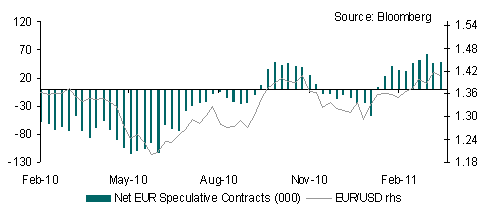
The bottom line is that the bad news is building up and the ability of the EUR to shake it off is lessening. Considering the fact that the market long EUR, with positioning well above the three-month average the EUR is vulnerable to position adjustment. After slipping over recent days EUR/USD looks supported above 1.3980 but its upside is looking increasingly restricted against the background of various pieces of bad news.