The case for Swiss franc weakness

EUR/CHF has continued to hug the 1.2000 ‘line in the sand’ enforced by the Swiss National Bank. CHF currently shows little sign of weakening although we continue to see risks of a higher EUR/CHF. Against the USD the CHF has been similarly stable but we look for USD/CHF to move higher eventually. The main imponderable is the timing of CHF weakness. Ongoing Eurozone doubts even after the agreement of a second bailout for Greece mean that the CHF remains a favoured destination for European money.

The outlook for EUR/CHF will depend on how the situation in the Eurozone develops. The recent agreement for a second Greek bailout received a muted reaction from markets, and there is a long way to go before confidence towards a resolution of the debt crisis can be fully restored. Assuming that there will be an eventual improvement in risk appetite, CHF will weaken given the strong correlation between EUR/CHF and risk over the past three months.

EUR/CHF has enjoyed a strong relationship with movements in interest rate differentials over the past few months, with both bond yields and interest rate futures. This implies that it will take a relative rise in German yields versus Swiss yields for EUR/CHF to move higher. This is certainly viable given the deterioration in Swiss economic data over recent months. Indeed, as reflected in the KoF Swiss leading indicator and manufacturing PMI data, the economy is heading downwards.

The threat of deflation has also increased in the wake of unwelcome CHF strength, which has left the currency extremely overvalued according to our measures of ‘fair value’. Growth will be weak this year but the economy may just avoid a negative GDP print. Against this background Swiss bond yields will remain low, along with policy rates. While the outlook for the Eurozone economy is not much better, bond yield differentials between the Eurozone and Switzerland are likely to widen, which will eventually help lead to a higher EUR/CHF exchange rate.

My blog posts will be less frequent over coming days as I am on a business trip to New York. Happy trading.
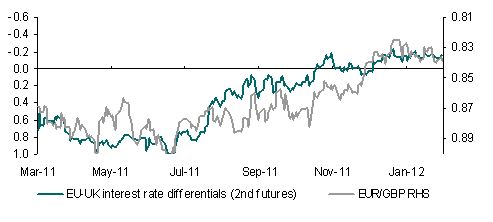
EUR/GBP upside overdone, CHF overly strong

Disappointing Eurozone service sector and manufacturing purchasing managers’ confidence indices as well as a contraction in Chinese manufacturing confidence sets the scene for a drop in risk assets. In addition in the US, existing home sales rose less than expected taking into account revisions to previous data.

Meanwhile scepticism over Greece’s ability to implement agreed upon reforms and reported resistance from Germany to increasing the firewall around peripheral Eurozone countries has delivered a further dose of negativity to markets. The market was probably looking for an excuse to sell after a strong rally and found plenty in yesterday’s news.

GBP has followed on the coat tails of the EUR over recent weeks, with the currency showing little independent direction. Reflecting this is the fact that EUR/GBP had until recently been trapped in a 0.83-0.84 range. As with the EUR I see downside risks to GBP over the short term against the USD.

Against the EUR, GBP will largely track the movement in yield differentials as it has done over recent months. Relatively dovish MPC minutes, with two members voting for bigger amounts of quantitative easing helped to put GBP under further pressure but the move higher in EUR/GBP look overdone.

My medium term view continues to show GBP appreciation versus EUR and current levels highlight a good opportunity to go short EUR/GBP. Markets are rewarding central banks that are proactive in their policy prescriptions. I exect this to result in some GBP resilience even if the BoE announces more QE.

EUR/CHF has continued to hug the 1.2000 line in the sand enforced by the Swiss National Bank. Ongoing Eurozone doubts even after the agreement of a second bailout for Greece mean that the CHF remains a favoured destination for European money. This is reflected by the fact that EUR/CHF has been highly correlated with Risk Aversion over the past 3-months.

It will take also take a relative rise in German yields versus Swiss yields for EUR/CHF to move higher. This is certainly viable given the deterioration in Swiss economic data over recent months. Indeed, as reflected in the KoF Swiss leading indicator and manufacturing PMI data, the economy is heading downwards. Assuming that there will be an eventual improvement in risk appetite, CHF will weaken given the strong correlation between EUR/CHF and risk aversion over the past 3-months.

Risk currencies flying high

The first month of 2012 passed rather more positively than anticipated and clearly was a good month for risky assets. Even the beleaguered EUR strengthened despite calls for an extended decline. Assets that were most heavily sold over 2011 were the biggest winners over January. Further signs of improvement in US economic data, receding fears of a China growth crash and even signs of tentative progress in the Eurozone debt crisis mean that sentiment may have finally turned a corner. This has been reinforced by the Fed’s commitment to maintain accommodative monetary policy until the end of 2014 and the ECB’s long term LTRO. I’m not entirely convinced but it wouldn’t pay to buck market optimism just yet.

Interestingly currency markets aren’t necessarily behaving as one would expect. In particular the JPY and CHF, both safe haven currencies, have not weakened despite an improvement in risk appetite. In contrast they have actually strengthened. Other currencies are behaving much as would be expected, especially high beta (risk sensitive) currencies, including AUD, NZD and many emerging market currencies, which have rebounded. Even the EUR has jumped past the 1.30 mark against the USD. Even the slow progress in agreeing on the magnitude of Greek writedowns has failed to dent confidence, with Eurozone peripheral bond yields dropping. Risk / high beta currencies are set to remain well supported over the short term.

Looking ahead the outcome of the US January jobs report at the end of the week as well as a final agreement on Greek debt will help determine whether the positive sentiment for risk assets will be maintained into next week. Meanwhile the USD looks as though it will remain under pressure especially given the continued downward pressure on US bond yields, which only continues to reinforce its role as a funding currency. This explains why both the JPY and CHF have stubbornly refused to weaken as narrowing US versus Japanese and Swiss bond yield differentials have kept these currencies under upward pressure. However, risks of FX intervention by both the Japanese and Swiss authorities suggests that upside may be limited.

Risk appetite remains fragile

Fortunately for the USD the situation in the eurozone has become so severe that the problems in the US are all but being ignored. Even in the US, attention on the nomination of the Republican presidential candidate has over shadowed the looming deadline for an agreement on medium term deficit reduction measures.

The Joint Select Committee on deficit reduction is due to submit a report to Congress by November 23 and a final package would be voted on by December 23. A lack of agreement would trigger automatic deficit reduction of $1.2 trillion, a proportion of which would take place in 2012. If this is the case it could potentially tip the economy into recession, necessitating QE3 and consequently a weaker USD.

Reports that the eurozone could fall apart at the seams as countries exit have shaken confidence, yet the EUR has managed to hold above the psychologically important 1.35 level. The strong reluctance of the European Central Bank (ECB) to embark on unsterilized bond purchases and to act as lender of the last resort, suggests that the crisis could continue to brew for a long while to come.

Nonetheless, the EUR found a semblance of support from news that former ECB vice-president Papademos was named new Prime Minister of Greece, the ECB was reported to be a strong buyer of peripheral debt, Italy’s debt auction was not as bad as feared, affirmation of the EFSF’s AAA rating by Moody’s and France’s AAA rating by S&P (following an erroneous report earlier). EUR/USD remains a sell on ralliesup to resistance around 1.3871, with initial resistance around the 1.3665 level.

The underlying pressure over the near term is for further JPY strength in the face of rising risk aversion and a narrowing in the US yield advantage over Japan. Given that the situation in the eurozone remains highly fluid as well as tense, with little sign of resolution on the horizon, risk aversion is set to remain elevated. Moreover, yield differentials have narrowed sharply and the US 2-year yield advantage over Japan is less than 10bps at present.

Against this background it is not surprising that the Japanese authorities are reluctant to intervene aggressively although there are reports that Japan has been conducting secret interventions over recent weeks. However, given that speculative and margin trading net JPY positioning have dropped significantly the impact of further JPY intervention may be less potent. In the meantime USD/JPY will likely edge towards a break below 77.00.

Swiss officials have continued to jawbone against CHF strength, with the country’s Economy Minister stating that the currency remains massively overvalued especially when valued against purchasing power parity. Such comments should be taken at face value but the CHF is unlikely to embark on a weaker trend any time soon.

Although the EUR/CHF floor at 1.20 has held up well while the CHF has lost some its appeal as a safe haven the deterioration in the situation in the eurozone suggests that the CHF will not weaken quickly.

Greece throws a spanner in the works

Having already retraced around 50% of its losses from its high around 4 April to its low on 27 October the USD index is on a firm footing and looks set to extend gains. The USD is benefitting both from the EUR’s woes and receding expectations of more US quantitative easing in the wake of less negative US data releases.

Whether the USD is able to build on its gains will depend on the outcome of the Fed FOMC meeting, accompanying statement and press conference today. While there have been some noises from Fed officials about the prospects of more QE, the Fed is likely to keep policy settings unchanged, leaving the USD on the front foot.

Greece has thrown a spanner in the works by calling a national referendum on the European deal. The fact that this referendum may not take place until January will bring about a prolonged period of uncertainty and further downside risks for the EUR against the USD and on the crosses. As a result of the increased uncertainty from the referendum, growing doubts about various aspects of last week’s agreement as well as hesitation from emerging market investors to buy into any European investment vehicle, peripheral bond spreads blew out further, and the EUR dropped.

The immediate focus will be on emergency talks today between European leaders in Cannes where Greek Prime Minister Papandreou has been summoned at a time when his grip on power appears to be slipping ahead of a government confidence vote on Friday. EUR/USD looks set to slip to support around 1.3525.

The Swiss National Bank’s floor under EUR/CHF has held up well since it was implemented in early September. How well it can be sustained going forward is questionable especially given that risk aversion is intensifying once again. A weaker than forecast reading for the Swiss October manufacturing PMI yesterday falling further below the 50 boom / bust reading to 46.9 highlights the growing economic risks and consequent pressure to prevent the CHF from strengthening further. However, now that Japan has shown its teeth in the form of FX intervention the CHF may find itself once again as the target of safe haven flows.

Technical indicators revealed that GBP was overbought and its correction lower was well overdue. However, GBP looks in better shape than the EUR even in the wake of some mixed UK data yesterday. On a positive note, UK Q3 GDP surprised on the upside in line with our expectations coming in at 0.5% QoQ. However, the forward looking PMI manufacturing index dropped more than expected in October, down to 47.4 suggesting that UK economic momentum is waning quickly.

EUR/GBP looks set to test its 12 September low around 0.8259 but GBP/USD remains vulnerable to a further pull back against a resurgent USD. Overall, GBP’s resilience despite the implementation of more quantitative easing by the Bank of England has been impressive and I expect it to continue to benefit from its semi safe haven status