EUR boosted, USD under pressure

Market attention remains fully focussed on events in Japan especially related to the country’s nuclear facilities. Risk aversion has spiked higher as a result, with ongoing Middle East tensions adding to the risk off tone. CHF is a key beneficiary of safe haven demand but the picture for JPY is obscured by repatriation expectations on one hand and FX intervention risks/Bank of Japan liquidity injections on the other, keeping USD/JPY clsoe to the 82.00 level. In contrast the AUD is vulnerable to a drop below parity with the USD on Japan worries, especially as Australia is a key destination for Japanese investment and therefore potential for reversal of such flows if Japanese institutions repatriate funds.

The EUR recovered over recent days as worries about the eurozone periphery ease and peripheral bonds spreads narrow. It is only a matter of time before overly long market positioning catches up with the EUR especially as the prospects of further interest rate support to the currency looked limited; markets have already priced in 75bps of policy rate hikes in the eurozone this year, which looks appropriate. It is difficult to see markets pricing in any more tightening than this over coming weeks. Despite its bounce back EUR/USD will struggle to break resistance around 1.4036.

Markets will digest the fallout from the informal EU leaders meeting last Friday which prepared the groundwork for the official meeting on 24/25 March. The initial reaction of the EUR appears to be positive but there is a significant risk of disappointment if the outcome of the meeting on 24/25 March does not live up to expectations. Indeed although Friday’s meeting resulted in an agreement in principle of a new “pact for the Euro” much will depend on the eventual details later this month.

Leaders also agreed on lowering interest rates to Greece by 100bps, and in principle enlarging the scope of the European Financial Stability Facility (EFSF) bailout fund to EUR 440 billion. The main positive surprise was opening the door for the fund to purchase eurozone debt. Data releases will offer little support to the EUR this week, with limited gains in the March German ZEW investor confidence survey today likely to leave markets unperturbed.

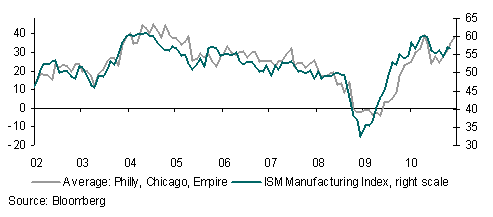
The USD’s gains last week proved short-lived and the currency will be tested by another relatively dovish Fed FOMC statement today and a benign reading for core CPI inflation in February. The Fed FOMC meeting is unlikely to deliver any changes to the Fed’s stance and whilst there has recently been some speculation that the Fed will soon remove its “extended period” comment, this is unlikely to happen any time soon. The statement will remind markets that the Fed is in no rush to alter its policy settings, an outcome that may limit the ability of the USD to strengthen this week even if data releases continue to remain on the positive side, including manufacturing survey and industrial production over coming days.
ECB In Focus

The highlight today is the European Central Bank (ECB) council meeting. Markets have priced in a hawkish stance from the ECB; Euro rates have edged higher whilst EUR/USD has strengthened. The ECB is likely to highlight worries about price developments today paving way for a hike in H2 2011. Watch for any shift in the balance of risks statement in the press conference and upward revisions to inflation and growth forecasts. In terms of liquidity operations the full allotment procedures at the Main Refinancing Operations (MRO) are likely to be extended for another three months.

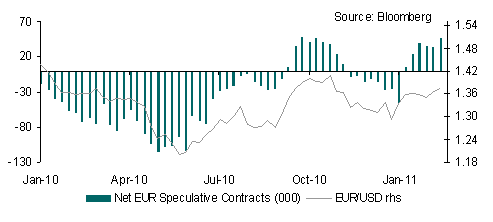
EUR risks are asymmetric and whilst the currency remains a buy on dips (with technical indicators pointing to a move to 1.4000) the bigger risk is if the ECB does not live up to the hawkish market expectations which could hit EUR given long positioning overhang. Other than this, risk aversion remains elevated according to my barometer, supporting JPY and CHF. US numbers remain upbeat as seen in the ADP private sector jobs report yesterday, which will likely lead to an upward revision to non-farm payrolls forecasts in February (currency consensus 195k). However, the USD impact of positive data is limited against the background of a relatively dovish Fed stance.

Losing Your Addiction

An interesting thing happened to me last week. On a business trip to Europe my blackberry broke and failed to work for the rest of the week. I felt like an addict coming off an addiction. The first couple of days were very tough; my usual instinct to constantly check for messages resulted in constant fidgeting and major withdrawal symptoms.

Once this had worn off I must admit I felt liberated. My addiction gone, it felt great to be weaned off my crackberry. The message here is that life goes on without access to mail. It’s an experience I would recommend to all users of such devices.

Back to reality and my view from Hong Kong this week is as follows. The risk-off tone as reflected in related to the turmoil in Libya and the increase in oil prices (as supply concerns intensify), may help to limit the pressure on the USD this week, but the overall tone is set to remain weak.

Much will depend on this week’s key US data releases and a testimony by Fed Chairman Bernanke to the US Senate, to determine whether the USD will find a more stable footing. Clearly the more hawkish tone of the European Central Bank (ECB) and Bank of England (BoE) in contrast to the lack of inclination by the Fed towards a tighter monetary policy stance could undermine the USD.

In this respect, it is doubtful that Bernanke will change his stance of the Fed failing to meet its dual mandate due to too low inflation. The main event is the February US jobs report at the tail end of the week. The consensus expectation of a 190k increase in payrolls will be finalised after gaining more clues from the US February ISM surveys and ADP jobs report earlier in the week. The week’s releases will likely reveal further improvements in US economic data, but given that this will do little to budge the Fed’s stance, the USD may be left somewhat underwhelmed.

The intensification in risk aversion over recent days has also been felt in the Eurozone periphery where bond market pressures have resumed. Nonetheless, the fallout on the EUR has been limited by hawkish ECB jawboning. Thursday’s ECB meeting will surely maintain this stance, and following the release of data on Tuesday likely to show a further increase in inflation in February, upside inflation risks are likely to be highlighted by ECB President Trichet in the press conference.

A likely pre-emptive strike from the ECB cannot be ruled out. Two rate hikes in H2 2011 are now likely even as the Bank maintains liquidity support for weaker peripherals. No change in policy but a hawkish press statement on Thursday will on the face of it play for a firmer EUR but i) the fact that the market has already discounted the possibility of early rate hikes and ii) the proximity of the US payrolls data on Friday and iii) uncertainty over the impact of the Irish election outcome in which the Fine Gael party won a clear victory, suggest that EUR risks are asymmetric. The net long positioning overhang also points to some downside risks to EUR.

There are plenty of other events and data on the calendar this week including Japan’s slate of month end releases, interest rate decisions by the Reserve Bank of Australia and Bank of Canada, UK PMI manufacturing survey data and Swedish Q4 GDP data.

The bottom line is that currencies will be driven by the conflicting influences of improving economic data on the one hand and elevated risk aversion on the other. The main beneficiaries of higher risk aversion will be the CHF and JPY though both have risen far whilst the USD will be restrained by a dovish Fed.

In contrast the EUR and GBP may yet extend gains but in both cases, markets have already shifted policy tightening expectations sharply over recent weeks and we suspect EUR/USD will be capped at resistance around 1.3860, whilst GBP/USD will similarly struggle to break its year high around 1.6279.

FX Winners and Losers

There has been a sense of mean reversion in FX markets so far this year as some of last year’s winners have become losers. Namely NZD, CHF, JPY and AUD have all lost ground whilst EUR and GBP have gained ground. The odd one out is the SEK which has strengthened over 2010 and in 2011 versus USD. I expect this pattern to change and the likely winners over the next 3- months are NZD, AUD and CAD, with CHF and JPY the likely losers.

EUR held up reasonably well in the wake of slightly disappointing growth data, with eurozone GDP rising less than expected in Q4, and a smaller than expected gain in the February German ZEW investor confidence survey (economic sentiment component). My sense is that the net long EUR speculative position has already been pared back somewhat over recent days reducing the potential selling pressure on the currency in the near term.

Given that EUR/USD is one of the only major currency pairs being influenced by interest rate differentials, its direction will hinge more on policy expectations but in the near the announcement by the German Finance Minister this morning of a restructuring plan for WestLB may give the currency some support.

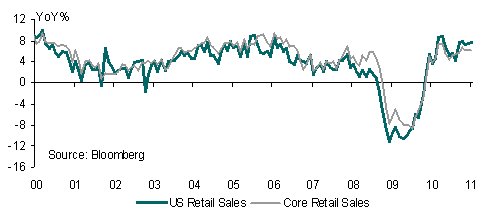
Perhaps one explanation for the stability of EUR/USD around the 1.3500 level is that US data was also disappointing yesterday. January retail sales rose less than forecast whilst revisions to back months suggest less momentum in Q4 consumer spending than previously envisaged. As with the eurozone data weather likely played a role in contributing to the outcome.

The net impact on currencies is that they are largely stuck within tight ranges. Further direction will come from the release of the Fed FOMC minutes for the January 26th meeting. The minutes may undermine the USD if a likely dovish slant continues to be expressed but given that the FOMC decision at that meeting to hold policy setting unchanged had no dissenters this should not come as a surprise.

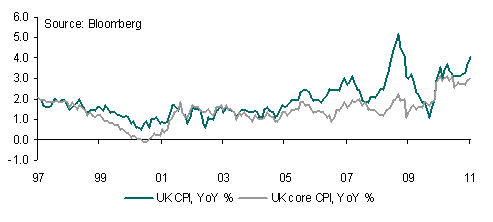
Whilst the battle between the USD and EUR ended in a stalemate GBP outperformed in the wake of the increase in UK January CPI inflation and in particular the letter from the BoE governor to the Chancellor keeping open the door to a rate hike. The Quarterly Inflation Report (QIR) today will be particularly important to determine whether the bounce in GBP is justified.

I remain hesitant to build on long GBP positions given the net long speculative overhang in the currency. The risks following yesterday’s jump in GBP are asymmetric, with a hawkish QIR likely to have less impact on the currency than the negative impact from a more dovish than expected report.

Econometer.org has been nominated in FXstreet.com’s Forex Best Awards 2011 in the “Best Fundamental Analysis” category. The survey is available at http://www.surveymonkey.com/s/fx_awards_2011

All Eyes On US Jobs Data

Happy New Year!

2010 ended on a sour note especially for eurozone equity markets (and the Australian cricket team) where there has yet to be a resolution to ongoing growth/fiscal/debt tensions.  The EUR strengthened into year end but this looked more like position adjustment than a shift in sentiment and EUR/USD is likely to face stiff resistance around the 1.3500 level this week, with a drop back towards 1.3000 more likely.  In the US there was some disappointment in the form of a surprise drop in December consumer confidence data but pending home sales and the Chicago PMI beat expectations, with the overall tone of US data remaining positive.

There will be plenty to chew on this week in terms of data and events which will provide some much needed direction at the beginning of the year.  The main event is the December US jobs report at the end of the week.   Ahead of this there will be clues from various other job market indicators including the Challenger jobs survey, ADP employment report, and the ISM manufacturing and non-manufacturing surveys.  The data will reflect a modest improvement in job market conditions and the preliminary forecast for December payrolls is for a 135k increase, with private payrolls set to rise by 145k and the unemployment rate likely to fall slightly to 9.7%.

The minutes of the 14 December Fed FOMC meeting (Tue) will also come under scrutiny against the background of rising US bond yields.  In addition, Fed Chairman Bernanke will speak on the monetary and fiscal outlook as well as the US economy to the Senate Budget Panel.   Bernanke will once again defend the use of quantitative easing whilst keeping his options open to extend it if needed.  However, the changing composition of the FOMC with four new members added in 2011 suggests a more hawkish tinge, which will likely make it more difficult to agree on further QE.   In any case, the tax/payroll holiday package agreed by the US administration means that more QE will not be necessary. 

It’s probably not the most auspicious time for new member Estonia to be joining the eurozone especially as much of the speculation last year focussed on a potential break up.  The beginning of the year will likely see ongoing attention on the tribulations of Ireland after its bailout, with looming elections in the country.  Portugal and Spain will also remain in focus as the “two-speed” recovery in 2011 takes shape.  Data releases this week include monetary data in the form of the eurozone December CPI estimate and M3 money supply.  Inflation will tick up to 2% but this ought to be of little concern for the ECB.  Final PMI data and confidence indices will likely paint a picture of slight moderation.   

The USD ended the year on a soft note, with year lows against the CHF and multi year lows vs. AUD registered, but its weakness is unlikely to extend much further.  The key driver will remain relative bond yields and on this front given the prospects for relative US yields to move higher, the USD will likely gain support.  There maybe a soft spot for the USD in Q1 2011 but for most of the rest of the year the USD is set to strengthen especially against the EUR which will increasingly comer under pressure as peripheral tensions and growth divergence weigh on the currency.