Currencies At Pivotal Levels

Ahead of today’s highly anticipated Fed FOMC meeting markets are holding their breath to determine exactly what the Fed will deliver. The consensus view is for the Fed to announce a programme of $500 billion in asset purchases spread over a period of 6-months. The reaction in currency markets will depend on the risks around this figure. Should the Fed deliver a bigger outcome, say in the region of $1 trillion or above, the US dollar will likely come under renewed pressure. However, a more cautious amount of asset purchases will be US dollar positive.
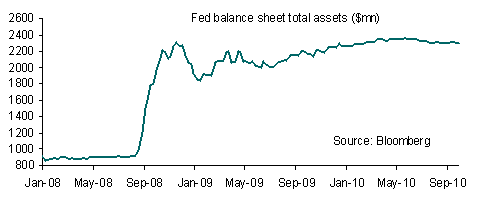
It has to be noted that the Fed will likely keep its options open and keep the program open ended depending on the evolution of economic data which it will use to calibrate its asset purchases. The USD will likely trade with a soft tone ahead of the Fed outcome, but with so much in the price, it may be wise to be wary of a sell on rumour, buy on fact outcome.

Whatever the outcome many currencies are at pivotal levels against the USD at present, with AUD/USD flirting around parity following yesterday’s surprise Australian rate hike, EUR/USD holding above 1.4000, GBP/USD resuming gains above 1.600 despite a knock back from weaker than forecast construction data, whilst USD/JPY continues to edge towards 80.00. Also, both AUD and CAD are trading close to parity with the USD. The Fed decision will be instrumental in determining whether the USD continues to remain on the weaker side of these important levels.

Going into the FOMC meeting the USD has remained under pressure especially against Asian currencies as noted by the renewed appreciation in the ADXY (a weighted index of Asian currencies) against the USD this week. Although it appears that the central banks in Asia have the green light to intervene at will following the recent G20 meeting the strength of capital inflows into the region is proving to be a growing headache for policy makers. One option is implementing measures to restrict “hot money” inflows but so far no central bank in the region has shown a willingness to implement measures that are deemed as particularly aggressive.

There has been some concern that Asia’s export momentum was beginning to fade as revealed in September exports and purchasing managers index (PMI) data in the region and this in turn could have acted as a disincentive to inflows of capital, resulting in renewed Asian currency weakness. The jury is still out on this front but its worth noting that Korean exports in October reversed a large part of the decline seen over previous months. Moreover, the export orders component of Korea’s PMI remained firm suggesting that exports will resume their recovery.

Nonetheless, manufacturing PMIs have registered some decline in October in much of Asia suggesting some loss of momentum, with weaker US and European growth likely to impact negatively. However, China’s robust PMI, suggests that this source of support for Asian trade will remain solid. Similarly a rise in India’s manufacturing PMI in October driven largely by domestic demand, highlights the resilience of its economy although with inflation peaking its unlikely that the Reserve Bank of India (RBI) will follow its rate hike on Tuesday with further tightening too quickly.
Temporary relief for US Dollar

Downbeat US economic news in the form of a widening US trade deficit, increase in jobless claims and bigger than expected increase in top line PPI inflation contrasted with upbeat earnings from Google. Google shares surged over 9% in after hours trading but US data tarnished the risk on mood of markets, leaving commodity prices and equities lower and the USD firmer. Higher US Treasury yields, especially in the longer end following a poor 30 year auction, helped the USD to push higher.

The USD’s trend is undoubtedly lower but profit taking may be the order of the day ahead of a speech by Fed Chairman Bernanke on monetary policy later today and the release of the highly anticipated US Treasury Report in which China may be named as a currency manipulator. A speech by the Minneapolis Fed’s Kocherlatoka (non voter) this morning sounded downbeat, even suggesting that “Fed asset purchases may have a muted effect”. Despite such comments the Fed appears likely to embark on QE2 at its 3 November meeting.

Today is also a key data for US data releases with September data on US retail sales, and CPI and October data on Michigan confidence and Empire manufacturing scheduled for release. Retail sales are likely to look reasonable, with headline sales expected to rise 0.5% and ex-autos sales expected up 0.4%. The gauges of both manufacturing and consumer confidence are also likely to show some recovery whilst inflation pressures will remain benign. Given the uncertainty about the magnitude of QE the Fed will undertake in November, the CPI data will have added importance.

The US trade will likely have resulted in an intensification of expectations that China will be labelled as a currency manipulator in the US Treasury report later today. The August trade deficit with China widened $28.04 billion, the largest on record. At the least it will give further ammunition to the US Congress who are spoiling for a fight ahead of mid-term congressional elections, whilst heightening tensions ahead of the November G20 meeting.

Indeed currency frictions continue to increase although “currency war” seems to be an extreme label for it. Nonetheless, Singapore’s move yesterday to widen the SGD band highlighted the pressure that many central banks in the region are coming under to combat local currency strength. Singapore’s move may be a monetary tightening but it is also a tacit recognition of the costs of intervening to weaken or at least limit the strength of currencies in the region. To have maintained the previous band would have required ongoing and aggressive FX intervention which has its own costs in terms of sterilization.

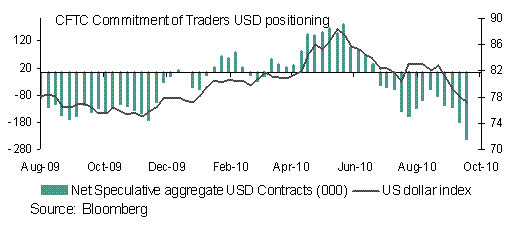
This problem will remain as long as the USD remains weak and this in turn will depend on US QE policy and bond yields. A lot of negativity is priced into the USD and market positioning has become quite extreme suggesting that it will not all be a downhill bet for the currency. Many currencies breached or came close to testing key psychological and technical levels yesterday, with EUR/USD breaching 1.4000, GBP/USD breaking 1.6000, USD/CAD breaking below parity and AUD/USD coming close to testing parity. Some reversal is likely today, but any relief for the USD is likely to prove temporary.

No FX co-operation

Despite all the jawboning ahead of the IMF / World Bank meetings over the weekend the meeting ended with little agreement on how deal to with the prospects of a “currency war”. US officials continued to sling mud at China for not allowing its currency, the CNY, to appreciate quickly enough whilst China blamed the US for destabilizing emerging economies by flooding them with liquidity due to the Fed’s ultra loose monetary policy stance. Chinese trade data on Wednesday my throw more fuel on to the fire given another strong surplus expected, lending support to those in the US Congress who want to label China as a “currency manipulator”.

Although the IMF communiqué mentioned countries working co-operatively” on currencies there were no details on how such cooperation would take place. The scene is now set for plenty of friction and potential volatility ahead of the November G20 meeting in Seoul. Although many central banks are worrying about USD weakness when was the last time US Treasury Secretary Geithner talked about a strong USD? US officials are probably happy to see the USD falling and are unlikely to support any measure to arrest its decline unless the drop in the USD turns into a rout. In contrast, the strengthening EUR over recent weeks equates to around 50bps of monetary tightening, a fact that could put unwanted strain on Europe’s growth trajectory, especially in the periphery.

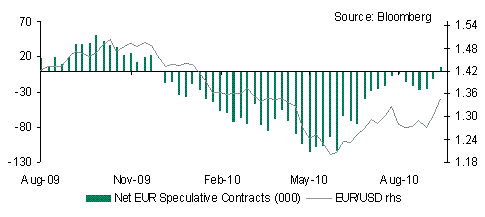
The outcome of the IMF meeting leaves things much as they left off at the end of last week. In other words there is little to stand in the way of further USD weakness apart from the fact that the market is already extremely short USDs. Indeed the latest CFTC IMM data revealed that aggregate net USD positioning came within a whisker of its all time low, with net positions at -241.2k contracts (USD -30 billion), the lowest USD positioning since November 2007. Interestingly and inconsistent with the sharp rise in the EUR, positioning in this currency remains well below its all time highs, supporting the view that rather than speculative investors it is central banks that are pushing the EUR higher.

The US jobs report at the end of last week proved disappointing, with total September payrolls dropping by 95k despite a 64k increase in private payrolls. The data will act to reinforce expectations that the Fed will begin a program of further asset purchases or quantitative easing (QE2) at its November meeting. Data and events this week will give further clues, especially the Fed FOMC minutes tomorrow and speeches from Fed Chairman Bernanke on Thursday and Friday as well as various other Fed speakers on tap.

Recent speeches by Fed officials have highlighted growing support for QE although some have tried to temper expectations. Questions about the timing and size of any new programme, as well as how it will be communicated remain unanswered. Although November seems likely for the Fed to start QE the Fed’s Bullard suggested that the Fed may wait until December. The minutes will be scrutinized for clues on these topics. The Fed is likely to embark on incremental asset purchases with the overall size being data dependent and the USD set to remain under pressure while this happens.

Speculators bail out of USDs

Risk appetite held up reasonably well last week, with markets failing to be derailed by concerns over Ireland’s banking sector and growing opposition to austerity measures across Europe. The main loser remained the USD, with the USD index hitting a low marginally above 78.00 and speculative positioning as reflected in the CFTC IMM data revealing a further sharp drop in sentiment to its lowest since Dec 2007.

This week is an important one for central bank meetings, with four major central banks deliberating on monetary policy including Bank of Japan (BoJ), Reserve Bank of Australia (RBA), European Central Bank (ECB) and Bank of England (BoE). The major event of the week however, is Friday’s release of the September US employment report. The RBA is set to hike its cash rate by 25bps, the BoJ may announced more easing measures whilst in contrast both the ECB and BoE are unlikely to alter their policy settings.

Whilst the BoJ is widely expected to leave its policy rate unchanged at 0.1%, it may announce further measures against the background of persistent JPY strength, a worsening economic outlook as reflected in last week’s Tankan survey and decline in exports. Japanese press indicate that the BoJ may increase lending of fixed rate 3 to 6 month loans to financial institutions as well as buy more short-term government debt.

The measures alongside risks of further JPY intervention may prevent USD/JPY slipping further but as reflected in the increase in speculative net long JPY positions last week, the market is increasingly testing the resolve of the Japanese authorities. Strong support is seen around USD/JPY 82.80, with the authorities unlikely to allow a break below this technical level in the short-term.

Although we will only see details of the voting in two weeks in the release of the UK BoE Monetary Policy Commitee (MPC) minutes it is likely that there was a three-way split within the MPC as reflected in recent comments, with MPC member Posen appearing to favour more quantitative easing whilst the MPC’s Sentance is set to retain his preference for higher rates. As has been the case over recent months the majority of the MPC are likely to have opted for the status quo.

GBP was a laggard over September as markets continued to fret over potential QE from the BoE. This uncertainty is unlikely to fade quickly suggesting limited gains against the USD and potentially more downside against the EUR. GBP speculative sentiment has improved but notably positioning remains short. EUR/GBP will likely target resistance around 0.8810.

In contrast to GBP the EUR has taken full advantage of USD weakness and looks set to extend its gains. Although there is a risk that speculative positioning will soon become overly stretched it is worth noting that positioning is well below its past highs according to the IMM data. EUR may have received some support from Chinese Premier Wen’s pledge to support Greece, and a stable EUR. Whilst there continues to be risks to the EUR from ongoing peripheral debt concerns such comments likely to be repeated at the EU-Asia summit today and tomorrow, will keep the EUR underpinned for a test of 1.3840.

FX Tension

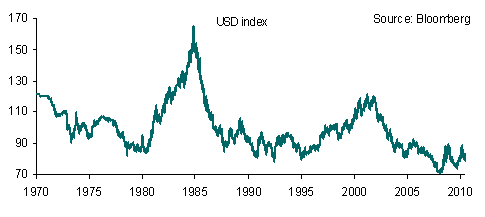
On September 22 1985 the governments of France, West Germany, Japan, US and UK signed the Plaza Accord which agreed to sharply weaken the USD. At this time it was widely agreed that the USD was overly strong and needed to fall sharply and consequently these countries engineered a significant depreciation of the USD.

It is ironic that 25 years later governments are once again intervening in various ways and that the USD is once again facing a precipitous decline as the Fed moves towards implementing further quantitative easing. This time central banks are acting unilaterally, however, and there is little agreement between countries. For instance Japan’s authorities found no help from the Fed or any other central bank in its recent actions to buy USD/JPY.

So far Japan’s FX interventions have been discreet after the initial USD/JPY buying on 15 September. The fact that Japan is less inclined to advertise its FX intervention comes as little surprise given the intensifying pressure from the US Congress on China for not allowing its currency, the CNY to strengthen. Tensions have deepened over recent weeks and the backing of a bill last week by an important Congressional committee to allow US companies to seek tariffs on Chinese imports suggests that the situation has taken a turn for the worse.

The softly softly approach to Japan’s FX intervention and US/China friction reflects the fact that unlike in 1985 we may be entering a period in which currency and in turn trade tensions are on the verge of intensifying sharply against the background of subdued global economic recovery.

The Fed’s revelation that it is moving closer to implementing further quantitative easing has shifted the debate to when QE2 occurs rather than if, with a November move moving into focus. Clearly the USD took the news negatively and will likely remain under pressure for a prolonged period as the simple fact of more USD supply weighs heavily on the currency. Markets will be able to garner more clues to the timing of QE2, with a plethora of Fed speakers on tap over coming days.

This week the US economic news will be downbeat, with September consumer and manufacturing confidence surveys likely to register declines, with consumer sentiment weighed down by the weakness in job market conditions. Personal income and spending will also be of interest and gains are expected for both. There will be plenty of attention on the core PCE deflator given that further declines could give clues to the timing of QE2.

Attention in Europe will centre on Wednesday’s recommendations for legislation on “economic governance” from the European Commission. Proposed penalties for fiscal indiscipline may include withholding of funding and/or voting restrictions but such measures would be politically contentious. Measures to enforce fiscal discipline ought to be positive for markets given the renewed tensions in peripheral bond markets in the eurozone.

The EUR was a major outperformer last week benefiting from intensifying US QE speculation and will set its sights on technical resistance (20 April high) around 1.3523 in the short-term. Notably EUR speculative positioning has turned positive for the first time this year according to the CFTC IMM data, reflecting the sharp shift in speculative appetite for the currency over recent weeks. The EUR has been surprisingly resilient to renewed sovereign debt concerns and similarly softer data will not inflict much damage to the currency this week.