Greece In The Spotlight (again)

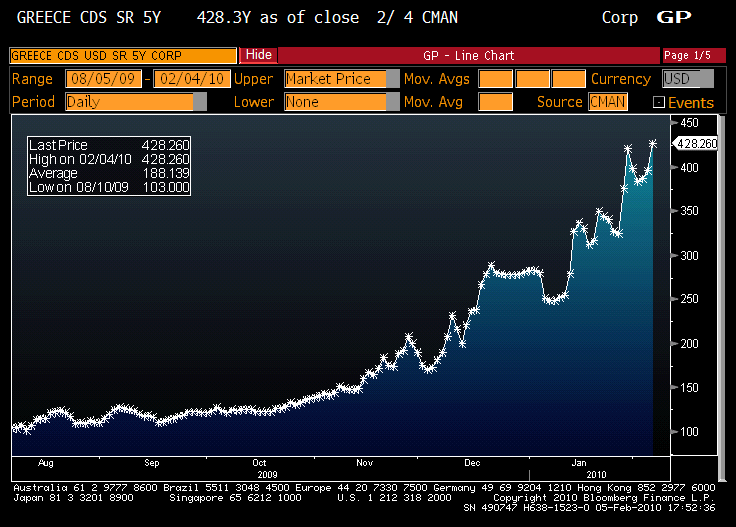
Once again Greek worries are hogging the limelight and although the Greek saga has become a rather tedious affair for markets, concerns are well founded.  The latest issue is whether Greece is willing to adhere to potentially tough measures that would be associated with IMF assistance for the country.  Latest speculation suggests that Greece may side step the IMF to avoid such measures though this was belatedly denied by the Greek authorities. 

Given the huge amount of bonds Greece needs to sell over the coming weeks renewed nervousness does not bode well for a good reception to this issuance. As it is financing costs are rising once again in the wake of a renewed widening in Greek sovereign bond spreads and servicing this debt will add to the economic misery.  Greece has little by way of upside over coming months and years.  Tough and necessary austerity measures mean that sharp growth deterioration is inevitable, deepening recession.

The lack of flexibility for Greece to devalue its way out of its quagmire means much more economic pain with no release valve.   The same applies to the likes of Spain and Portugal.  The overall loser will be the EUR which looks likely to succumb to further weakness in the months ahead; the parity trade remains a prospect. Perversely a weaker EUR may be exactly what is necessary to alleviate some of the pain for Southern European economies though the EUR would need to weaken by much more than we forecast to be of much help.   

Aside from Greek gyrations the overall market tone looks somewhat positive.  The Fed’s dovish minutes of its March 16 meeting in which it marginally downgraded growth and inflation forecasts, highlights that interest rates are unlikely to be raised by the Fed this year. This will keep in place an accommodative policy stance conducive to further improvements in risk appetite.     Moreover, data releases such as the US ISM manufacturing and non-manufacturing surveys, have been generally supportive to recovery,

Easing tensions on China/US exchange rate policy have also helped sentiment as the issue has been put to one side after the US administration delayed the decision whether to officially label China as a currency manipulator.  Pressure from the US Congress suggests that the issue will not be on the back burner for long and the issue of CNY revaluation will likely be a topic at the during the various meetings between US and Chinese officials over coming weeks. 

Nonetheless, the delay in the US Treasury report will work in favour of a Chinese currency revaluation sooner rather than later as China will likely react more favourable to less international pressure to revalue.
Why Buy Asian FX (Part 2)

The strength of portfolio capital inflows into Asia reflects the outperformance of Asian economies relative to Western economies. Whilst the US, Europe, Japan and UK have struggled to recover from recession and are likely to register only sub-par recovery over the coming months, Asian economies led by China are recovering quickly and strongly. This pattern is set to continue, leading to a widening divergence between Asian and G7 economic growth.

As growth strengthens inflationary pressures are set to build up and Asian central banks will likely raise interest rates more quickly than their G7 counterparts. Already some central banks have moved in this direction, with India, Malaysia, Philippines and Vietnam, having tightened policy. This will be followed by many other central banks in Asia over Q2 2010 including China. Even countries with close trade links to Asia, in particular Australia will rate hikes further over coming months, with Australian interest rates likely to rise to a peak of 5% by year-end.

Given that the US is unlikely to raise interest rates in 2010 higher interest rates across Asia will result in a widening in the interest rate differential with the US leading to more upside potential for Asian currencies as their ‘carry’ attraction increases relative to the USD. The most sensitive Asian currencies to interest rate differentials at present are the Malaysian ringgit (MYR), Thai baht (THB) and Philippines peso (PHP) but I believe that as rates rise in Asia, the sensitivity will increase further for many more Asian currencies.

Most Asian currencies have registered positive performances versus the USD in 2010 led by the MYR and Indonesian rupiah (IDR) and closely followed by the Indian rupee (INR), THB and South Korean won (KRW). The notable exception is China which has been unyielding to pressure to allow the CNY to strengthen. Even China is set to allow some FX appreciation although if the US labels China as a “currency manipulator” it could prove counterproductive and even result in a delay in CNY appreciation.

Looking ahead, the trend of strengthening Asian FX will continue likely led by the likes of the KRW and INR but with the MYR, TWD and IDR not far behind. Stronger growth, higher interest rates, strengthening capital inflows and higher equity markets will contribute to appreciation in Asian currencies over the remainder of the year.

Why Buy Asian FX (Part 1)

Given all the attention on Greece and European fiscal/debt woes over recent weeks it’s been easy to forget about the success story of Asian economies. Of course, there has been a lot of attention on China and the international pressure to revalue its currency. However, the stability and resilience of Asian economies has been impressive throughout the financial crisis and recent Greek saga, helping to boost the attraction of Asian currencies.

Asia has managed to avoid the fiscal/debt problems associated with many developed economies, due to much better fiscal management over recent years. There are a couple of exceptions however, including the Philippines and India, but the fiscal positions in these countries have seen an improvement and are unlikely to lead to anywhere near the same sort of problems associated with Greece and other European countries.

So far this year capital inflows into Asian equity markets have much been stronger than 2009, albeit after a rocky start to the year when flows dried up due to rising risk aversion. Since then inflows have resumed strongly. The comparison to 2008 is even more dramatic as much of Asia registered significant capital outflows that year. South Korea, India and Taiwan, respectively, have led the way in term of inflows into equity markets in 2010, with inflows of $4.3 billion, $3.7 billion and $3.3 billion, respectively.

It is no coincidence that Asian currencies are most sensitive to the performance of Asian equity markets, with strong capital inflows and rising equities leading to stronger currency performance. Asia is set to continue to be a strong destination for equity flows over coming months, which given the high Asian equity correlation with local currencies, will lead to further appreciation in most Asian FX. A likely CNY revaluation in China will also help to fuel further Asian FX upside.

US/China Tensions Ratchet Higher

FX policy tension is a theme that looks to be making a come back. The potential for CNY revaluation continues to be hotly debated, with international pressure on China intensifying. For its part China continues to resist such calls, but growing speculation that the US will label China a “currency manipulator” in the semi-annual US Treasury report on 15 April suggests that the issue will remain very much on the radar screen.

Tensions have ratcheted higher in the wake of a proposed bill by US senators targeting countries with “fundamentally misaligned currencies” and those needing “priority action”. Any country that is targeted would then have a year to correct its currency or face a case at the World Trade Organisation. If China is labelled as a currency manipulator it could also result in anti dumping regulations.

Much of the increase in tension may be attributable to politicking ahead of the November mid-term Congressional elections but it is clear that the issue is not going away quickly. Chinese Premier Wen’s strong comments over the past weekend denying any need for revaluation of the CNY suggests that the stakes will get even higher over coming months.

It is looking increasingly difficult for the US administration to ignore Congress’ calls for stronger action on FX. Moreover, US President Obama’s pledge to double US exports within 5-years will require some USD weakness, but the USD will need to weaken against Asian currencies led by China and not just against the usual culprits such as the EUR.

There is little sign of this happening anytime soon as Asian central banks continue to intervene to prevent their currencies from strengthening. Nonetheless despite China’s insistence that it does not believe the CNY is undervalued China is likely to be edging closer to an eventual revaluation in the CNY sometime in Q2 2010 as it combined a stronger currency with higher interest rates and tighter lending to curb inflation. A stronger CNY will also spur other Asian central banks to allow stronger currencies.

A deterioration in the China/US relationship could have potentially significant FX implications. The latest US Treasury TIC report this week showed that China reduced its holdings of US Treasuries for the third straight month in January. Should China feel that it needs to retaliate against a more aggressive US trade or FX stance it could reduce its holdings of US Treasuries further.

Currency Tensions Intensify Ahead of G7

Portugal, Greece and Spain remain firmly in the spotlight but it may not be long before the light broadens to include UK, US and many other countries facing similar difficulties on the fiscal front. Portuguese, Greek and Spanish equities were smashed in the wake of growing concerns and sentiment looks like it will get worse before it gets any better.

Events in each of these countries are not helping matters. In Portugal, parliament began to vote on a bill on financial transfers to the regions, which could damage the ability of the government to reduce the deficit whilst speculation that the Prime Minister is about to resign has intensified. In Greece tax collectors have started a 48-hour strike as social unrest worsens in the wake of the implementation of deficit cutting measures.

Although European officials pour cold water on the idea that the whole EMU Project could unravel bond markets are not taking any chances whilst the EUR looks destined to languish at ever weaker levels until there is a semblance of calm. Meanwhile. the European Central Bank (ECB) has clearly stated that does not want to get involved.

The G7 meeting in Canada will move rapidly into focus this weekend, with a joint press conference expected on Saturday. Sovereign debt concerns and restrictions and banks will likely be addressed whilst the not insignificant matter of China’s currency will also likely be discussed.

US pressure on China to strengthen the CNY has increased as has tensions between the two countries following US arms sales to Taiwan and a scheduled meeting between President Obama and the Dalai Lama.

There is growing speculation that the upcoming US Treasury report in April will label China as a currency manipulator which could result in tensions ratcheting up to a higher level. China holds the cards given the US reliance on Chinese money but with mid-term elections looming in the US and Obama’s promise to double US exports within five years, US pressure on China will intensify as will likely resistance from China.