G20 Leaves The US Dollar Under Pressure

The G20 meeting of Finance Ministers and Central bankers failed to establish any agreement on clear targets or guidelines. Perhaps the problem of trying to achieve consensus amongst a variety of sometimes conflicting views always pointed to an outcome of watered down compromise but in the event the G20 summit appears to pass the buck to November’s summit of G20 leaders in Seoul where more concrete targets may be outlined.

Officials pledged to “move towards more market determined exchange rate systems” and to “refrain from competitive devaluation of currencies”. What does this actually mean? The answer is not a great deal in terms of practical implications. The first part of the statement is the usual mantra from such meetings and the addition of the latter part will do little to stop central banks, especially in Asia from continuing to intervene given that no central bank is actually devaluing their currency but rather preventing their currencies from strengthening too rapidly.

The communiqué highlighted the need for advanced economies being “vigilant against excess volatility and disorderly movements in exchange rates”, but once again this is the mantra found in the repertoire of central bankers over past years and is unlikely to have the desired effect of reducing the “excessive volatility in capital flows facing some emerging countries”. In other words many emerging countries will continue to have an open door to impose limited restrictions on “hot money” flows.

Although the language on currencies was stronger than in previous summits it arguably changes very little in terms of the behaviour of central banks and governments with respect to currencies. The communiqué is wide open to varying interpretations by countries and is unlikely to prevent the ongoing trend of USD depreciation and emerging market country FX appreciation and interventions from continuing over coming weeks.

The onus has clearly shifted to the November summit of G20 leaders but once again it seems unlikely that substantial agreements will be found. In the interim the November 3 Fed FOMC meeting will be the next major focus and if the Fed embarks on renewed asset purchases as widely expected FX tensions will remain in place for some time yet.

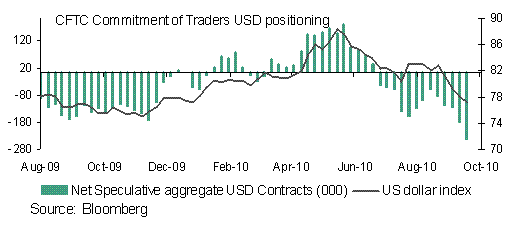
So whilst a “currency war” was always unlikely “skirmishes” will continue. In the meantime the USD is set to remain under pressure although it’s worth noting that speculative positioning has recorded a reduction in net aggregate USD short positions over the last couple of weeks, suggesting that some of the USD selling pressure may have abated. Whether this reflected caution ahead of the G20 meeting (as the data predates the G20 meeting) or indicated the USD having priced in a lot of quantitative easing (QE2) expectations already, is debatable.

The path of least resistance to USD weakness remains via major currencies including AUD, CAD and NZD. Officials in Europe are also showing little resistance to EUR strength despite the premature tightening in financial conditions and negative impact on growth that it entails. Scandinavian currencies such as SEK and NOK have also posted strong gains against the USD and will likely continue to show further outperformance.

The JPY has been the best performing major currency this year followed not far behind by the CHF despite the FX interventions of the authorities in Japan and Switzerland. Although USD/JPY is fast approaching the 80.00 line in the sand level expected to result in fresh FX intervention by the Japanese authorities, the path of the JPY remains upwards. Japan is unlikely to go away from the G20 meeting with any change in policy path as indicated by officials following the weekend deliberations.
No FX co-operation

Despite all the jawboning ahead of the IMF / World Bank meetings over the weekend the meeting ended with little agreement on how deal to with the prospects of a “currency war”. US officials continued to sling mud at China for not allowing its currency, the CNY, to appreciate quickly enough whilst China blamed the US for destabilizing emerging economies by flooding them with liquidity due to the Fed’s ultra loose monetary policy stance. Chinese trade data on Wednesday my throw more fuel on to the fire given another strong surplus expected, lending support to those in the US Congress who want to label China as a “currency manipulator”.

Although the IMF communiqué mentioned countries working co-operatively” on currencies there were no details on how such cooperation would take place. The scene is now set for plenty of friction and potential volatility ahead of the November G20 meeting in Seoul. Although many central banks are worrying about USD weakness when was the last time US Treasury Secretary Geithner talked about a strong USD? US officials are probably happy to see the USD falling and are unlikely to support any measure to arrest its decline unless the drop in the USD turns into a rout. In contrast, the strengthening EUR over recent weeks equates to around 50bps of monetary tightening, a fact that could put unwanted strain on Europe’s growth trajectory, especially in the periphery.

The outcome of the IMF meeting leaves things much as they left off at the end of last week. In other words there is little to stand in the way of further USD weakness apart from the fact that the market is already extremely short USDs. Indeed the latest CFTC IMM data revealed that aggregate net USD positioning came within a whisker of its all time low, with net positions at -241.2k contracts (USD -30 billion), the lowest USD positioning since November 2007. Interestingly and inconsistent with the sharp rise in the EUR, positioning in this currency remains well below its all time highs, supporting the view that rather than speculative investors it is central banks that are pushing the EUR higher.

The US jobs report at the end of last week proved disappointing, with total September payrolls dropping by 95k despite a 64k increase in private payrolls. The data will act to reinforce expectations that the Fed will begin a program of further asset purchases or quantitative easing (QE2) at its November meeting. Data and events this week will give further clues, especially the Fed FOMC minutes tomorrow and speeches from Fed Chairman Bernanke on Thursday and Friday as well as various other Fed speakers on tap.

Recent speeches by Fed officials have highlighted growing support for QE although some have tried to temper expectations. Questions about the timing and size of any new programme, as well as how it will be communicated remain unanswered. Although November seems likely for the Fed to start QE the Fed’s Bullard suggested that the Fed may wait until December. The minutes will be scrutinized for clues on these topics. The Fed is likely to embark on incremental asset purchases with the overall size being data dependent and the USD set to remain under pressure while this happens.

What the G8 communiqué didn’t say

There was a stark contrast between the outcome of the weekend’s G8 meeting in Lecce, Italy, and April’s G20 summit in London.  For a start, the tone was far more positive than in London, with Finance Minsters attending the meeting indicating that economic forecasts may need to be revised upwards rather than the steady stream of downward revisions seen over recent months.

The overall tone was one of cautious optimism.  The communiqué noted “there are signs of stabilization in our economies, including a recovery of stock markets, a decline in interest rate spreads, improved business and consumer confidence”.  However, at the behest of the UK the comments “but the situation remains uncertain and significant risks remain to economic and financial stability” was inserted into the final communiqué.   Such an inclusion is logical and at least suggests that officials are not getting to carried away with the improvement in recent data. 

Officials also began discussing “exit strategies” in terms of withdrawing massive global monetary and fiscal stimulus and even requested the IMF look at the issue in more detail.  Whilst it is premature to even discuss exit strategies the comments were clearly aimed at easing bond market concerns about widening fiscal deficits and inflation risks.  As Tim Geithner highlighted, recovery would be stronger if “if we make clear today how we get back to fiscal sustainability when the storm has fully passed”.   Nonetheless, a mere discussion about exit strategy is highly unlikely to remove the current angst that has built up in bond markets globally. 

Additionally, the communiqué included a commitment to develop standards governing the conduct of international business and finance, international regulatory reform, exchange of information for tax purposes and a commitment to refrain from protectionism.   None of these points will move markets this week and all were unsurprising discussion points. 

So what was missing?  The issue of stress tests on European banks was left out of the final communiqué even though it was discussed at the meeting. Reported disagreements with Germany and France over transparency over the publication of stress test results meant that an agreement could not be reached.  This is a big disappointment.  I have written about the issue in two previous posts “European economy in a whole lot of trouble” and “Stress testing European and UK banks” on my blog Econometer.   The fact that more wasn’t done will mean that uncertainty about the health of balance sheets in particular of banks in Germany will remain a constraint to European recovery.  At the least it will make it increasingly likely that in addition to a sharp decline in European growth this year GDP could also drop in 2010.

In addition, economic data continues to lag in the Eurozone compared to the improving signs in the US and elsewhere as highlighted by the huge 21% annual drop in April Eurozone industrial production at the end of last week.  This data even led to another omission with reference to “encouraging figures in the manufacturing sector” previously included in the draft dropped in the final communiqué.   It is clearly too early to talk about manufacturing recovery.

Also missing in the final communiqué was any reference to currencies. Although it was always unlikely that FX would be a major topic at the meeting due to the absence of central bankers attending, the drop in the dollar and concerns from foreign official investors (see a recent post on my blog “Are foreign investors really turning away from US debt”) raised the prospect that there would be some international backing of the US “strong dollar” policy led by the US. 

In the event there wasn’t any comment, but dollar positive comments on the sidelines of the meeting will likely limit any pressure on the dollar this week.  The dollar will be helped by comments on the sidelines of the G8 meeting as well as important comments from Russian Finance Minister Kudrin who stated that he has full confidence in the dollar with no immediate plans to move to a new reserve currency. Ahead of the meeting of BRIC countries this week the comments from Russia add further evidence that there will be no plan to move away from the dollar. Moreover, geopolitical tensions including the protests over the results of Iran’s elections as well as more jawboning from North Korea will work in favour of the dollar this week. 

The euro could look especially vulnerable this week. The lack of attention on European banks stress tests will be a disappointment for those hoping for more transparency and will act as a further drag on the euro.  This is likely to see the euro struggle to make much headway this week, with the recent high above 1.43 likely to provide tough resistance to any move higher in EUR/USD, with a bigger risk of a pull back towards the 1.37-1.38 levels.