What Stress?

Fed Chairman Bernanke has inadvertently fuelled an increase in risk aversion in the wake of his testimony to the Senate. Although Bernanke noted that he did not see the prospects of a double-dip as a high probability event he stated that the economic outlook is “unusually uncertain”. Nonetheless, although such measures would be implemented if the situation deteriorated further, the Fed was not planning on extending its non-traditional policy options in the near term.
USD benefits as Bernanke does not indicate more quantitative easing.

A combination of caution about growth prospects and disappointment that Bernanke stopped short of indicating that the Fed would embark on further non-conventional policy measures left equities weaker, but the USD was stronger, both due to higher risk aversion as well as less risk of the Fed turning the USD printing press back on again. Bernanke is back at Congress today, with a speech to the House Panel. Although this is effectively a repeat of yesterday’s testimony, the Q&A session may throw up additional clues to Fed thinking and potential for extending quantitative easing but I suspect the USD will retain its firmer tone.

In Europe, most attention remains on the upcoming release of EU bank stress test results. Leaks suggest most banks will likely pass the EU bank stress tests, with the notable exceptions of a few Spanish Cajas and German Landesbanks. Already governments in Germany, France, Greece and Belgium have said their banks are likely to pass. We should all be bracing ourselves for relief to flow through European financial markets, but somehow this does not feel like an environment that will welcome such a result. More likely questions will be asked about why did so few banks fail and why the tests were not rigorous enough?

For example, the test for “sovereign shock” is said to affect only the value of government bonds that banks mark to market, but what about the far larger proportion of government debt that is held in banking books? There are also question marks over the capital hurdle, with the most adverse scenario that banks need to reach a maximum Tier 1 capital ratio of at least 6% by end 2011. Moreover, there have also been reported divisions within European Union (EU) members about how much information to divulge. EUR has also ready lost ground over recent days but the currency could face much more selling pressure into next week if the tests are found to lack credibility.

Please note that econometer.org will take a break until the week of 16th August. Good Luck.
EUR strength is overdone

The latest in a long line of disappointing US data was released on Friday. University of Michigan consumer confidence sent an alarming signal about the propensity of the US consumer to contribute to economic recovery. Confidence dropped much more than expected, to its lowest level since August 2009, fuelling yet more angst about a double-dip in growth.

The Fed’s relatively dovish FOMC minutes last week contributed to the malaise and undermined the USD in the process as attention switched from the timing of exit strategies to whether the Fed will expand quantitative easing. Friday’s benign June CPI report left no doubt that the Fed has plenty of room on its hands, with core inflation remaining below 1% and likely to decelerate further over the coming months. Against this background Fed Chairman Bernanke’s semi-annual testimony to the US Congress (Wed/Thu) will be a particular focus, especially if he hints at potential for further QE, a possibility that appears remote, but could harm the USD.

Arguably the biggest event of the week is the European bank stress test results on Friday. Although several European governments have suggested that the banks in their countries will pass the tests there is still a considerable event risk surrounding the announcement. 91 banks are being tested and much will depend on how rigorous the tests are perceived to be. Should they be seen not to be sufficiently thorough, for instance in determining a realistic haircut on sovereign debt holdings, the potential for pressure on the EUR to increase once again will be high. Similarly debt auctions across Europe this week will also garner interest but similar success to last week’s Spanish auction cannot be guaranteed.

The big question in FX markets is whether the EUR can hold onto its recent gains and whether the USD will be punished further amidst growing double-dip worries. Interestingly the USD’s reaction on Friday to the soft consumer confidence data was not as negative as has been the case recently, with higher risk aversion once again outweighing negative cyclical influences. Various risk currencies actually came under pressure against the USD and this is likely to extend into this week. Despite a threat to the USD from any QE hints by Bernanke, speculative positioning has turned net short USD once again suggesting potential for less USD selling.

The bigger risk this week is to the EUR, which could face pressure on any disappointment from the bank stress test results. The EUR was strong against most major currencies last week, suggesting that the strengthening in EUR/USD is less to do with USD weakness, but more related to EUR strength. This strength in the EUR is hard to tally with the worsening economic outlook in the eurozone and the fact that a stronger EUR from an already overvalued level will crimp eurozone growth further. The latest CFTC IMM data has revealed a further covering of short positions, but this is likely to be close to running its course. Technically EUR/USD has broken above its ‘thick’ Ichimoku cloud, and the weekly MACD is turning above its signal line from oversold levels suggesting a period of further strength but its gains are set to be short-lived.

The Week Ahead

As last week progressed there was a clear deterioration in sentiment as growth worries crept back into the market psyche. It all started well enough, with a positive reaction to China’s de-pegging of the CNY but the euphoria faded as it became evident that there was still plenty of two-way risk on the CNY. A change in Prime Minister in Australia, which fuelled hopes of a resolution to a controversial mining tax, and an austere budget in the UK, were also key events. However, sentiment took a hit as the Fed sounded more cautious on the US economy in its FOMC statement.

The US Congress finalised a major regulatory reform bill towards the end of the week and markets, especially financial stocks, reacted positively as the bill appeared to give some concessions to banks and was not as severe as feared. However, equity market momentum has clearly faded against the background of renewed growth concerns including sprouting evidence of a double-dip in the US housing market as well as fresh worries about the European banking sector. As if to demonstrate this US Q1 GDP was duly revised lower once again, to a 2.7% annualised rate of growth.

The US Independence Day holiday and World Cup football tournament will likely keep liquidity thin in the run up to month and half year end. However, there is still plenty to digest this week including the all important employment report and consumer confidence data in the US. In Europe economic sentiment gauges, purchasing managers indices and the flash CPI estimate will be in focus. Elsewhere, Japan’s Tankan survey and usual slate of month end Japanese releases, Switzerland’s KoF leading indicator and Australian retail sales will be of interest.

On balance, economic data this week is unlikely to relieve growth concerns, with Eurozone, US and UK consumer and manufacturing confidence indicators likely to post broad based declines due to a host of factors. The data will further indicate a slowing in growth momentum following Q2 2010, with forward looking surveys turning lower, albeit gradually. Whilst a double-dip scenario still seems unlikely there can be no doubt that austerity measures and the waning of fiscal stimulus measures are beginning to weigh on growth prospects even if there is still plenty of optimism for emerging market and particularly Asian growth prospects.

This suggests that Q3 could turn into a period of heightened uncertainty in which equity markets and risk assets will struggle to gain traction. In addition to growth worries, some tensions in money markets remain in place whilst banking sector concerns seem to be coming back to the fore, especially in Europe and these factors will prevent a sustained improvement in risk appetite from taking place over the coming quarter. Some more clarity may come from the results of European stress tests but much will depend on just how stressful the tests are.

In the near term, the main focus of attention will be on the US June jobs report released at the end of the week. Non-farm payrolls are set to record a decline over the month due to a reversal in census hiring, with a consensus expectation of a 110k fall. Private sector hiring is likely to record a positive reading, however, suggesting some improvement in the underlying trend in jobs growth, albeit a very gradual one. Downside risks to consensus suggest plenty of scope for disappointment.

Interestingly, weaker US data of late, has managed to restrain the USD, suggesting that cyclical factors and not just risk aversion are beginning to play into FX movements. Notably the USD was on the back foot against a number of currencies as last week progressed. Even the beleaguered EUR managed to end the week well off its weekly low and close to where it closed the previous week whilst risk currencies such as the AUD and NZD as well as GBP also posted firm performances.

Perhaps some reversal of the optimism towards US recovery prospects give USD bulls some cause for concern, but pressure is likely to prove temporary, especially given that the US economy is still on course to outperform many other major economies. Over the short-term, especially ahead of the US jobs report markets are set to remain cautious with range trading likely to dominate in the week ahead, suggesting that EUR/USD is unlikely to breach the key level of 1.2500. GBP performance has been robust but even this currency is likely to make much headway above GBP/USD 1.5000, where there are likely to be plenty of sellers.

The Pain Of A Stronger Swiss Franc

Volatility and increasingly large market swings are characterizing current market conditions. A warning by Fitch on the UK’s “formidable” fiscal challenge, concerns about Bulgaria’s public finance statistics and a massive public sector strike in Spain, combined to fuel another bout of risk aversion.

Hungary’s government attempted to diffuse worries about its finances, with the country’s Prime Minister listing measures including cutting public pay and prohibiting mortgages denominated in foreign currencies, in order to hit the 3.8% of GDP budget deficit target. There was also some good news in the US, with small business confidence (NFIB) rising to its highest level since September 2008 whilst ABC consumer confidence edged higher.

The US Beige Book and Fed Chairman Bernanke’s testimony on the US economy to Congress, mark the highlights today. The Beige Book is set to reveal further signs of economic recovery but with limited inflation pressures. Bernanke is likely to maintain a similar tone to comments he made yesterday, highlighting a “moderate” economic recovery, with unemployment likely to stay “high for a while”. His testimony will be scrutinized for the timing of rate hikes, and any elaboration on his comments about rates rising before the economy is at full employment.

Against the background of the many and varied uncertainties still afflicting markets maintain a sell on rallies view on risk trades is still the best option. EUR/USD will struggle to breach resistance around 1.2010 and remains susceptible to test support around 1.1826. GBP/USD could target fresh lows in a “negative reversal”, with potential to head back down to 1.3996.

Confidence has plummeted to extreme lows and it will be several months before appetite for risk trades returns. The AUD and NZD as well as many Asian currencies will struggle over the interim period before their appreciation trend finally resumes.

In contrast to the weakening of risk currencies, CHF strength is showing little sign of letting up. Switzerland recorded a massive 50% jump in FX reserves in May to CHF 232 billion from CHF 153 billion in April. This is not usually market moving data but the scale of the jump in reserves is huge and it is not just due to valuation changes. The Swiss National Bank (SNB’s) effective abandonment of defending a particular level in EUR/CHF turned into more a smoothing operation but this did not stop the bank from massive FX interventions. Despite the interventions EUR/CHF dropped by 0.8% over the month.

Aside from alleviating upward pressure on the CHF the interventions had an indirect effect of reducing the pain of holders of CHF mortgages. E.g. around 30% of Hungary’s bank loans and 60% of mortgages are denominated in CHF but countries across Europe have plenty of CHF denominated loans, especially Austria. Although Hungary announced steps to meet its deficit targets its woes are far from over.

The CHF has appreciated by around 3% since the beginning of May versus HUF, exacerbating the pain for CHF borrowers in the country. The fact that CHF strength shows no sign of letting up on the back of strong data and safe haven flows, the pain for these borrowers will only add to the problems for banks and borrowers alike in Europe.

Risk Appetite Puts Dollar On The Back Foot

Markets look somewhat calmer going into this week helped by comments by Fed members who noted that the discount rate hike did not signal a shift in monetary policy, something which is likely to be repeated by Fed Chairman Bernanke in his testimony to Congress on Wednesday and Thursday.  A tame US January CPI report last Friday helped too, giving further support to the view that the Fed will not hike the Fed Funds rate for some time yet; a rate hike this year seems highly unlikely in my view.  

Data this week will be conducive to a further improvement in risk appetite and despite the lingering concerns about Greece the EUR may find itself in a position to extend gains.  In Europe all eyes will be on the February German IFO survey and eurozone sentiment indicators, which following the surprising strength in the manufacturing Purchasing Managers Indices (PMIs), are likely to reveal solid gains. 

The main highlights in Japan this week includes January trade data and industrial production. The trade numbers will be particularly important to determine whether the rebound in exports due in large part to robust Asian demand, has continued whilst the bounce back in exports will be a key factor in fuelling a further gain in industrial output. 

In the US aside from the testimonies by Fed Chairman Bernanke there are plenty of releases on tap including consumer confidence, new and existing home sales, durable goods orders and a likely upward revision to Q4 GDP.  For the most part the data will show improvement and play for a further improvement in risk appetite. 

FX direction will depend on whether markets focus on the potentially positive USD impact of a reduction in USD liquidity or on the likely firmer tone to risk appetite this week.  Given expectations of firmer data and the soothing tone of the Fed, risk currencies will likely perform better, with crosses such as AUD/JPY favoured.  The USD will likely be placed on the back foot, especially given the very long market positioning in the currency.

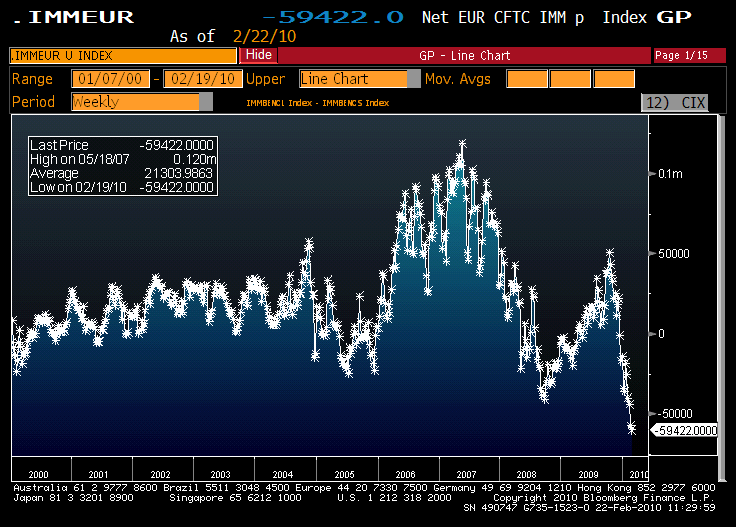
The EUR will be helped by the fact that speculative market, according to the CFTC IMM data, holds record short positions in the EUR (as of the week ended 16 February) giving plenty of potential for short-covering.   The more timely Tokyo Financial Exchange (TFX) data also reveals that positioning in EUR/JPY has continued to be scaled back.  

CFTC Commitment of Traders (IMM) data – Net EUR speculative positioning

EUR/USD bounced smartly from its lows around 1.3444 on Friday, partly reflecting some short covering and the drop in FX volatility suggests the market is more comfortable with EUR/USD around these levels.  A positive IFO survey and improved risk appetite could see EUR/USD test resistance around 1.3774, its 20 day moving average, over coming days.  Ongoing Greek concerns suggest that any EUR bounce will be limited, however. 

USD/JPY looks well supported and although data this week will suggest that exports are improving despite JPY strength, the relatively more aggressive stance of the Fed compared to the BoJ, long JPY positioning, and improved risk appetite, give plenty of scope for the JPY to extend losses, with technical USD/JPY support seen around 91.28.