Data and earnings focus

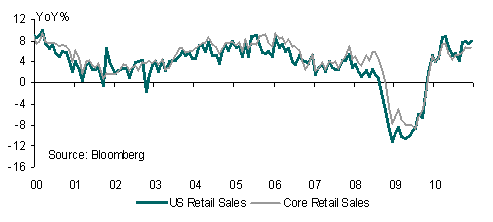
Friday’s round of US data were generally upbeat, highlighting that consumer spending is coming back to life. Inflation pressures however, remain benign at least on the core reading highlighting the Fed’s concern that inflation is running below the level consistent with its mandate. In other words it will be a long time, probably late into 2012 before policy rates increase.
While the Fed is no hurry to raise rates despite a few hawkish rumblings within the FOMC the European Central Bank (ECB) in contrast appears to have become more eager to pull the trigger for higher rates. ECB President Trichet’s hawkish press conference last week set the cat amongst the pigeons and marked a clear shift in ECB rhetoric towards a more hawkish stance.

A very big problem for the ECB is that the eurozone economy is not performing along the lines that its hawkish rhetoric would suggest, especially in the periphery. Growth momentum in the core in contrast, as likely reflected in the January ZEW investor confidence and IFO business confidence survey data this week in Germany, remains positive. Both surveys are likely to stabilize at healthy levels but how long can the likes of Germany drag along the eurozone periphery?

There will be relatively more attention on the meeting of Eurogroup/Ecofin officials, with focus on issues such as enlarging the size of the European Financial Stability Facility (EFSF) bailout fund and development of a “comprehensive plan” to contain the eurozone crisis. Don’t look for any conclusive agreements as this may have to wait until the European Union (EU) Council meeting on 4 February assuming (optimistically given ongoing German resistance) some agreement can even be reached.

Following the success (albeit at relatively high yields) of the eurozone debt auctions last week, sentiment for peripheral debt will face further tests this week in the form of debt sales in Spain, Belgium and Portugal.

The US Martin Luther King Jr. holiday will result in a quiet start to the week for markets but there will be plenty to chew on. This week’s key earnings reports include several banks scheduled to release Q4 earnings. Financials are a leading sector in the rally in equities at present and these earnings will be critical to determine whether the rally has legs.

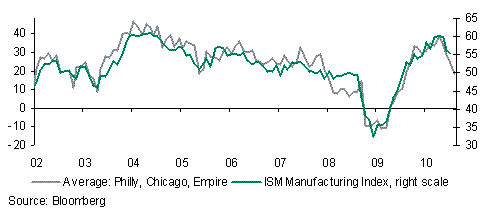
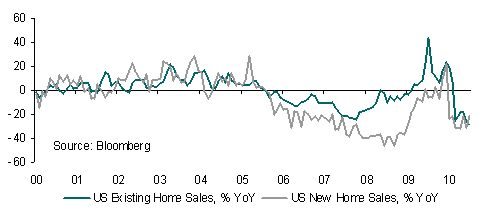
The US data slate includes January manufacturing surveys in the form of the Empire and Philly Fed, both of which are likely to post healthy gains whilst existing home sales are also likely to rise. This will not change the generally weak picture of the US housing market, with high inventories and elevated foreclosures characterizing conditions. As if to prove this, housing starts are set to drop in December. On the rates front, the Bank of Canada is likely to keep its policy rates on hold this week.
After coming under pressure last week much for the USD will depend on the eurozone’s travails to determine further direction. Concrete evidence of progress at the Ecofin may bolster the EUR further, with resistance seen around 1.3500 but don’t bank on it. The ability of eurozone officials to let down often lofty expectations should not be ignored. In any case following sharp gains last week progress over coming days for the EUR will be harder to achieve.
Positive Data Run Continues

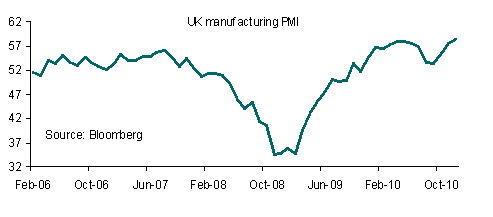
The batch of data releases in Tuesday’s trading session was generally positive. Leading the way was a stronger than expected increase in the UK manufacturing purchasing managers index (PMI) for December at 58.3 which coming in at a 16-year high. The data gave a boost to GBP though GBP/USD is unlikely to gain much of a foothold above 1.5600.

In the US, factory orders surprisingly jumped 0.7% in November and whilst the data is second tier it does maintain the run of generally upbeat US data. Meanwhile eurozone inflation came in higher than forecast at 2.2% YoY, above the European Central Bank (ECB) target level for the first time in two years. The outcome is unlikely to trigger a response from the ECB especially given that core inflation remains well behaved. After hitting a post CPI release high of 1.3433 EUR/USD is likely to drift lower in the short term.

Separately the Fed FOMC minutes of the December 14 meeting revealed little to surprise. Of note, FOMC members highlighted that the improvement in economic conditions was insufficient to warrant any change to the asset purchase program. The bottom line for the Fed is that the dual mandate of maximum employment and price stability is still not in reach and therefore they will keep the pedal to the floor in terms of policy stimulus. Although a further round of quantitative easing seems unlikely the Fed is likely to stick it out in terms of the $600 billion in planned asset purchases whilst an actual rate hike is unlikely until well into 2012.

Commodity prices dropped sharply overnight with soft commodities and energy prices in particular leading the declines. Commodity currencies fell as a result, with the AUD also impacted by growing worries about the impact of the Queensland floods. Initial estimates suggest that total damage from the flooding could reach AUD 6 billion and as Queensland represents around 19% of Australian GDP, the impact on growth could be significant. Growth could drop by a sharp -0.8% YoY in Q1 GDP. This is based on the assumptions that 40% of all exports will experience a 30% reduction

Today’s data slate in the US will be crucial to provide the final clues to Friday’s December payrolls report. The ADP jobs report, ISM non-manufacturing survey and Challenger job cuts data are all scheduled for release. The run of positive US data will help the USD to trade on a firm footing over the short term but clearer direction will await the outcome of the December jobs report whilst the beginning of the Q4 earnings season next week will also be influential. The exception to USD strength will continue to be Asian currencies where more upside is likely, but I prefer to play this via short EUR/Asian FX than the USD.

The Week Ahead

As markets make the last strides towards year end it appears that currencies at least are becoming increasingly resigned to trading in ranges. Even the beleaguered EUR has not traded far from the 1.3200 level despite significant bond market gyrations. Even news that inflation in China came in well above expectations in November (5.1% YoY) and increased prospects of a rate hike is likely to prompt a limited reaction from a lethargic market.

At the tail end of last week US data provided further support to the growing pool of evidence indicating strengthening US economic conditions, with the trade deficit surprisingly narrowing in October, a fact that will add to Q4 GDP growth, whilst the Michigan measure of consumer confidence registered a bigger than expected increase in November to its highest level since June.

The jump in consumer confidence bodes well for retail spending and highlights the prospects that US November retail sales tomorrow are set to reveal solid gains both headline and ex-autos sales driven by sales and promotions over the holiday season. Other data too, will paint an encouraging picture, with November industrial production (Wed) set to reveal a healthy gain helped by a bounce in utility output. Manufacturing surveys will be mixed with a rebound in the Empire manufacturing survey in December likely but in contrast a drop in the Philly Fed expected.

The main event this week is the FOMC decision tomorrow the Fed is expected to deliver few surprises. The Fed funds rate is expected to remain “exceptionally low for an extended period”. Despite some recent encouraging data recovery remains slow and the fact that core inflation continues to decelerate (CPI inflation data on Wednesday is set to reveal a benign outcome with core CPI at 0.6%) whilst the unemployment rate has moved higher means that the Fed is no rush to alter policy including its commitment to buy $600 billion in Treasuries including $105 billion between now and January 11.

In Europe there are also some key releases that will garner plenty of attention including the December German ZEW and IFO investor and manufacturing confidence surveys and flash purchasing managers indices (PMI) readings. The data are set to remain reasonably healthy and may keep market attention from straying to ongoing problems in the eurozone periphery but this will prove temporary at least until the markets are convinced that European Union leaders are shifting away from “piecemeal” solutions to ending the crisis. The EU leaders’ summit at the end of the week will be important in this respect. A Spanish debt auction on Thursday will also be in focus.

Assuming the forecasts for US data prove correct it is likely that US bond markets will remain under pressure unless the Fed says something that fuels a further decline in yield such as highlighting prospects for more quantitative easing (QE). However, following the tax compromise agreement last week this seems unlikely. Higher relative US bond yields will keep the USD supported, and as I have previously noted, the most sensitive currencies will be the AUD, EUR and JPY, all of which are likely to remain under varying degrees of downward pressure in the short term. The AUD will also be particularly sensitive to prospects of further Chinese monetary tightening.

US Dollar Tensions

There was considerable relief, most acutely in the US administration, that the US August jobs report revealed a better than expected outcome. To recap, private sector payrolls increased by 67k vs. an upwardly revised 107k in July whilst total non farm payrolls dropped 54k. The data sets the market up for a positive start to the week in terms of risk appetite despite Friday’s drop in the August US non-manufacturing ISM index, deflating some of the market’s upbeat mood.

Once again I wonder how long positive sentiment can be sustained with so many doubts about recovery prospects and limited ammunition on the fiscal front as well as some reluctance on the monetary front, to provide further stimulus should a double dip become a reality.

Markets will be treated to several major central bank decisions including from the Bank of Japan, Bank of England, Bank of Canada and Reserve Bank of Australia this week. These meetings are set to prove uneventful, with unchanged decisions across the board expected although the Bank of Canada decision is a tough call.

The main US release this week is the Fed’s Beige Book on Wednesday, a report which will help the Fed to prepare for the FOMC meeting on September 21. The evidence contained within it is unlikely to be positive reading, with consumer spending set to be relatively soft and evidence of recovery likely to remain patchy.

On Thursday the US July trade deficit is set to reveal some narrowing and as usual the deficit with China will be of interest given the renewed tensions over FX policy. FX tension seems to be intensifying once again due to the relatively slow pace of CNY appreciation since the June de-pegging as well as political posturing ahead of November US mid-term elections. A deterioration in US trade data, a factor that largely contributed to the soft Q2 GDP outcome in contrast to a strengthening in China’s trade surplus will have added fuel to the fire.

The firmer risk backdrop has put the USD on the back foot, with the USD index dropping sharply overnight. Nonetheless, speculative USD positioning as reflected in the CFTC IMM data reveals further short covering up to the end of August, implying USD speculative sentiment is actually turning less negative.

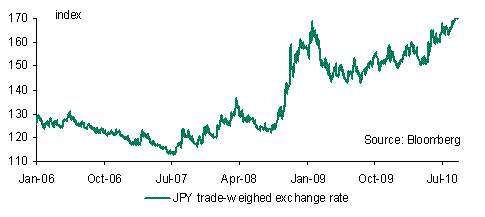
Another country which has a different sort of tension regarding the USD is Japan. Improving risk appetite will likely prevent the JPY from visiting previous highs against the USD but will do little to reduce FX intervention speculation. Indeed, there was more jawboning over the weekend on the subject, with Japan’s finance minister Noda reiterating that Japan would take decisive action to stem the JPY’s appreciation but adding that coordinated FX intervention was a difficult option. Clearly Japan us unlikely to succeed with unilateral FX intervention.

Political events have added to the debate on FX policy as focus turns to the election for leader of the ruling DPJ party next week, with a battle looming between current Prime Minister Kan and challenger Ozawa. Although Ozawa is unpopular with the electorate he yields plenty of political power, and appea rs to be more inclined towards FX intervention. Having failed to sustain a move above 85.00 the pull back in USD/JPY suggests little appetite to extend gains, likely leaving USD/JPY in a relatively tight range, with strong support around 83.55 and resistance around 85.23.

US payrolls clues

Most investors will be glad to see the back of August, a month that marked the biggest monthly decline in US stocks in nine years. The main imponderable is whether September will be any better. A series of manufacturing surveys globally today will do little to restore confidence although there was some good news in a slight increase in China’s official August purchasing managers index (PMI) as well a stronger than forecast increase in Australian Q2 GDP, which will likely provide some short-term relief for risk trades.

There was also some slight solace for markets in terms of US data at least from the point of view that the data was not as disappointing as many recent releases. Although the August Chicago PMI slipped (to 56.7) consumer confidence increased (to 53.5) though admittedly confidence remains at a relatively low level. The job market situation detailed within the consumer confidence report was more pessimistic in August than the previous month, however, with those reporting jobs hard to get moving higher. This sends a negative signal for Friday’s payrolls data.

There will be more clues to Friday’s US jobs report today which will enable any fine tuning of forecasts to take place in the wake of the August ADP employment report and ISM manufacturing survey. Consensus forecasts centre on a 15k increase in private jobs. Despite the slight increase in the Empire manufacturing survey in August, the falls in other manufacturing surveys point to some downside risks to the ISM today, with a simple average of the three pointing to the ISM closer to the 50 mark, which will highlight a loss in US manufacturing momentum.

Manufacturing surveys elsewhere will also be in focus, with the final PMI readings scheduled to be released for the eurozone and UK. There is likely to be confirmation of the slight drop in the eurozone PMI to 55.0 in August while the UK PMI is likely to drop to around 57.0 over the month. Both surveys remain at a relatively high level but it is clear that activity is moderating in H2 2010 from a healthy level in H2. The data will give little support to the EUR but the currency has found a degree of stability over the last couple of days. Nonetheless, a further downward move is in prospect.

The Fed FOMC minutes provided little for markets to get excited about. The minutes noted concerns about large scale asset purchases from some Fed officials, indicating resilience to increasing quantitative easing despite acknowledging increased downside risks to the growth and inflation outlook. It is unclear exactly what will be the trigger for further QE as acknowledged by Fed Chairman Bernanke last week.

The minutes will do little to help market confidence given the hesitancy to pursue further QE and provide further stimulus to the economy but the USD is likely to benefit from the fact that the Fed may not be as eager to expand its balance sheet further. Other currencies that remain beneficiaries in the current risk averse environment are the JPY and CHF. The JPY may find further upside more difficult given ongoing intervention fears but the trend remains for a lower USD/JPY in the coming weeks.