Edging Towards A European Deal For Greece

The momentum towards some form of agreement at the Special EU Summit today is growing, with French and German leaders reaching a “joint position on Greece’s debt situation”. Details of this position are still unknown, however. EUR has found support as expectations of a positive outcome intensify.

However, given that positive news is increasingly being priced in, and the market is becoming increasingly long, upside EUR potential will be limited even in the wake of a comprehensive agreement. A break above EUR/USD resistance around 1.4282 would bring in sight the next key resistance level around 1.4375 but this where the rally in EUR/USD is set to be capped.

Prospects of a major US debt default or at the least a government shutdown appear to be receding as the US administration has indicated some willingness to opt for a short term increase in the US borrowing limit to give more time for a bigger deficit reduction deal to be passed by Congress. Meanwhile, there will be further news on the deficit reduction plans put forward by the “gang of six” US senators, with a press conference scheduled for later today.

Debt ceiling negotiations are likely to be the main focus of market attention, with the Philly Fed manufacturing survey and weekly jobless claims relegated to the background. A speech by Fed Chairman Bernanke is unlikely to deliver anything new today. The USD is likely to be on the back foot given expectations of a deal in Europe and improved risk appetite but we expect losses to be limited.

The JPY continues to defy my bearish expectations. Over recent days the US yield advantage over Japan in terms of 2Y bonds dropped to multi-year lows below 20bps. Given the high correlation between USD/JPY and yield differentials, this has corresponded with the fall below 80.00.

Expectations of JPY weakness versus USD is highly dependent on the US – Japan yield gap widening over coming months. For this to happen it will need concerns about the US economy and expectations of more Fed asset purchases to dissipate, something that may not happen quickly given the rash of disappointing US data releases lately.

GBP found itself on the front foot following the release of the Bank of England Monetary Policy Committee minutes, which were less dovish than anticipated. They also revealed that the BoE expects inflation to peak higher and sooner than previously expected. However, the fact that the overall tone was similar to the last set of minutes meant there was little follow through in terms of GBP.

Further direction will come from June retail sales data today and forecasts of a bounce in sales will likely help allay concerns about a downturn in consumer spending. Nonetheless, GBP is still likely to struggle to break through resistance around 1.6230 versus USD.
EUR to struggle to extend gains

Once again the USD index failed to break above its 100-day moving average, its third failure to do so over recent weeks. The USD is now trading below its 20- and 50- day moving averages and looks vulnerable to further weakness. However, much will depend on the travails of the EUR and how quickly the boost to this currency fades following last week’s Greek austerity plan approval.

The USD was helped last week by the relative move higher in US bond yields, which saw 2-year yield differentials between the Eurozone and US drop below 100bps for the first time since the beginning of April. Given that the six-month correlation between 2-year bond yield differentials and EUR/USD is at a very high level, it is reasonable to assume that this will remain an important factor driving the currency pair going forward.

The yield differential narrowing seen last week has reversed as German yields have moved sharply higher this week, however. This is in large part attributed to more positive developments in Greece but nonetheless, it has helped to push the EUR higher.

Ratings agencies may yet spoil the party for the EUR, with S&P’s warning that Greece’s debt rollover plans may put the country’s ratings into select default, fuelling some caution. Should ratings agencies downgrade Greek debt to junk it will not only be international investors that will re-think their exposure to the country but the European Central Bank (ECB) could also stop holding Greek debt as collateral for loans although an official from the Bank noted that this would happen only if all the major ratings agencies downgrade Greek debt to default.

Attention is now turning to the implementation risks of austerity measures and asset sales. While Greece’s contribution to eurozone GDP is small, the pain of implanting more budget cuts will push the economy deeper into recession and reveal the stark divergences in growth in the eurozone at a time when the ECB is hiking interest rates.

In reaction to such concerns there is likely to be a series of measures announced over coming days and weeks to boost growth according to Greece’s finance minister. As the S&P comments and implementation/growth concerns suggest, the EUR may struggle to extend gains, especially as the currency is looking increasingly stretched at current levels, with this week’s ECB rate hike largely in the price. Top side resistance for EUR/USD is seen around 1.4598.

Risk on, risk off

The USD has lost some upward momentum as risk appetite improved but FX markets remain skittish as sentiment gyrates between ‘risk on’ and ‘risk off’. The fact that US Q1 GDP was left unrevised whilst jobless claims surprisingly increased together with ongoing Greece concerns suggests that a risk off mood may filter into markets despite positive US earnings. Although the USD has not particularly benefitted from any rise in risk aversion lately, worries about the next IMF tranche being withheld from Greece will likely play more positively for the USD.

Nonetheless, lurking in the background and helping to keep the USD restrained is the Fed’s ongoing asset purchases as QE2 remains in place until the end of June. Moreover US data disappointments points to risks that the Fed will only slowly embark on its exit strategy. Additionally any agreement towards extending the US debt ceiling appears to be far off, and threatens to go down to the wire all the way to August 2. US debt markets and the USD appear to be downplaying this issue at present but it remains a clear threat to US markets.

Continuing to limit any upside in the EUR is the fact that officials and markets continue to gyrate on whether Greece will or will not restructure its debt. Apparent divisions between the view of some officials and the ECB are adding to the confusion whilst fresh worries about the IMF withholding funding for Greece will likely keep EUR/USD capped.

Peripheral worries as well as growth concerns are clearly weighing on confidence and a broad based decline in economic and business confidence in various eurozone May measures is expected to be revealed in data today . Weaker data taken together with ongoing concerns about the eurozone periphery will likely see the EUR struggle, with the currency set to settle into a range versus USD over the short-term, with technical support around 1.3968 and resistance at 1.4210.

The loss of USD momentum has also been exhibited in USD/JPY which has turned lower following its recent upward move hitting a low around 81.09. The big news was the fact that April nationwide core CPI recorded its first YoY increase since December 2008. At the margin may reduce the pressure on the Bank of Japan (BoJ) to enact more aggressive policy measures, which in turn is positive for the JPY. A big factor contributing to keeping the JPY supported over recent weeks is the ongoing inflow of foreign capital into Japan’s bond and equity markets, with Japan recording six straight weeks of net inflows.

USD/JPY is one currency pair where the correlation with US – Japan 2-year bond yield differentials is holding up well over the past 3-months. The fact that the yield differential has dropped to its lowest level since November 2010 at around 30bps reveals the declining US yield advantage, and plays for a lower USD/JPY. Against this background the JPY is likely to remain supported in the short-term, but will find it tough to break through technical support around USD/JPY 80.15.

Risk off mood

A ‘risk off’ tone is quickly permeating its way through the market psyche as tensions surrounding the eurozone periphery reach fever pitch. This is reflected in the sharp jump in equity volatility as indicated by the VIX ‘fear’ gauge. Equity markets and risk trades in general look set to remain under pressure in the current climate.

Moreover, the EUR which is finally succumbing to bad news about the periphery will continue to face pressure over the short-term. Against this background economic data will likely be relegated to the background this week but it worth noting that what data there is on tap, is likely to send a weaker message, with data such as durable goods orders in the US as well as various purchasing managers indices (PMI) data in the eurozone today likely to show some slippage.

The Greek saga remains at the forefront of market attention, with restructuring speculation remaining high despite various denials over the weekend by Greek and European Central Bank (ECB) officials. News that Norway has frozen payments to Greece, whilst Fitch ratings agency’s downgrades of Greece’s ratings by 3 notches and S&P’s downgrade of Italy’s ratings outlook to negative, have all contributed to the malaise afflicting the periphery.

This weekend’s local election in Spain in which Prime Minister Zapatero and his Socialist Party suffered its worst defeat in more than 30 years leading to a transfer of power in the Spanish regions, will lead to concerns about the ability of the government to carry out much needed legislative changes.

It is difficult to see any improvement in sentiment towards the peripheral Europe and consequently the EUR over the short-term. In Greece, Prime Minister Papandreou will attempt to push through further unpopular austerity measures through parliament this week in advance of a 5th bailout tranche of EUR 12 billion scheduled for next month. This comes at a time when opinion polls show the government losing more support and 80% of those surveyed saying they would not accept more austerity measures.

The deterioration in sentiment for the EUR has been rapid as reflected in the CFTC IMM data, with net long speculative positions now at their lowest since 15 February and heading further downhill. Conversely, USD short covering has been significant though there is still a hefty USD short overhang, which points to more USD short covering as EUR sentiment sours.

Nonetheless, the USD still has plenty of risks hanging over it including the fact that it still suffers from an adverse yield differential (note that 2-year Treasury yields have fallen to the lowest since 6 December 2010). Safe haven currencies in particular CHF are the key beneficiaries and notably EUR/CHF touched a record low around 1.2354 and is showing little sign of any rebound.

Temporary Euro Relief

Eurozone peripheral country travails continue to garner most market attention. There was at least a semblance of improvement on this front as peripheral bond spreads with German bunds narrowed on Tuesday but this was largely due to European Central Bank (ECB) bond buying than any improvement in sentiment. The fact that German bund yields also rose helped to narrow bund-peripheral spreads further.

A clearer test of sentiment will be today’s debt sales by Portugal followed by actions by Spain and Italy tomorrow. ECB buying of Portuguese bonds has given some relief to other debt, with Spanish and Italian debt spreads narrowing too. Even Greece managed to sell short term debt (EUR 1.95 bn of 26 week T-bills) but at a higher cost than the previous sale.

Perhaps a stronger boost to sentiment will come from the news that European Union (EU) governments are discussing an increase in the EUR 440 billion bailout fund in recognition of the fact that the fund may prove too small to cope if the crisis spreads to Spain. However, don’t expect a decision anytime soon, with next week’s meeting of EU finance ministers unlikely to agree to such a move. Support (or lack) of from Germany may prove to be a sticking point against the background of domestic political pressure.

Other options being considered include the possibility of the EFSF (European Financial Stability Facility) purchasing bonds in the secondary market and lowering interest rates on EFSF bailout loans. News that Japan will buy 20% of EFSF bonds this month as well as recent supportive comments from China suggest that an increase in the size of the EFSF may be easily funded by such investors. The EUR will gain some support against the background of such speculation but its upside may be restrained around its 200-day moving average at EUR/USD 1.3071.

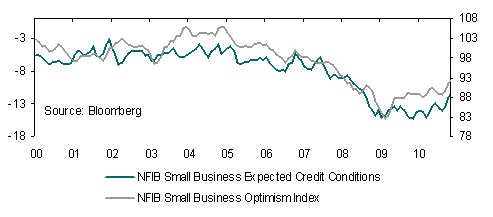
In the US the economic news was not so positive for a change as the National Federation of Independent Business (NFIB) small business optimism survey came in weaker than expected in December, an outcome that will come as a blow given that it suggests some stuttering in the recovery process as well as hiring.

There is only secondary data scheduled today, with most attention on the Fed’s Beige Book later tonight. The survey of Federal Reserve districts will likely reveal a broad based but moderate improvement in economic conditions with the exception of housing activity. A speech by the Fed’s Fisher on Monetary policy will also be in focus. Like the Fed’s Plosser overnight he may highlight some caution about the impact of Fed quantitative easing (QE).

The AUD is increasingly feeling the impact of the flooding in Queensland Australia as the extent of economic damage is revealed. Reserve Bank of Australia (RBA) board member McKibbin estimated that it could knock off at least 1% from economic growth. This may prove too negative and although the flooding will result in a significantly negative impact on growth in Q1 rebuilding and reconstruction will mean that overall growth for 2011 will not be as significantly impacted. Nonetheless, a paring back in RBA policy tightening expectations will see the AUD come under further pressure, with a move down to around AUD/USD 0.9634 on the cards over the short-term.