All Eyes On US Jobs Data

Happy New Year!

2010 ended on a sour note especially for eurozone equity markets (and the Australian cricket team) where there has yet to be a resolution to ongoing growth/fiscal/debt tensions.  The EUR strengthened into year end but this looked more like position adjustment than a shift in sentiment and EUR/USD is likely to face stiff resistance around the 1.3500 level this week, with a drop back towards 1.3000 more likely.  In the US there was some disappointment in the form of a surprise drop in December consumer confidence data but pending home sales and the Chicago PMI beat expectations, with the overall tone of US data remaining positive.

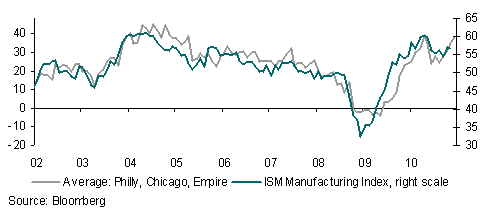
There will be plenty to chew on this week in terms of data and events which will provide some much needed direction at the beginning of the year.  The main event is the December US jobs report at the end of the week.   Ahead of this there will be clues from various other job market indicators including the Challenger jobs survey, ADP employment report, and the ISM manufacturing and non-manufacturing surveys.  The data will reflect a modest improvement in job market conditions and the preliminary forecast for December payrolls is for a 135k increase, with private payrolls set to rise by 145k and the unemployment rate likely to fall slightly to 9.7%.
The minutes of the 14 December Fed FOMC meeting (Tue) will also come under scrutiny against the background of rising US bond yields.  In addition, Fed Chairman Bernanke will speak on the monetary and fiscal outlook as well as the US economy to the Senate Budget Panel.   Bernanke will once again defend the use of quantitative easing whilst keeping his options open to extend it if needed.  However, the changing composition of the FOMC with four new members added in 2011 suggests a more hawkish tinge, which will likely make it more difficult to agree on further QE.   In any case, the tax/payroll holiday package agreed by the US administration means that more QE will not be necessary. 

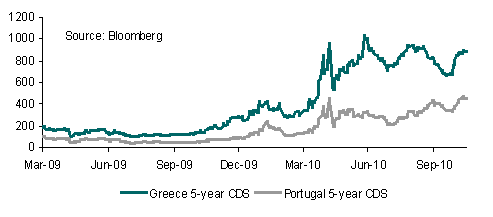
It’s probably not the most auspicious time for new member Estonia to be joining the eurozone especially as much of the speculation last year focussed on a potential break up.  The beginning of the year will likely see ongoing attention on the tribulations of Ireland after its bailout, with looming elections in the country.  Portugal and Spain will also remain in focus as the “two-speed” recovery in 2011 takes shape.  Data releases this week include monetary data in the form of the eurozone December CPI estimate and M3 money supply.  Inflation will tick up to 2% but this ought to be of little concern for the ECB.  Final PMI data and confidence indices will likely paint a picture of slight moderation.   

The USD ended the year on a soft note, with year lows against the CHF and multi year lows vs. AUD registered, but its weakness is unlikely to extend much further.  The key driver will remain relative bond yields and on this front given the prospects for relative US yields to move higher, the USD will likely gain support.  There maybe a soft spot for the USD in Q1 2011 but for most of the rest of the year the USD is set to strengthen especially against the EUR which will increasingly comer under pressure as peripheral tensions and growth divergence weigh on the currency.
US bonds sell off, USD rallies

US Treasuries didn’t like it but the compromise agreement to extend Bush era tax cuts, as well as a 13-month unfunded extension of long term unemployment benefits and a $120 billion payroll tax holiday will provide the US economy with further support and likely to lead to some upgrading of US growth forecasts. The agreement changes the dynamic of fiscal support for the US economy and means that the US is the only major country not tightening fiscal policy. It also implies less heavy lifting needed from the Federal Reserve.

Whilst some US taxpayers will not now face tax increases following the end of the year, the longer term question of fiscal adjustment and reform appears to have been postponed. US bond yields jumped on the news as the agreement effectively adds $1 trillion to US debt over the next couple of years. The contrasting fiscal stance with Europe could eventually haunt US markets as focus eventually return to US fiscal issues, with negative implications for the country’s credit ratings. However, at present, attention remains firmly fixed on European sovereign risk rather than US deficit fears.

There has been some relief to European debt markets, albeit temporarily, with debt markets ignoring the news that European Finance Ministers have not agreed to extend the size of the support fund (EFSF) and have also failed to agree on the introduction of recently touted “E-bonds”. ECB buying of peripheral bonds has given some support whilst the passage of the first votes of the Irish budget has eased tensions in its bond markets. Nonetheless as highlighted by the IMF, Europe’s ”piecemeal” response to the debt crisis in the region is insufficient to stem the crisis, suggesting that the current easing in pressure could prove short-lived.

The jump in US bond yields has given the USD some support but I wouldn’t overplay the impact on the USD of bond yields at present. Correlations reflecting the sensitivity of bond yields to various currencies remain relatively low suggesting that the influence of yield on FX is still limited. That said, the correlation is likely to increase over coming months as US yields move higher. The impact on USD/JPY is likely to be particularly sharp, with the currency pair likely to move higher over coming months. The USD has likely rallied due to the likelihood that the tax cut extensions will mean prospects of less quantitative easing by the Fed and prospects of relatively firmer US growth.

An ongoing concern for markets is the prospects of higher interest rates in China. As regular readers of Econometer many note, my blog posts have been a bit sporadic lately. This is not down to laziness but the fact that I have been on the road quite a bit travelling in Asia (and UK) visiting clients. One of the clear concerns that I have heard often repeated is the potential for China’s measures to curb real estate speculation, rising inflation, and lending, to slow China’s growth sharply and cause problems for the rest of the world. This is the topic of another post for another day, but against the background of such concerns the AUD and other high beta currencies are likely to fail to make much headway.

Edging Towards A Bailout

A confluence of factors have come together to sour market sentiment although there appeared to be some relief, with a soft US inflation reading (core CPI now at 0.6% YoY) and plunge in US October housing starts reinforcing the view that the Fed will remain committed to carry out its full QE2 program, if not more.

However any market relief looks tenuous. Commodity prices remain weak, with the CRB commodities index down 7.4% in just over a week whilst the Baltic Dry Index (a pretty good forward indicator of activity and sentiment) continues to drop, down around 21% since its recent high on 27 October. Moreover, oil prices are also sharply lower. Increasingly the drop in risk assets is taking on the form of a rout and many who were looking for the rally to be sustained into year end are getting their fingers burnt.

Worries about eurozone peripheral countries debt problems remains the main cause of market angst, with plenty of attention on whether Ireland accepts a bailout rumoured to be up EUR 100 billion. Unfortunately Ireland’s reluctance to accept assistance has turned into a wider problem across the eurozone with debt in Portugal, Greece and also Spain suffering. An Irish bailout increasingly has the sense of inevitability about it. When it happens it may offer some short term relief to eurozone markets but Ireland will hardly be inspired by the fact that Greece’s bailout has had little sustainable impact on its debt markets.

Ireland remains the primary focus with discussions being enlarged to include the IMF a well as ECB and EU. What appears to be becoming clearer is that any agreement is likely to involve some form of bank restructuring, with the IMF likely to go over bank’s books during its visit. Irish banks have increasingly relied on ECB funding and a bailout would help reduce this reliance. Notably the UK which didn’t contribute to Greece’s aid package has said that it will back support for Ireland, a likely reaction to potential spillover to UK banks should the Irish situation spiral out of control. Any bailout will likely arrive quite quickly once agreed.

Although accepting a bailout may give Ireland some breathing room its and other peripheral county problems will be far from over. Uncertainties about the cost of recapitalising Ireland’s bank will remain whilst there remains no guarantee that the country’s budget on December 7 (or earlier if speculation proves correct) will be passed. Should Ireland agree to a bailout if may provide the EUR will some temporary relief but FX markets are likely to battle between attention on Fed QE2 and renewed concerns about the eurozone periphery, suggesting some volatile price action in the days and weeks ahead.

Reports of food price controls of and other measures to limit hot money inflows into China as well as prospects for further Chinese monetary tightening, are attacking sentiment from another angle. China’s markets have been hit hard over against the background of such worries, with the Shanghai Composite down around 10% over the past week whilst the impact is also being felt in many China sensitive markets across Asia as well as Australia. For instance the Hang Seng index is down around 7% since its 8 November high.

Caught In The Headlights

For a prolonged period of time market attention had firmly focused on the Fed and prospects for quantitative easing (QE2). Now that QE has been delivered with little surprise, as the Federal Reserve arguably did a good job of living up to market expectations, it is Europe that is back in the limelight. Until recently the major surprise about Europe was how well the economy and the EUR were doing and how quickly the European Central Bank (ECB) would diverge from the Fed in its policy path.

This all looks premature and as if to confirm the shift in outlook the slowing in eurozone growth in Q4 (0.4% QoQ) revealed last week is likely to mark the beginning of a sharp and diverging deceleration in growth over coming quarters. The EUR may still have some life left in it given the ongoing purchases via recycled intervention flows from Asian central banks but weaker growth and peripheral worries are undermining this vestige of support.

Unfortunately for Europe the region is now not being caste in a good light and the peripheral trio of Ireland, Greece and Portugal are all staring into the headlights with nowhere to run. A crash of sorts seems inevitable but will there be any casualties? Markets are being whipsawed as they determine what will happen next in this slow motion saga.

Irish officials have maintained they do not need any aid package following discussions held over the weekend. Any bailout would likely come from a EUR 60 billion fund from the European Commission meaning a quick distribution but Ireland’s refusal will likely see pressure resume on peripheral debt markets in Europe as well as the EUR.

Portugal is also in the spotlight following comments by its foreign minister that the country may be forced to abandon the EUR if there is a failure to adopt a broad coalition government to deal with the crisis. This sounds like scaremongering but nonetheless highlights the political tensions in the country.

In Greece the second round of regional elections reveals the ruling Pasok party candidates are in the lead, reducing the prospect of early general elections. Nonetheless, this will do little to alleviate pressure as the EU is set to revise higher Greece’s 2009 deficit and debt estimates implying even more difficulty in meeting this year’s targets.

An EU/IMF team will visit Greece to assess progress as well as decide on whether the country should receive its 3rd instalment of a EUR 110 billion loan. Suggestions from PM Papandreou that he does not rule out having to extend the repayment of the loan will not auger well for sentiment. Finally, the government is set to present its 2011 final budget on Thursday, suggesting plenty of event risk this week.

A meeting of EU finance ministers tomorrow and Wednesday will also garner attention. Germany’s stance that investors will only have to take the brunt of losses from debt rescheduling only from 2013 still remains a contentious issue amongst officials even though it is a slightly softer stance than previously stated. Agreement on this as well as pressure on Ireland to accept funding will be key points of discussion.

Event wise, an auction of T-bills in Greece tomorrow as well as a Spanish debt auction on Thursday will be watched to determine how far the contagion of Irish woes have spread. The news is unlikely to be good, with higher yields likely. Unfortunately tomorrow’s German November ZEW investor confidence survey will provide further signs of retreating investor sentiment in the wake of renewed peripheral debt concerns.

USD pressure, EUR resilience, GBP whipsawed

Speculation the Fed will begin a new program of asset purchases or QE2 as soon as November is intensifying. The weaker than expected reading for US consumer confidence in September released on Tuesday has only added to this expectation as sentiment continues to be hit by job market concerns. Against this background the USD remains under strong downward pressure, with little sign of any turnaround.

The prospects of further USD debasing as well as intervention in many countries to prevent their currencies from strengthening against the USD continues to power gold prices which hit a new record high having breezed through the $1300 per troy ounce mark. In the current environment it is hard to see gold prices turning much lower although there may be some risk of profit taking in the weeks ahead.

The EUR remains a key beneficiary of USD weakness but this currency has problems of its own to contend with. Indeed, peripheral debt concerns, especially with regard to Ireland and to a lesser extent Portugal have increased, with borrowing costs rising as the yield on their debt widens against core eurozone debt. The stronger EUR will only make it harder for these countries to achieve any sort of recovery and could also damage the stronger exporting countries of Northern Europe led by Germany.

So far however, the EUR has managed to show some impressive resilience to renewed peripheral country sovereign debt concerns including comments by S&P about the high costs of rescuing an Irish Bank. Perhaps the knowledge that there is a still a huge bailout fund from the EU and IMF available if needed and also the prospect that the ECB will increase its buying of eurozone debt, has provided a buffer for the EUR.

At some point the ECB may be forced to join the battle in at least attempting to talk its currency lower but at this stage the central bank is showing no inclination to either talk down the currency or physically intervene to weaken the EUR. In the meantime, EUR/USD is likely to strengthen further despite the likely negative impact on European growth, with the currency likely to set its sights on an eventual break above 1.40.

One currency that may struggle in the wake of expectations of Fed QE2 is GBP. Uncertainty over whether the Bank of England will follow the Fed in implementing further quantitative easing could see GBP lag the gains in other currencies against the USD. Conflicting comments from MPC members Posen who noted that there may be a need for further QE in the UK to support the faltering economy were countered by Sentance who noted that there was no need for more QE. GBP/USD is likely be whipsawed as the debate continues and is set to lose further ground against the EUR.