FX Tension

On September 22 1985 the governments of France, West Germany, Japan, US and UK signed the Plaza Accord which agreed to sharply weaken the USD. At this time it was widely agreed that the USD was overly strong and needed to fall sharply and consequently these countries engineered a significant depreciation of the USD.
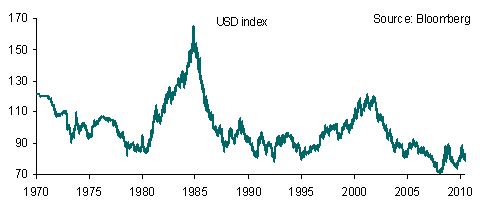
It is ironic that 25 years later governments are once again intervening in various ways and that the USD is once again facing a precipitous decline as the Fed moves towards implementing further quantitative easing. This time central banks are acting unilaterally, however, and there is little agreement between countries. For instance Japan’s authorities found no help from the Fed or any other central bank in its recent actions to buy USD/JPY.

So far Japan’s FX interventions have been discreet after the initial USD/JPY buying on 15 September. The fact that Japan is less inclined to advertise its FX intervention comes as little surprise given the intensifying pressure from the US Congress on China for not allowing its currency, the CNY to strengthen. Tensions have deepened over recent weeks and the backing of a bill last week by an important Congressional committee to allow US companies to seek tariffs on Chinese imports suggests that the situation has taken a turn for the worse.

The softly softly approach to Japan’s FX intervention and US/China friction reflects the fact that unlike in 1985 we may be entering a period in which currency and in turn trade tensions are on the verge of intensifying sharply against the background of subdued global economic recovery.

The Fed’s revelation that it is moving closer to implementing further quantitative easing has shifted the debate to when QE2 occurs rather than if, with a November move moving into focus. Clearly the USD took the news negatively and will likely remain under pressure for a prolonged period as the simple fact of more USD supply weighs heavily on the currency. Markets will be able to garner more clues to the timing of QE2, with a plethora of Fed speakers on tap over coming days.

This week the US economic news will be downbeat, with September consumer and manufacturing confidence surveys likely to register declines, with consumer sentiment weighed down by the weakness in job market conditions. Personal income and spending will also be of interest and gains are expected for both. There will be plenty of attention on the core PCE deflator given that further declines could give clues to the timing of QE2.

Attention in Europe will centre on Wednesday’s recommendations for legislation on “economic governance” from the European Commission. Proposed penalties for fiscal indiscipline may include withholding of funding and/or voting restrictions but such measures would be politically contentious. Measures to enforce fiscal discipline ought to be positive for markets given the renewed tensions in peripheral bond markets in the eurozone.

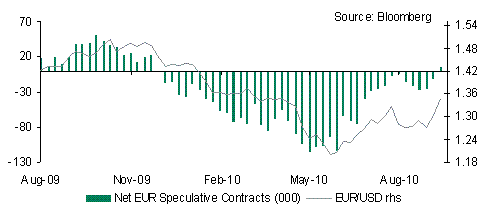
The EUR was a major outperformer last week benefiting from intensifying US QE speculation and will set its sights on technical resistance (20 April high) around 1.3523 in the short-term. Notably EUR speculative positioning has turned positive for the first time this year according to the CFTC IMM data, reflecting the sharp shift in speculative appetite for the currency over recent weeks. The EUR has been surprisingly resilient to renewed sovereign debt concerns and similarly softer data will not inflict much damage to the currency this week.
No Let Up in USD Pressure

At the end of a momentous week for currency markets it’s worth taking stock of how things stand. Much uncertainty remains about the global growth outlook, especially with regard to the US economy, potential for a double-dip and further Fed quantitative easing. Although there is little chance of QE2 being implemented at next week’s Fed FOMC meeting speculation will likely remain rife until there is clearer direction about the path of the US economy.

In Europe, sovereign debt concerns have eased as reflected in the positive reception to debt auctions this week. Nonetheless, after a strong H1 2010 in terms of eurozone economic growth the outlook over the rest of the year is clouded. Such uncertainty means that markets will also find it difficult to find a clear direction leaving asset markets at the whim of day to day data releases and official comments.

The added element of uncertainty has been provided by Japan following its FX intervention this week. Whilst Japanese officials continue to threaten more intervention this will not only keep the JPY on the back foot but will provide a much needed prop for the USD in general. Indeed Japan’s intervention has had the inadvertent effect of slowing but not quite stopping the decline in the USD, at least for the present.

The fact that Japanese officials continue to threaten more intervention suggests that markets will be wary of selling the USD aggressively in the short term. The headwinds on the USD are likely to persist for sometime however, regardless of intervention by Japan and/or other Asian central banks across Asia, until the uncertainty over the economy and QE2 clears.

Japan’s intervention has not gone down well with the US or European authorities judging by comments made by various officials. In particular, the FX intervention comes at a rather sensitive time just as the US is piling on pressure on China to allow its currency the CNY to strengthen further. Although US Treasury Secretary Geithner didn’t go as far as proposing trade and legal measures in his appearance before Congress yesterday there is plenty of pressure from US lawmakers for the administration to take a more aggressive stance, especially ahead of mid-term Congressional elections in November. Ironically, the pressure has intensified just as China has allowed a more rapid pace of CNY nominal appreciation over recent days although it is still weaker against its basket according to our calculations.

Another country that has seen its central bank intervening over many months is Switzerland, with the SNB having been aggressively intervening to prevent the CHF climbing too rapidly. However, in contrast to Japan the SNB is gradually stepping back from its intervention policy stating yesterday that it would only intervene if the risk of deflation increased. Even so, Japan may have lent the Swiss authorities a hand, with EUR/CHF climbing over recent days following Japan’s intervention.

The move in EUR/CHF accelerated following yesterday’s SNB policy meeting in which the Bank cut its inflation forecasts through 2013, whilst stating that the current policy stance in “appropriate”. Moreover, forecasts of “marked” slowdown in growth over the rest of the year highlight the now slim chance of policy rates rising anytime soon. Markets will eye technical resistance around 1.3459 as a near term target but eventually the CHF will likely resume its appreciation trend, with a move back below EUR/CHF 1.3000 on the cards.

Q2 Economic Review: Double-Dip Recession or Prolonged Recovery?

I was recently interviewed by Sital Ruparelia for his website dedicated to “Career & Talent Management Solutions“, on my views on my view on the Q2 Economic Review: Double-Dip Recession or Prolonged Recovery?

Sital is a regular guest on BBC Radio offering career advice and job search tips to listeners. Being a regular contributor and specialist for several leading on line resources including eFinancial Careers and Career Hub (voted number 1 blog by ‘HR World’), Sital’s career advice has also been featured in BusinessWeek online.

Please see below to read my article

Since we last discussed the economic outlook at the end of quarter 1, much has happened and unfortunately there has not been a great deal of positive news. I retained a cautiously optimistic outlook for economic recovery for the Q1 Economic Review: elections, recovery and underemployment discussion article, but highlighted that recovery would be a long and drawn-out process, with western economies underperforming Asian economies.

The obstacles to recovery discussed then continue to apply now, including consumers paying down debt, high unemployment, tight credit conditions and weak confidence.

Click here to read the rest…

World Cup FX Positioning/Data Highlights

The market tone felt decidedly better over the course of the last week although it was difficult to tell if this was due to position squaring ahead of the World Cup football or a genuine improvement in sentiment. There was no particular event or data release that acted as a catalyst either, with the European Central Bank (ECB) and Bank of England (BoE) meetings passing with little fanfare.

US data ended the week mixed, with retail sales disappointing in May but in contrast June consumer confidence beating expectations. Although questions about the pace of recovery remain, other data such as the Fed’s Beige Book suggest that recovery remains on track, sentiment echoed, albeit cautiously by Fed Chairman Bernanke last week.

Attention this week will centre on inflation data. Expected benign CPI readings will support the view that the Fed will take its time to raise interest rates. Speeches by the Fed’s Bullard, Plosser and Bernanke this week will be eyed for further clues on Fed thinking.

Central banks in Brazil and New Zealand hiked rates last week but this is not likely to be echoed this week. No change is likely from both the Bank of Japan and Swiss National Bank although there will be plenty of attention on the SNB’s comments on the CHF following recent data showing a surge in FX reserves due to currency intervention. The BoJ is unlikely to announce anything new but perhaps some further detail on the loan support plan could be forthcoming.

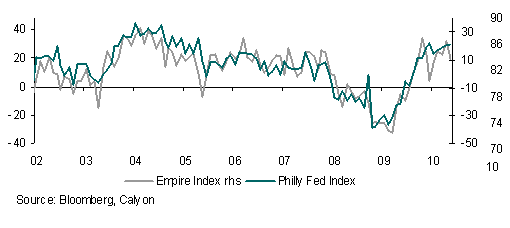
Manufacturing data will also garner some attention, with the US June Empire and Philly Fed surveys and May industrial production on tap. All three reports will confirm the improving trend in manufacturing activity in the US. Housing data will look weaker, with starts set to pull back in starts in May following the expiry of government tax incentive programmes though permits are set to rise.

In Europe, the June German ZEW (econ sentiment) investor sentiment survey will likely slip slightly due to ongoing fiscal/debt worries but this will be countered by stronger domestic data. In any case the index remains at a high level and a slight drop is unlikely to derail markets.

GBP may find some support form upgrade of UK growth forecasts by the CBI to 1.3% for 2010 and relatively hawkish comments from the BoE’s Sentance in the weekend press warning that inflation is higher than expected, indicating that the Bank may need to hike rates sooner than expected.

Further GBP/USD direction will come from CPI and retail sales data this week as well as public borrowing figures and a report by the new Office of Budget Responsibility on the UK’s fiscal position ahead of the June 22 budget. A break above GBP/USD resistance around 1.4760 is unlikely to materialise.

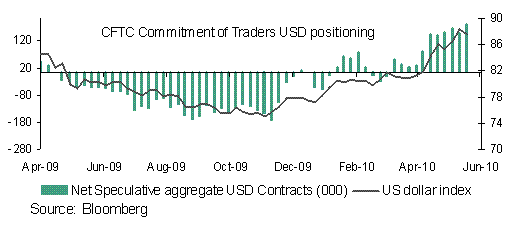
Despite the many data releases this week, the overall tone is likely to be one of consolidation and reduced volatility in the days ahead. This may allow EUR/USD to gain some ground due to short covering, with the CFTC commitment of traders (IMM) report revealing a further increase in net short speculative positions last week, close to the record set a few weeks back, though we suspect that there will be strong resistance around 1.2227.

The fact that the IMM data revealed that net aggregate net USD long positions reached an all time high last week, highlights the potential for profit taking this week. USD/JPY will look to take out resistance around 92.55 but this looks unlikely unless the BoJ dishes up anything particularly dovish from its meeting.

Wait And See

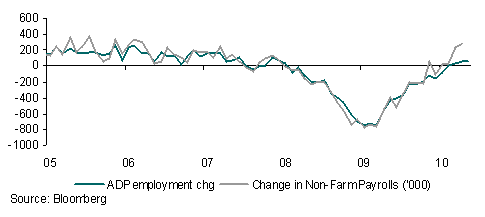
It’s difficult to be too conclusive in my blog post today given that markets are in waiting mode for a number of events to pass. First and foremost is the US May jobs report. The consensus forecast is for a gain of 536k in nonfarm payrolls and a slight drop in the unemployment rate to 9.8%. Payrolls estimates range from a high of 750k to a low of 220k, the wide margin likely reflecting the uncertainty of the amount of census hiring.

On the face of it a 500k+ gain in payrolls looks strong, but the bulk of this, probably about three-quarters, will made up of census hiring which by its nature is transitory. Therefore, only about 100k in payrolls will be due to private sector jobs growth, which is still not bad. Most of the clues leading up to the jobs data are consistent with the consensus, including the 55k increase in the May ADP.

The second event is the change in Prime Minister in Japan. Naoto Kan, the previous Finance Minister is set to take over the helm. His job is going to tough, with all eyes on how and when the government begins to get to grips with Japan’s burgeoning debt burden which is approaching 200% of GDP. Most of this, around 96% is held by domestic investors, so Japan is less exposed to foreign investor sentiment.

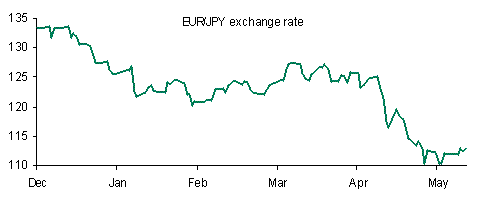
Nonetheless, even domestic investors including many large life insurance companies are increasing their overseas investments at the expense of Japanese debt. Kan is also a supporter of weaker JPY so at the least the rhetoric from Japanese officials to weaken the JPY will step up, especially given the very painful move in EUR/JPY over recent months.

Finally, the G20 meeting beginning today in South Korea will garner attention. Topics will include bank regulation and capital requirements, the European debt crisis, and policy tools such as the recent suggestion by South Korea to make permanent the currency swap agreements between central banks. Aside from a commitment to keep policy supportive, and likely talking up the efforts to combat the crisis in Europe, it is difficult to see anything particularly market moving emerge from the meeting.