FX / Economic Preview

The European Union (EU) aid package for Greece and extension of collateral requirements by the European Central Bank (ECB) helped return a semblance of confidence to markets. Although the probability of a Greek default now looks extremely small, further austerity measures, fiscal issues in other EU countries and the negative impact on growth that all of this implies, suggest that Europe will be plagued by various problems for some time yet.

As a result of more favourable market conditions Greece is set to launch a syndicated bond issues today or tomorrow of up EUR 5 billion according to press reports. Attention will also turn to Greek debt rollovers, beginning with EUR 8.2 billion on April 20.

Improving sentiment following the Greece deal has extended to the EUR, with the currency bouncing off its lows around 1.3267. EUR/USD will now look to break through resistance around 1.3446, which would set up a test of 1.3516. There is plenty of scope for short-covering to help the EUR as reflected in the latest IMM Commitment of Traders’ report (a gauge of speculative market positioning) which revealed net EUR positions reaching yet another record low in the week to 23rd March. Whilst sovereign/official buying interest may keep EUR/USD supported this week the currency pair is best played as a sell on rallies.
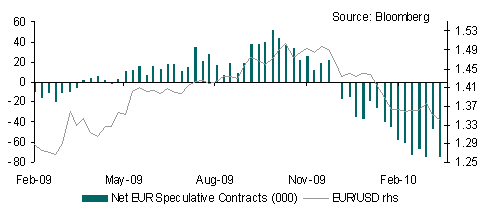
A similar assessment applies for GBP. Speculative sentiment for the currency also hit a record low in the latest week but unlike the Greek deal helping the EUR, last week’s UK budget has done little to boost GBP’s prospects. Moreover, a report in the Financial Times highlighting hedge funds bets against GBP, suggests that there are still plenty of headwinds against the currency.

Volumes are set to thin out this week ahead of upcoming holidays, whilst the US March jobs report at the end of the week will likely prevent moves out of current ranges ahead of its release. The consensus forecast is for a 190k increase in non-farm payrolls though much of this is likely to reflect hiring for the 2010 US consensus and a rebound from adverse weather effects in February.

In Europe March economic confidence surveys will be watched closely to determine how much damage Greece and general fiscal woes are having on sentiment. Some improvement, in line with the Eurozone Purchasing Managers Index (PMI) and the German IFO business confidence survey, is expected, which will help to give further, albeit limited relief to the EUR.

The Japanese data slate kicked off the week in good form, with the release of February retail sales data, revealing its biggest annual increase in 12-years. It is difficult to see the recovery in sales taking much greater hold given persistent deflation pressures however, and part of the gain probably reflects the government’s shopping incentive program.

Aside from industrial production and jobs data in Japan the key release will be the results of the Q1 Tankan survey on Wednesday. The survey of manufacturers’ confidence is set to show further improvement. USD/JPY is likely to remain supported around 91.67 but will need a further widening in US/Japan 10-year bond yield spreads to push higher.

GBP bulls brave or crazy?

The UK Pound’s (GBP) performance over recent months has been dismal. The currency has failed to show any real sign of recovery, having fallen to and below the psychologically important level of 1.50 against the USD. A number of factors including fiscal/debt concerns, political worries, and uncertainties about whether the Bank of England will step up asset purchases, have accumulated to turn even the most ardent GBP bulls into bears.

The outcome of the upcoming UK general election widely expected on May 6, remains a major weight on GBP sentiment. Until the outcome is clear or unless one or other party develops a clear lead in the polls, it is difficult o see GBP sustain any durable recovery. In the near term GBP/USD is vulnerable to a test of its 2010 low around 1.4780 and then towards 1.44. The risk to this is that the market is very short GBP which could result in a sharp bounce in GBP in the wake of any good news. However, a rally in GBP will only result in fresh sellers.

Ahead of the elections will be the budget and this will be closely scrutinized for steps to reduce the size of the burgeoning fiscal deficit. Whichever party comes into power will need to convince markets that a credible and timely plan exists to reduce the size of the deficit and prevent a sovereign ratings downgrade. If not, GBP could see itself under much more pressure. In this respect it’s worth noting the Fitch ratings warning that the UK sovereign credit profile has deteriorated.

It’s not all bad for GBP, however. By some measures it’s now the most undervalued major currency, opening up the possibility of a sharper bounce back over the medium term. Moreover, UK debt markets are already trading as if a ratings downgrade has taken place, whilst arguably GBP has also priced in a lot of negative news already, as reflected in the very negative speculative positioning in the currency.

The economic news is also not as bad as the headlines might suggest and although recent housing data has been a bit mixed, both consumer spending and the housing market have held up reasonably well. Bearing all this in mind GBP is set to recover over the medium term, but it would be very brave to buy the currency any time soon, at least until UK elections are out of the way.

Better Levels To Sell

It is questionable how long the slight improvement in risk appetite at the beginning of this week lasts given the fickle nature of market sentiment at present and propensity for more disappointment. More than likely any relief will be short-lived given 1) there are still major concerns about fiscal/debt problems in Greece, Spain, Portugal, etc 2) the sharp decline in economic activity that various austerity plans will lead to and 3) rising social/labour unrest due to cuts in spending and hikes in taxes that need to be implemented.

Attention remains firmly fixed on Greece’s woes whilst global growth concerns have reappeared following some disappointing data releases in the US last week as well the decline in China’s manufacturing purchasing managers’ index (PMI) in February, released overnight, which although obscured by the timing of Chinese Lunar New Year holidays, suggests that China’s economy is losing some of its recent strong momentum.

Speculation of a rescue plan for Greece will likely give some support to the beleaguered EUR though it may only end up providing better levels to sell the currency. EU Monetary Affairs Commissioner Rehn is scheduled to meet with Greek Prime Minister Papandreou today against the background of talks about the possibility of EUR 25 billion in aid to Greece using state owned lenders to buy Greek debt. Any aid will likely come with demands for more action to reduce Greece’s yawning budget deficit which will fuel further weakness in economic activity.

A key test of sentiment towards Greece’s austerity plans will be the market reception to an upcoming sale of as much as EUR 5 billion in 10-year Greek bonds. Given the reassurances given by the EU the sale of bonds will likely not be too problematic. As an indication, Greek 10-year bond yields dropped sharply on Friday as sentiment improved.

The bounce in Greek debt was accompanied by a firmer EUR/USD which rebounded to a high of around 1.3667 as markets covered short positions. It’s probably way too early to suggest that the EUR has began a sustainable rally however, and more likely it has settled into a new range, with support around the 2010 low of 1.3444. The latest CFTC Commitment of Traders’ (IMM) data revealed a further increase in net short EUR positioning to a new record low in the week to 23rd February. This highlights both the weight of pessimism on the currency as well as significant potential to rebound.

Conversely, the IMM data reveals that net USD positions are at their highest in almost a year and well above their three-month average, suggesting that USD positioning is looking a bit stretched though its worth noting that positioning is still well off its record high. Nonetheless, with a bailout for Greece in the offing, risk appetite could gain a stronger foothold this week, in turn keeping the USD capped.

As for the EUR, although a lot of bad news is in the price, for the currency to rebound on a sustainable basis it will require fiscal/growth worries to recede. Despite talk of Greek aid, there is a long way to go before Europe’s fiscal/debt problems are resolved.

Disappointments Galore

Well the calm at the beginning of the week did not last very long.  Although the overnight price action can hardly be labelled as panic given both FX and equity volatility remain relatively well behaved, there is no doubt that worries are creeping back into the market psyche.  It seems that markets are once again trading on each piece of news and for the most part the news is not encouraging.  

A plethora of disappointments will set a negative tone for markets today.   Risk has come off the table in the wake of the worse than expected February German IFO business confidence survey and US Conference Board consumer confidence.   Cautious comments by Bank of England Governor King in which he kept the door open to further quantitative easing and a ratings downgrade of four of the largest Greek banks has added to the damage.

The German IFO was likely dealt a temporary blow by severe weather conditions.   The 10.5 point fall in US consumer confidence from an already relatively low level had no mitigating factors however, and revealed a deterioration in job market conditions, which combined with renewed weakness in jobless claims, does not bode well for next week’s US payrolls report, pointing to a decline of around 40k in February payrolls.

Overall, the market mood has darkened and there is little to turn sentiment around in the near term.  In prospect of likely weak reading for US payrolls next week and continuing worries about European fiscal/debt problems any improvement in risk appetite is likely to be limited.  This will help bond markets, the USD and JPY but most risk trades will face pressure. 

It is still worth being selective in FX markets.  The EUR remains the weak link and is set to struggle to make any headway, with upside likely to be restricted to resistance around 1.3747.  Similarly GBP is set to struggle in the wake of King’s comments as well as ongoing economic and deficit concerns, with GBP/USD vulnerable to a drop to around 1.5293.   In contrast, Asian currencies and commodity currencies look far more resilient.

Euro Still Vulnerable

Markets have become rather skittish, with attention gyrating between sovereign deficit/debt concerns on the one hand and better news on the corporate and economic front on the other.  This week the latter appears to be gaining the upper hand helped by an easing of concerns about Greece. Although the Greek saga is by no means close to an end, especially given the new deadlines set by the EU Commission on adherence to budget cuts, the chances of the worst case scenario of default or pull out from the EU looks to have diminished. 

Renewed attention on other EU members, especially in light of the derivatives transactions carried out by Greece and potentially by other European countries to disguise the extent of their budget problems suggests that there is still more pain ahead. Nonetheless, it is increasingly clear that investors are differentiating between Europe and the rest of the world much to the chagrin of the EUR.  

Differentiation between the eurozone and the US was particularly apparent in the wake of stronger than forecast earnings and data in the US. Two more companies joined the three-quarters of S&P 500 companies beating earnings forecasts whilst economic reports including US January industrial production and housing starts came in ahead of forecasts.  This pattern is set to continue today, with the US Philly Fed manufacturing index set to increase to around 17 in February from 15.2 in January. 

In contrast, data in Europe has been much less impressive, with for example, the February ZEW survey of investor confidence recording its 5th consecutive decline in February.  The eurozone economic news may look a little better in the form of likely increases in manufacturing Purchasing Managers Indices (PMIs) but unless the data reveals particularly strong readings the growing perception that Europe is falling behind in the recovery process will remain in place.

Despite the improvement in risk appetite the USD has taken a firmer tone, appearing to react more to positive data and implications for a reduction in policy accommodation by the Fed.  In particular, the USD was spurred by the FOMC minutes of the January 26-27 meeting, in which the Fed debated its exit strategy from quantitative easing.  Some officials even went as far as pushing for asset sales in the “near future” to reduce the size of the Fed’s balance sheet.

Even though the USD has taken a firmer tone it will continue to be buffeted by the conflicting forces of improved risk appetite and shifting interest rate expectations.  Correlations reveal that risk is still the dominant FX factor suggesting that there may still be some further downside left for the USD as risk appetite improves. 

Although commodity currencies have also come under pressure due to the generally firmer USD tone overnight, the downside in these currencies is likely to prove limited especially given strong data releases.  For example, data overnight revealed that business confidence rose to its highest level in 15 years in Australia.  Added to upbeat comments from RBA deputy governor Lowe and strong labour market data, it highlights the growing probability of a March rate hike by the RBA.

The EUR remains the weak link and although it may benefit from easing Greek concerns the growing evidence of a relatively slower economic recovery in the eurozone suggests any upside in the EUR will be limited.  Having dropped below technical support around 1.3580, EUR/USD looks vulnerable to a further push lower in the short-term.