Fed discount rate move boosts dollar

The Fed’s move to hike the discount rate by 25bps has set the cat amongst the pigeons.   Although the move was signalled in the FOMC minutes yesterday a hike in the discount rate was not expected to happen so soon.  The Fed sees the modifications which also include reducing the typical maximum maturity for primary credit loans to overnight, as technical adjustments, rather than a signal of any change in monetary policy. 

Nonetheless, the market reaction has been sharp, with the USD strengthening across the board and short term interest rate and stock futures falling.  Although the reaction looks overdone and will likely be followed by some consolidation over the short term, the move will be interpreted as the beginning of a move towards monetary policy normalisation despite the Fed’s insistence that this is not the case.  The firm USD tone is set to remain in place for now but the bulk of the strengthening has likely already occurred following the announcement.  

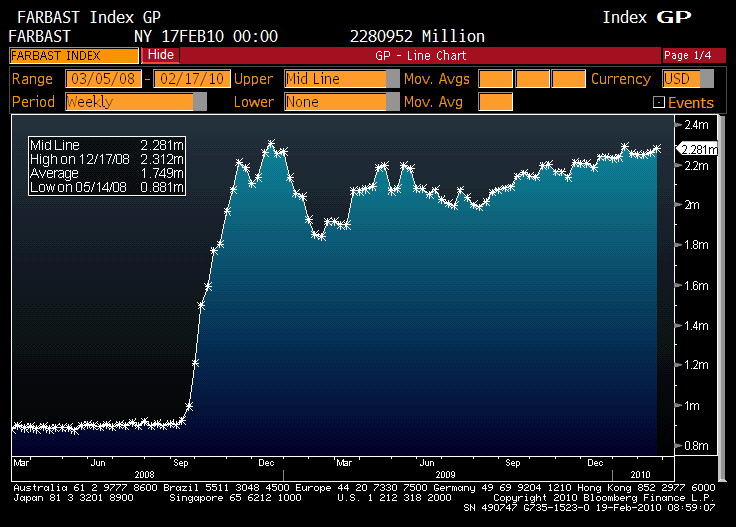
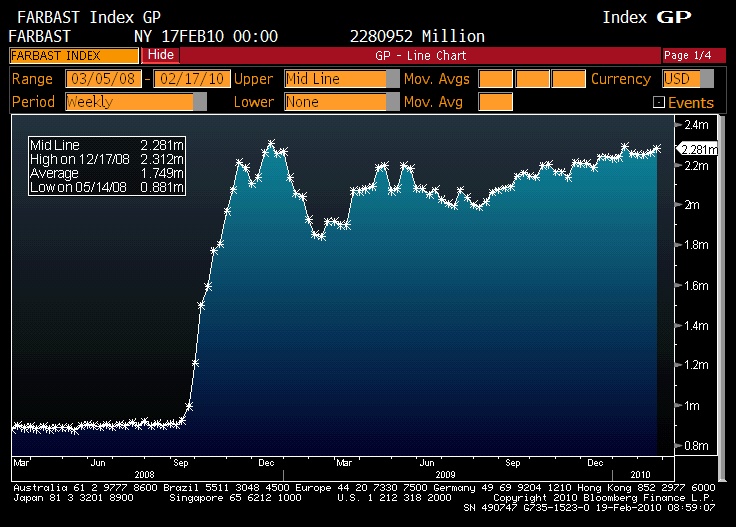
The Fed’s desire to reduce the size of its burgeoning balance sheet, which at $2.3 trillion is roughly around three times its size before the financial crisis began, will imply further measures to reduce USD liquidity over the coming months.   A withdrawal of liquidity could have positive implications for the USD but given that the Fed is still some months away from hiking the Fed Funds rate, interest rate differentials will not turn positive for the USD for a while yet. 

The move has however, changed the complexity of the FX market and likely shifted currencies into new lower ranges against the USD.  There were plenty of reasons to sell EUR even before the Fed move and the discount rate hike inflicted further damage on EUR/USD which dropped below the key psychological level of 1.35.  GBP and commodity currencies were also big losers, with GBP/USD below 1.55.  Key technical support levels to watch will be EUR/USD 1.3422, GBP/USD 1.5374 and AUD/USD 0.884.

US Federal Reserve Balance Sheet ($trillion)
Central banks in the spotlight

The market mood continues to be weighed down by a combination of worries including monetary tightening in China and Greece’s debt woes. Consequently, risk aversion has taken a turn for the worse over the last couple of weeks. Measures of currency and equity market volatility have also spiked. Meanwhile, risk currencies have remained under pressure, especially those that are most sensitive to risk aversion including AUD, NZD, CAD, and a long list of emerging market currencies.

Greece’s problems remain a major drag on the EUR, with speculative sentiment for the currency dropping close to the all time low recorded in September 2008, according to the CFTC IMM data. Further developments including news that the European Commission will officially recommend that Greece should implement more severe cuts on public sector spending are unlikely to help to reverse negative sentiment for the currency. A lack of confidence and scepticism over Greece’s ability to cut its budget deficit suggest little respite for the EUR in the weeks ahead.

Markets will have plenty of other things to focus on this week, with various manufacturing and service sector PMIs, four major central bank decisions, and the January US non-farm payrolls report, due for release. The PMIs are likely to confirm that output in both manufacturing and service industries remains expansionary but only consistent with limited growth rather than the rapid rebound in activity seen following past recessions.

The most interesting central bank decision this week is likely to be that of the Reserve Bank of Australia. Recent data has if anything given more reason for the central bank to raise interest rates, including the latest release which was the TD Securities inflation gauge, which jumped 0.8% in January, the biggest increase in 6-months. Although a hike is now largely discounted, some hawkish rhetoric from the RBA could be sufficient to give the AUD some support.

Although the UK Bank of England is unlikely to shift policy at its meeting on Thursday the statement will be scrutinized for clues as to whether quantitative easing is over. Any indication that there will be no further QE measures will play positively for GBP given that it has been restrained by speculation that the BoE will increase asset purchases. No change is also expected by the ECB but once again Greece will likely dominate the press conference. Meanwhile Norway’s Norges Bank is likely to pause in its policy of gradual tightening.

Clearly the funding currency of choice, the USD, has been one of the main beneficiaries of higher risk aversion and this has been reflected in the latest CFTC Commitment of Traders report, which shows that net short aggregate USD speculative positions have dropped sharply, with USD positioning close to flat again. Similarly, the other beneficiary, namely the JPY, has also seen a significant shift in positioning as shorts have been covered. Expect more to come.

Appetite for carry trades was not be helped by the news that the UK’s Lord Turner has signalled a regulatory crackdown on FX carry trades. The report in the UK press fuelled a sell of in JPY crosses but is unlikely to have more than a short term market impact given the practical difficulties in regulating carry trades. Nonetheless, the fact that speculative positioning is still quite long in the AUD, NZD and CAD suggest scope for more downside in such currencies in the current risk averse environment.

China tightens policy

Risk appetite has soured due to a combination of the rise in China’s reserve requirements, disappointing earnings including Alcoa and a profit warning by Chevron, setting the scene for a day in the red for Asian markets.  The turn in sentiment has hit commodities and commodity currencies particularly hard whilst the JPY has outperformed.  As would be expected against the background of higher risk aversion the US dollar made up some ground.

All eyes are on China and markets will now look to the implications for CNY policy.  Increasingly it seems that data and policy in China is driving global markets and aside from the hike in reserve requirements this was also evident in the fact that stronger trade data over the weekend helped to counter the impact of the soft US December payrolls report.  Further increases in the reserve ratio are likely over coming months followed by actual hikes in interest rates (likely the 1 year rate).  China’s move to tighten policy further over coming months will likely be accompanied by allowing greater appreciation of the CNY too.

The news worsened overnight as the ABC Consumer Confidence index dropped by 6 points to -47, the biggest one-week drop in the last 25 years.  US trade data also came in worse than expected, with the deficit widening to $36.4bn in November.  There is little on the data front today to keep markets occupied today, suggesting that direction will come from equity markets and with more earnings this week including Intel Corp and JPMorgan Chase & Co. there will be plenty to digest.  In the near term the tone of risk aversion is set to continue to dominate but any pull back in risk currencies is likely to prove short-lived.   

There will be more Fed speakers as well as the Fed’s Beige Book today to provide clues ahead of the January 26-27 FOMC meeting.   Aside from noting some improvements in the economy, weak labour market conditions as well as a lack of inflationary pressures will help support expectations that the Fed will hold off from raising interest rates this year.   Fed speakers include Fisher and Plosser both of whom give speeches on the US economy though neither are current voters on the FOMC.   Plosser’s comments so far have highlighted the need for a timely “exit strategy”.

High yield / commodity currencies take the lead

Although equity markets continue to tread water the appetite for risk looks untarnished. So far into the new-year the winners are commodity / high yield plays as well as emerging market assets. The AUD, NOK, NZD and CAD have been the stars on the major currency front, with only GBP registering losses against the USD so far this year. The move in these currencies has been well supported by resurgent commodity prices; the CRB commodities index is up close to 10% since its low on 9 December.

There is little reason to go against this trend and the USD index is set to continue to lose ground as risk appetite improves further. I highlighted the upside potential in high yield / commodity currencies in a post titled “FX Prospects for 2010” and stick with the view that there is much further upside. I still prefer to play long positions in these currencies versus JPY which I believe will come under growing pressure as the year progresses.

Economic data has also been supportive, especially in Australia, supporting the AUD’s yield advantage. Although comments from the central bank towards the end of last year downplayed expectations of much further tightening, data releases support the case for another rate hike at the 2 February RBA meeting, with a fourth consecutive hike of 25bps to 4.00% likely at the meeting.

There will be some important clues from next week’s jobs data in Australia but judging by the solid gain in November retail sales, which rose 1.4% versus consensus expectations of 0.3%, and 5.9% jump in building approvals, the case for a rate hike has strengthened.  AUD/USD will now set its sights on technical resistance around 0.9326. 

AUD/USD has the highest sensitivity with relative interest rate differentials – correlation of 0.85 with Australia/US interest rate futures differentials over the past month – and so unsurprisingly the AUD rallied further as markets reacted to the strong retail sales data. I believe Australian interest rates will eventually get back up to 6% – pointing to more upside for AUD/USD as this is more than is priced in by the market.

It is fortunate for the USD that the correlation between the USD index and interest rate expectations remains low but nonetheless the December 15 FOMC minutes may have provided another excuse to sell the currency. The minutes were interpreted as slightly dovish by the market, with many latching on to the comments that some members of the FOMC debated the potential to expand the scale of asset purchases and continuing them beyond the first quarter.

Caution ahead of US payrolls

The weaker than forecast November US ISM non-manufacturing, a negative UK press report about the problems in Dubai and caution ahead of the US jobs report have dampened risk appetite overnight though there is expected to be little action until the release of the US jobs report today, with some USD short covering likely ahead of the release.  The jobs data could add to disappoint, with data this week including the ADP jobs report, and the employment components of the ISM surveys consistent with a worse than consensus (-125k) reading.  

It was encouraging however, that jobless claims revealed a further decline (457k) to its lowest since November 2008 indicating further improvement in the jobs market, though the data will have little bearing on today’s payrolls data which as noted above will likely disappoint expectations.  A below consensus may fuel some increase in risk aversion and a slightly firmer USD though markets are most likely to settle into ranges in the near term. 

The JPY may make up some lost ground against the background of weaker equity performance.  Amidst the confusing messages on the JPY over recent weeks officials appear to be giving stronger hints at intervention, leaving the currency on the back foot over recent days.  The drop in the JPY may prove temporary however, if official rhetoric is not followed up by action; USD/JPY is likely to struggle to break through resistance around 88.60.  

Following the BoJ’s disappointing JPY P10 trillion operation announced this week attention turns to the announcement of new government stimulus measures which were reportedly expected today.  This may also prove disappointing however, as there appears to be disagreement between coalition partners on the size and composition of stimulus.  Finance Minister Hatoyama was expected to announce additional spending of up to JPY 4 trillion.  

There was no surprise that the ECB left the refi rate unchanged at 1% yesterday but some surprise in the steps to withdraw provision.  The ECB announced that the interest rate on the December 12-month tender will be indexed to the refi rate and that the full allotment at most of the ECB’s refinancing operations is extended until 13 April 2010 only. As much as ECB President Trichet tried to play down the perception that the steps were a signal of a tighter policy markets are unlikely to interpret it this way. 

Despite the shift in the ECB’s stance EUR/USD pared gains after reaching a high around 1.5141 but failed to test resistance at 1.5150 which is likely to provide strong resistance in the days ahead, reflecting the fact that markets had priced in a hawkish shift by the ECB already.   Going forward, if the market perceives the ECB as prematurely shifting towards a more hawkish stance against the EUR could suffer rather than find any support from such actions