EU Deal Boosts Euro But Momentum To Fade

The European Union deal for Greece was clearly on the positive side of expectations and from that perspective helped to buoy sentiment for European assets. The fact that EU leaders managed to work over differences and emerge with a solid deal will help remove some of the uncertainty about Greece’s future and lower the risks of contagion.

To recap EU leaders announced a EUR 109 billion second aid package for Greece. Private bondholders will contribute a target of a further EUR 37 billion via bond swaps or rolling over existing debt for new bonds maturing in 30 years. Investors will have the option to exchange existing debt into four instruments. The aim is to obtain 90% participation from Greek bondholders.

Moreover, it appears that governments will guarantee any defaulted Greek debt offered as collateral until the country can return to the market. Effectively this means that even if ratings agencies declare a default rating on Greek debt, Greek banks may still be able to obtain funding from the European Central Bank (ECB) as the debt is guaranteed by national governments.

Greece, Portugal and Ireland will benefit from lower interest rates on loans and longer maturities. Moreover, the European Financial Stability Facility (EFSF) bailout fund will have a wider scope for bond buying directly from investors. This lets the ECB off the hook to avoid further use of its own bond purchase programme and removes any further impairing of its balance sheet. The idea of a tax on banks was removed, as criticism of the workability of such a plan increased.

The downside of the deal includes the fact that:
1) European tax payers are on the line for a potentially unlimited amount to guarantee defaulted Greek debt,
2) The bondholder programme is only limited to Greece, so there is no contingency should something similar be needed in other countries
3) The participation rate for private bondholders is yet to be known (but will most likely be high).
3) The deal will lead to a default on Greek debt given the programme amounts to a 21% drop in value but a credit event is unlikely to be triggered.
4) Greece still has a highly ambitious privatisation and austerity plan to implement which even some Greek officials have admitted is overly optimistic and at worst could turn into a fire sale of Greek assets.
5) EFSF bond purchases will need the “mutual agreement” of member states which is by no means guaranteed.
6) The fund size is not large enough should Italy and Spain need similar bailouts especially as leaders have stressed that the Greek package will not be replicated for other countries.

The EUR rallied on the outcome of the European talks. However, the EUR has plenty of other worries to deal with including divergence in growth across the eurozone, overly long EUR market positioning, EUR overvaluation, likely growth underperformance versus the US and a likely rebound in general for the USD over coming months especially if the Fed does not embark on QE3 and agrees a deal to raise the debt ceiling. EUR/USD is likely to remain supported in the near term, with near term resistance around 1.4467. I still suspect that the momentum will not last, with EUR/USD looking particularly rich at current levels.
Edging Towards A European Deal For Greece

The momentum towards some form of agreement at the Special EU Summit today is growing, with French and German leaders reaching a “joint position on Greece’s debt situation”. Details of this position are still unknown, however. EUR has found support as expectations of a positive outcome intensify.

However, given that positive news is increasingly being priced in, and the market is becoming increasingly long, upside EUR potential will be limited even in the wake of a comprehensive agreement. A break above EUR/USD resistance around 1.4282 would bring in sight the next key resistance level around 1.4375 but this where the rally in EUR/USD is set to be capped.

Prospects of a major US debt default or at the least a government shutdown appear to be receding as the US administration has indicated some willingness to opt for a short term increase in the US borrowing limit to give more time for a bigger deficit reduction deal to be passed by Congress. Meanwhile, there will be further news on the deficit reduction plans put forward by the “gang of six” US senators, with a press conference scheduled for later today.

Debt ceiling negotiations are likely to be the main focus of market attention, with the Philly Fed manufacturing survey and weekly jobless claims relegated to the background. A speech by Fed Chairman Bernanke is unlikely to deliver anything new today. The USD is likely to be on the back foot given expectations of a deal in Europe and improved risk appetite but we expect losses to be limited.

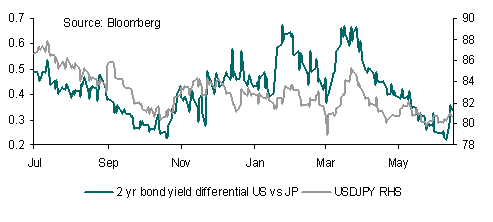
The JPY continues to defy my bearish expectations. Over recent days the US yield advantage over Japan in terms of 2Y bonds dropped to multi-year lows below 20bps. Given the high correlation between USD/JPY and yield differentials, this has corresponded with the fall below 80.00.

Expectations of JPY weakness versus USD is highly dependent on the US – Japan yield gap widening over coming months. For this to happen it will need concerns about the US economy and expectations of more Fed asset purchases to dissipate, something that may not happen quickly given the rash of disappointing US data releases lately.

GBP found itself on the front foot following the release of the Bank of England Monetary Policy Committee minutes, which were less dovish than anticipated. They also revealed that the BoE expects inflation to peak higher and sooner than previously expected. However, the fact that the overall tone was similar to the last set of minutes meant there was little follow through in terms of GBP.

Further direction will come from June retail sales data today and forecasts of a bounce in sales will likely help allay concerns about a downturn in consumer spending. Nonetheless, GBP is still likely to struggle to break through resistance around 1.6230 versus USD.

Euro crisis intensifies

The blowout in eurozone non-core debt has intensified and unlike in past months the EUR has been a clear casualty. The lack of a concrete agreement over a solution given divergent views of EU officials, the European Central Bank (ECB) and private sector participants threatens a further ratcheting higher of pressure on markets over coming weeks.

The only real progress overnight as revealed in the Eurogroup statement appeared to be in the renewing the option of buying back Greek debt via the eurozone bailout fund, extending maturities and lowering interest rates on loans. This will be insufficient to stem the pressure on the EUR, with the currency verging on a sharp drop below 1.40.

The USD continues to take advantage of the EUR’s woes and has actually staged a break above its 100-day moving average yesterday after several attempts previously. This sends a bullish signal and the USD is set to remain supported given that there is little in sight of a resolution to the problems festering in the eurozone.

Today’s release of the June 22 Fed FOMC minutes will give some clues to Fed Chairman Bernanke’s testimony to the House of Representatives tomorrow, but as long as the minutes do not indicate a greater willingness to embark on more asset purchases, the USD is set to remain resilient.

GBP has also benefitted from the EUR’s weakness, and unlike the EUR has only drifted rather than dived versus the USD. However, the UK economy is not without its own problems as revealed in a further drop in retail sales overnight, albeit less negative than feared, with the British Retail Consortium (BRC) like for like sales falling 0.6% in June.

A likely increase in June CPI inflation in data today to a 4.8% annual rate will once again highlight the dichotomy between weak growth and high inflation. In turn, such data will only provoke further divisions within the Bank of England MPC. While further gains against the beleaguered EUR are likely, with a test of EUR/GBP 0.8721 on the cards in the short term, GBP will struggle to sustain any gain above 1.6000 versus USD.

Both AUD and NZD are vulnerable against the background of rising risk aversion and a firmer USD in general. However, both currencies are not particularly sensitive to risk aversion. Interestingly the major currency most sensitive to higher risk aversion in the past 3-months is the CAD and in this respect it may be worth considering playing relative CAD underperformance versus other currencies.

As for the AUD it is more sensitive to general USD strength, suggesting that it will be restrained over coming sessions too and given that market positioning is still very long AUD, there is scope for further downside pressure to around 1.0520 versus USD.

EUR higher but resistance looms

EUR and risk currencies in general were buoyed by the passage of the austerity bill in the Greek parliament. The implementation bill is also likely to be passed later today opening the door for the disbursement of EUR 12 billion from the European Union / IMF from the EUR 110 bailout agreed for the country. Combined with news that German banks are progressing towards agreeing on a mechanism to roll over Greek debt alongside French banks as well as likelihood of an European Central Bank (ECB) rate hike next week, the EUR is set to remain supported over the short term.

Nonetheless, it once again looks as though a lot of good news is priced in and it would be surprising if EUR/USD could extend to above strong resistance around 1.4557 given the many uncertainties ahead, not the least of which includes the stance of ratings agencies on any Greek debt rollover.

USD/JPY is the only major currency pair that is correlated with bond yield differentials at present (2-year yields) and therefore it should not come as a surprise that USD/JPY has moved higher as the yield differential between the US and Japan has widened by around 10bps over the past week. Indeed, yesterday’s move above 81.00 was spurred by the move in yield differentials although once again the currency pair failed to build sufficient momentum to close above this level.

Further gains will require US bond yields to move even higher relative to Japan but perhaps the end of QE2 today may mark a turning point for US bond markets and currencies. The end of QE2 taken together with a jump in bond supply over coming months, will see US Treasury yields will move sharply higher, implying much more upside for USD/JPY.

AUD has bounced back smartly over recent days, with the currency eyeing resistance around 1.0775 versus USD. A general improvement in risk appetite has given the currency some support but markets will be unwilling to push the currency much higher ahead of the Reserve Bank of Australia (RBA) meeting next week. On the plus side, there are no rate hikes priced in for Australia over the remainder of the year, suggesting an asymmetric risk to next week’s meeting.

In other words, unless the RBA openly discusses rate cuts in the statement, the AUD will likely remain supported. Conversely any indication that a rate hike may be in prospect will be AUD supportive. In any case we continue to believe the AUD offers better value especially relative to NZD and maintain our trade idea to buy AUD/NZD.

Euro unimpressed by Greek confidence vote

News that the Greek government won a confidence vote has left the EUR unimpressed and gains will be limited ahead of the June 28 vote on the country’s 5-year austerity plan. The EUR was in any case rallying ahead of the vote, which the government won by 155-143 votes, and has actually lost a little ground following the vote.

EUR sentiment is likely to remain somewhat fragile given the ongoing uncertainties, but now that the first hurdle has been passed markets there is at least a better prospect of Greece receiving the next EUR 12 billion aid tranche before the July 15 “do or default” deadline. Over the near term EUR/USD upside is likely to remain capped around the 1.4451 resistance level (15 June high).

The next key event for markets is the Fed FOMC meeting outcome and press conference. This is unlikely to bode particularly well for the USD given that the Fed is set to downgrade its growth forecasts, with the comments on the economy likely to sound a little more downbeat given the loss of momentum recently as reflected in a string of disappointing data releases.

Nonetheless, monetary settings are unlikely to be changed, with the Fed committed to ending QE2 by the end of June. I remain positive on the USD’s prospects but its recovery is fragile due to the fact that US bond yields remain at ultra low levels.

Whilst only AUD/USD and USD/JPY have maintained significant correlations with bond yield differentials over the past three months, it will eventually require US bond yields to move higher in relative terms for the USD to find its legs again on a more sustainable basis.

In the meantime the approach of the end of QE2 by the end of June will on balance play positively for the USD as at least the Fed’s balance sheet will no longer be expanding even if the reinvestment of principle from its holdings of US Treasuries suggest that there will not be a quick or immediate reduction in the size of the balance sheet anytime soon.

There is little appetite to intervene to weaken the JPY at present, with the Japanese authorities blaming the strengthening in the JPY versus USD on the latter’s weakness rather than the former’s strength. Until yield differentials widen, USD/JPY will continue to languish at current levels or even lower.

GBP will garner direction from the release of the Bank of England Monetary Policy Committee meeting minutes. Whilst GBP has edged higher against the USD it has remained vulnerable against EUR. A likely dovish set of minutes reflecting some weak activity data, easing core inflation and soft wage growth, suggests little support for GBP over the short term.