Japanese FX Intervention

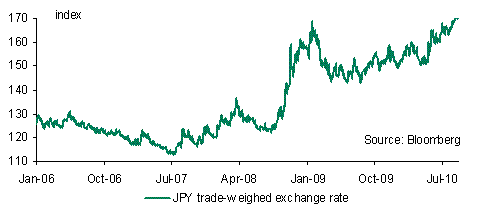
The Bank of Japan acting on the behest of the Ministry of Finance intervened to weaken the JPY, the first such action since 2004. The intervention came as the USD was under broad based pressure, with the USD index dropping below its 200-day moving average. USD/JPY dropped to a low of around 82.88 before Japan intervened to weaken the JPY. The move follows weeks of verbal intervention by the Japanese authorities and came on the heels of the DPJ leadership election in which Prime Minister Kan retained his leadership.

One thing is for certain that Japanese exporters had become increasingly concerned, pained and vocal about JPY strength at a time when export momentum was waning. However, the move in USD/JPY may simply provide many local corporates with better levels to hedge their exposures.

Time will tell whether the intervention succeeds in engineering a sustainable weakening in the JPY but more likely it will only result in smoothing the drop in USD/JPY over coming months along the lines of what has happened with the SNB interventions in EUR/CHF. As many central banks have seen in the past successful intervention is usually helped if the market is turning and in this case USD/JPY remains on a downward trajectory.

Although the BoJ Governor Shirakawa said that the action should “contribute to a stable foreign exchange-rate formation” it is far from clear that the BoJ favoured FX intervention. Indeed, the view from the BoJ is that the move in USD/JPY is related less to Japanese fundamentals but more to US problems.

Now that the door is open, further intervention is likely over coming days and weeks but for it to be effective it will require 1) doubts about US growth to recede, 2) speculation of Fed QE 2 to dissipate, 3) and consequently interest rate differentials, in particular bond yields between the US and Japan to widen in favour of the USD. This is unlikely to happen quickly, especially given continued speculation of further US quantitative easing. A final prerequisite to a higher USD/JPY which is related to the easing of some of the above concerns is for there to be an improvement in risk appetite as any increase in risk aversion continues to result in JPY buying.

When viewed from the perspective of Asian currencies the Japanese intervention has put Japan in line with other Asian central banks which have been intervening to weaken their currencies. However, Asian central bank intervention has merely slowed the appreciation in regional currencies, and Japan may have to be satisfied with a similar result. Japan’s intervention may however, give impetus to Asian central banks to intervene more aggressively but the result will be the same, i.e. slowing rather then stemming appreciation.

As for the JPY a further strengthening, with a move to around 80.00 is likely by year end despite the more aggressive intervention stance. Over the short term there will at least be much greater two-way risk, which will keep market nervous, especially if as is likely Japan follows up with further interventions. USD/JPY could test resistance around 85.23, and then 85.92 soon but eventually markets may call Japan’s bluff and the intervention may just end up putting a red flag in front of currency markets to challenge.
US Dollar Tensions

There was considerable relief, most acutely in the US administration, that the US August jobs report revealed a better than expected outcome. To recap, private sector payrolls increased by 67k vs. an upwardly revised 107k in July whilst total non farm payrolls dropped 54k. The data sets the market up for a positive start to the week in terms of risk appetite despite Friday’s drop in the August US non-manufacturing ISM index, deflating some of the market’s upbeat mood.

Once again I wonder how long positive sentiment can be sustained with so many doubts about recovery prospects and limited ammunition on the fiscal front as well as some reluctance on the monetary front, to provide further stimulus should a double dip become a reality.

Markets will be treated to several major central bank decisions including from the Bank of Japan, Bank of England, Bank of Canada and Reserve Bank of Australia this week. These meetings are set to prove uneventful, with unchanged decisions across the board expected although the Bank of Canada decision is a tough call.

The main US release this week is the Fed’s Beige Book on Wednesday, a report which will help the Fed to prepare for the FOMC meeting on September 21. The evidence contained within it is unlikely to be positive reading, with consumer spending set to be relatively soft and evidence of recovery likely to remain patchy.

On Thursday the US July trade deficit is set to reveal some narrowing and as usual the deficit with China will be of interest given the renewed tensions over FX policy. FX tension seems to be intensifying once again due to the relatively slow pace of CNY appreciation since the June de-pegging as well as political posturing ahead of November US mid-term elections. A deterioration in US trade data, a factor that largely contributed to the soft Q2 GDP outcome in contrast to a strengthening in China’s trade surplus will have added fuel to the fire.

The firmer risk backdrop has put the USD on the back foot, with the USD index dropping sharply overnight. Nonetheless, speculative USD positioning as reflected in the CFTC IMM data reveals further short covering up to the end of August, implying USD speculative sentiment is actually turning less negative.

Another country which has a different sort of tension regarding the USD is Japan. Improving risk appetite will likely prevent the JPY from visiting previous highs against the USD but will do little to reduce FX intervention speculation. Indeed, there was more jawboning over the weekend on the subject, with Japan’s finance minister Noda reiterating that Japan would take decisive action to stem the JPY’s appreciation but adding that coordinated FX intervention was a difficult option. Clearly Japan us unlikely to succeed with unilateral FX intervention.

Political events have added to the debate on FX policy as focus turns to the election for leader of the ruling DPJ party next week, with a battle looming between current Prime Minister Kan and challenger Ozawa. Although Ozawa is unpopular with the electorate he yields plenty of political power, and appea rs to be more inclined towards FX intervention. Having failed to sustain a move above 85.00 the pull back in USD/JPY suggests little appetite to extend gains, likely leaving USD/JPY in a relatively tight range, with strong support around 83.55 and resistance around 85.23.

Follow The Oracle

Many investors are probably wishing they had the psychic abilities of Paul the octopus. The mollusc once again gave the correct prediction, by picking Spain to beat the Netherlands to become the winner of the World Cup. This ability would have been particularly useful for currency forecasters, many of which have been wrong footed by the move higher in EUR/USD over recent weeks.

Confidence appeared to return to markets over the past week helped by a string of rate hikes in Asia from India, South Korea and Malaysia, and firm data including yet another consensus beating jobs report in Australia. An upward revision to global growth forecasts by the International Monetary Fund (IMF) also helped, with the net result being an easing in double-dip growth concerns.

The good news culminated in a much stronger than forecast June trade surplus in China. However, China’s trade numbers will likely keep the pressure on for further CNY appreciation, and notably US Senators are still pushing ahead with legislation on China’s FX policy despite the US Treasury decision not to name China as a currency manipulator.

Political uncertainty on the rise again in Japan following the loss of control of the upper house of parliament by the ruling DPJ party. The JPY has taken a softer tone following the election and will likely remain under pressure. CFTC IMM speculative JPY positioning has increased but this has been met with significant selling interest by Japanese margin accounts who hold their biggest net long USD/JPY position since October 2009 according to Tokyo Financial Exchange (TFX) data.

In the absence of the prodigious abilities of an “oracle octopus” data and events this week will continue to show slowing momentum in G3 country growth indicators but not enough to warrant renewed double-dip concerns. Direction will be largely driven by US Q2 earnings. S&P 500 company earnings are expected to have increased 27% from a year ago according to Thomson Reuters.

There are several data releases of interest in the US this week but the main release is the retail sales report for June which is likely to record another drop over the month. Data and events in Europe include the Eurogroup finance ministers meeting, with markets looking for further insight into bank stress tests across the region. Early indications are positive but the scope of the tests remains the main concern. The July German ZEW survey will garner some interest and is likely to show a further slight decline in economic sentiment.

EUR/USD gains looked increasingly stretched towards the end of last week, as it slipped back from a high of around 1.2722. Technical resistance around 1.2740 will prove to be tough level to crack over coming days, with a pullback to support around 1.2479 more likely. CFTC IMM data reveals that short covering in EUR has been particularly sharp in the last week, with net short positions cut by over half, highlighting that the scope for further short covering is becoming more limited.

Conversely aggregate net USD long positions have fallen by over half in the last week as USD sentiment has soured, with longs at close to a three-month low. The scope for a further reduction in USD positioning is less significant, suggesting that selling pressure may abate.

Japanese yen and FX sensitivity to interest rates

Interest rates have some way to go before they take over from risk aversion as the key driver of currency markets but as noted in my previous post, low US interest rates have played negatively for the dollar. As markets have continued to pare back US tightening expectations and US interest rate futures have rallied, interest rate differentials have moved against the dollar. 

The most sensitive currency pair in this respect has been USD/JPY which has been the most highly correlated G10 currency pair with relative interest rate differentials over the past month. It has had a high 0.93 correlation with US/Japan interest rate differentials and a narrowing in the rate differential (mainly due to a rally in US rate futures) has resulted in USD/JPY moving lower and the yen becoming one of the best performing currencies over recent weeks.

Going forward the strong FX / interest rate correlation will leave USD/JPY largely at the whim of US interest rate markets (as Japanese rate futures have hardly moved). Fed officials if anything, are adding to the pressure on the dollar as they continue to highlight that US interest rates will not go up quickly. San Francisco Fed President Yellen was the latest official to do so, warning that the prospects for a “tepid” recovery could fuel inflation risks on the downside.

This echoes the sentiments of other Fed officials over recent weeks and suggests that the Fed wants to prevent the market pricing in a premature reversal in US monetary policy.   It looks increasingly likely that the Fed will maintain interest rates at current levels throughout 2010 given the massive amount of excess capacity and benign inflation outlook, suggesting that interest rate differentials will play negatively for the dollar for several months to come.

As for the yen its path will not only depend on relative interest rates but also on the policies of the new DPJ led government. If Japanese press speculation proves correct the new Finance Minister may favour a stronger yen which will benefit domestic consumers rather than a weaker yen that would benefit exporters. Against this background, markets will largely ignore comments by outgoing Finance Minister Yosano who said that further yen strength would be detrimental for exporters.

The market certainly believes that the yen will strengthen further as reflected by the sharp increase in speculative positioning over recent weeks; net CFTC IMM long yen positions have reached their highest since 10 February 2009. Although USD/JPY has pushed higher since it’s low around 90.21 the upside is likely to be limited against this background and a re-test and likely break back below the key 90.00 psychological level is likely soon.