USD Pressured As Yields Dip

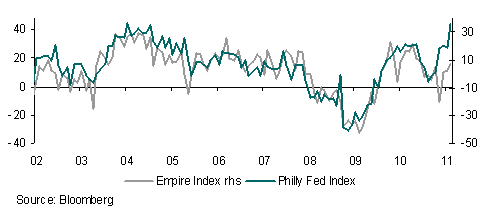
The USD came under pressure despite a higher than forecast reading for January US CPI and a strong jump in the February Philly Fed manufacturing survey. On the flip side, an increase in weekly jobless claims dented sentiment. The overnight rally in US Treasury yields was a factor likely weighing on the USD. The US calendar is light today leaving markets to focus on the G20 meeting and to ponder next week’s releases including durable goods orders, existing and new home sales.
The jump in the European Central Bank (ECB) marginal facility borrowing to EUR 15 billion, its highest since June 2009, provoked some jitters about potential problems in one or more eurozone banks. At a time when there are already plenty of nerves surrounding the fate of WestLB and news that Moody’s is reviewing another German bank for possible downgrade, this adds to an already nervous environment for the EUR.

Nonetheless, EUR/USD appears to be fighting off such concerns, with strong buying interest on dips around 1.3550. The G20 meeting under France’s presidency is unlikely to have any direct impact on the EUR or other currencies for that matter, with a G20 source stating that the usual statement about “excess volatility and disorderly movements in FX” will be omitted.

Although USD/JPY has been a highly sensitive currency pair to differentials between 2-year US and Japanese bonds (JGBs), this sensitivity has all but collapsed over recent weeks. USD/JPY failed to break the 84.00 level, coming close this week. There appears to be little scope to break the current range ahead of next week’s trade data and CPI.
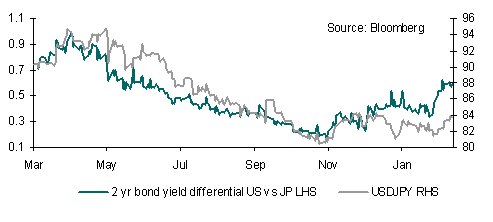
Given the recent loss in momentum of Japan’s exports the data will be instructive on how damaging the strength of the JPY on the economy. In the near term, escalating tensions in the Middle East will likely keep the JPY supported, with support around USD/JPY 83.09 on the cards.

It seems that the jump in UK CPI this week (to 4.0%) provoked even more hawkish comments than usual from the Bank of England BoE’s Sentance, with the MPC member stating that the Quarterly Inflation Report understates the upside risks to inflation indicating that interest rates need to rise more quickly and by more than expected. Specifically on GBP he warned that the Bank should not be relaxed about its value.

Although these comments should not be particularly surprising from a known hawk, they may just help to underpin GBP ahead of the January retail sales report. Expectations for a rebound in sales following a weather related drop in the previous month will likely help prop up GBP, with GBP/USD resistance seen around 1.6279.
Euro Sentiment Jumps, USD Sentiment Dives

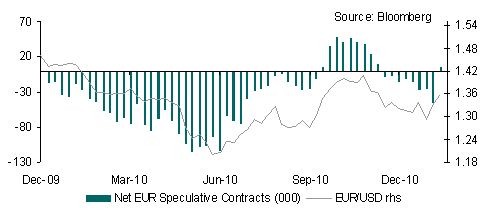
The bounce in the EUR against a broad range of currencies as well as a shift in speculative positioning highlights a sharp improvement in eurozone sentiment. Indeed, the CFTC IMM data reveals that net speculative positioning has turned positive for the first time since mid-November. A rise in the German IFO business confidence survey last week, reasonable success in peripheral bond auctions (albeit at unsustainable yields), hawkish ECB comments and talk of more German support for eurozone peripheral countries, have helped.

A big driver for EUR at present appears to be interest rate differentials. In the wake of recent commentary from Eurozone Central Bank (ECB) President Trichet following the last ECB meeting there has been a sharp move in interest rate differentials between the US and eurozone. This week’s European data releases are unlikely to reverse this move, with firm readings from the flash eurozone country purchasing managers indices (PMI) today and January eurozone economic sentiment gauges expected.

Two big events will dictate US market activity alongside more Q4 earnings reports. President Obama’s State of The Union address is likely to pay particular attention on the US budget outlook. Although the recent fiscal agreement to extend the Bush era tax cuts is positive for the path of the economy this year the lack of a medium to long term solution to an expanding budget deficit could come back to haunt the USD and US bonds.

The Fed FOMC meeting on Wednesday will likely keep markets treading water over the early part of the week. The Fed will maintain its commitment to its $600 billion asset purchase program. Although there is plenty of debate about the effectiveness of QE2 the program is set to be fully implemented by the end of Q2 2011. The FOMC statement will likely note some improvement in the economy whilst retaining a cautious tone. Markets will also be able to gauge the effects of the rotation of FOMC members, with new member Plosser possibly another dissenter.

These events will likely overshadow US data releases including Q4 real GDP, Jan consumer confidence, new home sales, and durable goods orders. GDP is likely to have accelerated in Q4, confidence is set to have improved, but at a low level, housing market activity will remain burdened by high inventories and durable goods orders will be boosted by transport orders. Overall, the encouraging tone of US data will likely continue but markets will also keep one eye on earnings. Unfortunately for the USD, firm US data are being overshadowed by rising inflation concerns elsewhere.

Against the background of intensifying inflation tensions several rate decisions this week will be of interest including the RBNZ in New Zealand, Norges Bank in Norway and the Bank of Japan. All three are likely to keep policy rates on hold. There will also be plenty of attention on the Bank of England (BoE) MPC minutes to determine their reaction to rising inflation pressures, with a slightly more hawkish voting pattern likely as MPC member Posen could have dropped his call for more quantitative easing (QE). There will also be more clues to RBA policy, with the release of Q4 inflation data tomorrow.

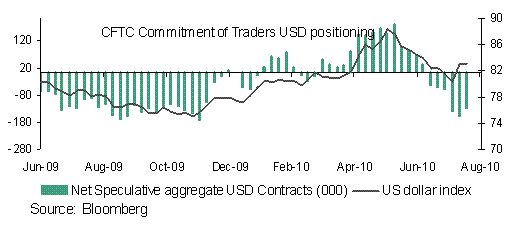
Both the EUR and GBP have benefitted from a widening in interest rate futures differentials. In contrast USD sentiment has clearly deteriorated over recent weeks as highlighted in the shift in IMM positioning, with net short positions increasing sharply. It is difficult to see this trend reversing over the short-term, especially as the Fed will likely maintain its dovish stance at its FOMC meeting this week. This suggests that the USD will remain on the back foot.

Risk on mood prevails

The end of the year looks as though it will finish in a firmly risk on mood. Equity volatility in the form of the VIX index at its lowest since July 2007. FX volatility remains relatively low. A lack of market participants and thinning volumes may explain this but perhaps after a tumultuous year, there is a certain degree of lethargy into year end.

Whether 2011 kicks off in similar mood is debatable given the many and varied worries remaining unresolved, not the least of which is the peripheral sovereign debt concerns in the eurozone. It is no surprise that the one currency still under pressure is the EUR and even talk that China offered to buy Portuguese sovereign bonds has done little to arrest its decline.

Reports of officials bids may give some support to EUR/USD just below 1.31 but the various downgrades to ratings and outlooks from ratings agencies over the past week has soured sentiment for the currency. The latest move came from Fitch ratings agency which placed Greece’s major banks on negative ratings watch following the move to place the country’s ratings on review for a possible downgrade.

The USD proved resilient to weaker than forecast data including a smaller than forecast 5.6% gain in existing home sales in November. The FHFA house price index recorded a surprise gain of 0.7% in October, which mitigated some of the damage. The revised estimate of US Q3 GDP revealed a smaller than expected revision higher to 2.6% QoQ annualized from a previous reading of 2.5%. Moreover, the core PCE was very soft at 0.5% QoQ, supporting the view that the Fed has plenty of room to keep policy very accommodative.

Despite the soft core PCE reading Philadelphia Fed President Plosser who will vote on the FOMC next year indicated that if the economy continues to strengthen he will look for the Fed to cut back on completing the $600 billion quantitative easing (QE) program. Although the tax deal passed by Congress will likely reduce the need for QE3, persistently high unemployment and soft core inflation will likely see the full $600 billion program completed. Today marks the heaviest day for US data this week, with attention turning to November durable goods orders, personal income and spending, jobless claims, final reading of Michigan confidence and November new home sales.

Overall the busy US data slate will likely maintain an encouraging pattern, with healthy gains in income and spending, a rebound in new home sales and the final reading of Michigan confidence likely to hold its gains in December. Meanwhile jobless claims are forecast to match the 420k reading last week, which should see the 4-week average around the 425k mark. This will be around the lowest since August 2008, signifying ongoing improvement in payrolls. The data should maintain the upward pressure on US bond yields, which in turn will keep the USD supported.

Please note that this will be the last post on Econometer.org this year. Seasons greatings and best wishes for the new year to all Econometer readers.

Week Ahead

The market mood can be characterised as uncertain and somewhat downbeat, as reflected by the downdraft in US equity markets which posted their second weekly loss last week. Conversely, there has been a bullish run in government bonds, with the notable exception of peripheral debt. Over the last week markets had to contend with more data disappointment, in the wake of soft Japanese Q2 GDP, and a plunge in the August Philly Fed into negative territory, its first contraction since July 2009. Additionally a jump in jobless claims, which hit 500k highlighted the slow improvement in US job market conditions currently underway.

Despite all of this, the USD proved resilient and instead of the usual sell-off in the wake of soft data it benefited instead from increased risk aversion. The USD is set to retain some of this resilience though range-trading is likely to dominate over much of the weak. Reflecting the USD’s firmer stance, speculative positioning in the form of the CFTC IMM data revealed a reduction in aggregate USD short positioning in the latest week and although positioning is well below the three-month average, the improvement over the latest week and current magnitude of short positioning, highlights the potential and scope for further short-covering.

Negative data surprises have forced many to downgrade their forecasts for growth and policy implications, especially in the US. Markets will look for further clarity on the economic outlook this week but it is not clear that anything conclusive will be delivered. At the end of the week Q2 GDP will be revised sharply lower and whilst the data is backward looking it will reveal the weaker momentum of growth going into the second half of the year.

US Housing data will be mixed, with existing home sales set to drop in July as the impact of the expiration of home buyers tax credits continues to sink in whilst new home sales will likely increase but only marginally and will remain well below the April levels. Overall the picture of housing market activity remains bleak and this week’s data will do little to shake this off. On a more positive note July durable goods orders and August Michigan confidence will rise, the latter only marginally though. There will be plenty of attention on Fed Chairman Bernanke’s speech at the Jackson Hole Fed conference at the end of the week, especially given speculation of more quantitative easing in the pipeline.

The European data slate kicks off today with the release of manufacturing and service sector PMIs. Both are likely to register small declines, albeit from high levels. Nonetheless, taken together with a likely drop in the August German IFO survey on Wednesday and weaker June industrial orders tomorrow, the data will highlight that the momentum of growth in the region is coming off the boil, with the robust GDP outcome registered in Q2 2010 highly unlikely to be repeated. Against this background EUR/USD will find it difficult to make any headway. Technically further donwnside is likely over the short-term, with a test of 1.2605 support on the cards

Japan releases its slate of month end releases including jobs data, household spending and CPI. A slight improvement in job market conditions and increased spending will be insufficient to allay growth and deflation concerns, especially with CPI remaining firmly in negative territory. The onus will remain on the authorities to try to engineer a weaker JPY, which remains stubbornly around the 85.00 level versus USD. Talk of a BoJ / MoF meeting today has been dismissed, suggesting the prospect of imminent action is small. Meanwhile, speculative JPY positioning has dropped slightly in the last week but remain close to historical highs.

Aside from various data releases this week markets will digest the outcome of Australia’s federal elections. From the point of view of markets the outcome was the worst possible, with no clear winner as both the incumbent Prime Minister of the ruling Labour Party and opposition Liberal-National Party leader Tony Abbot failed to gain an outright majority. The outcome of a hung parliament will likely keep the AUD on the back foot, with trading in the currency likely be somewhat volatile until a clear outcome is established as both candidates try to garner the support of a handful of independents. However, it is notable that apart from an initial drop the AUD has managed to hold its ground. Nonetheless, the given the fluidity of the political situation there will be few investors wanted to take long positions at current levels around 0.8900 versus USD.

Some Respite For The Euro

Following several days in which confidence in Greece’s ability to weather the storm was deteriorating, news that Greece asked for EU/IMF help helped to boost global markets and the EUR.  Meanwhile strengthening economic and earnings news helped to provide an undercurrent of support for markets, which boosted the end week rally in risk appetite.  

A 27% jump in US new home sales in March, a firm durable goods orders report as well better than expected earnings, with around 80% of companies reporting first quarter earnings beating expectations, highlight that US economic recovery is becoming increasingly well entrenched.  This is likely to be confirmed by the release of US Q1 GDP this week, set to register over 3% annualised quarterly growth.  

In Europe the picture is far more divergent, with exporting countries such as Germany doing well as evidenced from surveys such as the IFO and ZEW surveys, but in contrast the club med countries are not doing so well.  The highlights of the data calendar this week are April confidence indicators and the flash reading of Eurozone CPI.  Confidence indicators are likely to reveal some improvement, but despite Friday’s EUR/USD bounce, the data will be insufficient to prevent EUR/USD continue to move lower, with 1.3150 still a firm target over coming weeks.  

The official request for aid from Greece from the EU/IMF begins a new chapter in the long running saga for the country.  Greece will officially detail the amount of aid needed in a letter to the European Commission and European Central Bank who will then decide whether to approve it.  

A few dates to note are the maturing of EUR 8.5 billion in bonds on May 19, the completion of discussion with the IMF, EU and ECB on May 6 and state elections in Germany on May 9, which could throw a spanner in any financial support from Germany for Greece.   Meanwhile Greek unions are threatening further strikes to protest against austerity measures that Greece needs to carry out to win any aid package.   

Aside from Greece, attention will continue to be focussed on earnings but the main event of the week will be the Fed FOMC meeting on 27/28 April. Whilst a no change outcome is highly likely, with interest rates set to be left at between 0-0.25%, there will be plenty of attention on whether the Fed removes the comment that policy rates will remain low for an “extended period”. If the comment is removed the statement will be taken in somewhat of a hawkish context, which would boost the USD.