Greek Saga Rumbles On – Does Anybody Care?

The debate over Greece continues to rumble on. France and Spain requested a separate summit meeting of the 16 heads of eurozone countries immediately before the full 27-member EU summit starting tomorrow but this was met with resistance. Meanwhile, Germany has called for “a substantial contribution” from the IMF towards a Greek aid package, whilst maintaining that no EU deal will be reached for Greece at the summit.

Frankly, the whole Greek saga has become extremely boring, with the lack of agreement about how to fix it doing little to inspire confidence. In particular the fractured opinion amongst EU leaders highlights the difficulties in reaching an agreement in a union made up of so many conflicting interests. At most the summit may agree on the conditions for a rescue package for Greece rather than a package itself. This will leave markets unimpressed,

US new home sales data today is likely to paint a slightly better picture with a small gain expected, albeit following the 11.2% plunge in the previous month. Sales will be helped by the extension of the home buyer tax credit. The US February durable goods orders report is also released today, with a small increase expected. A smaller gain in transport orders suggests that the 2.6% jump last month will not be repeated.

In Europe, the key release is the March German IFO business climate survey and a rebound is likely following February’s decline, helped by warmer weather and a weaker EUR. Flash readings of Eurozone March purchasing managers indices (PMIs) are also released but these are unlikely to extend gains from the previous month. Despite expectations of firmer data the EUR/USD is vulnerable to a further decline, with support around 1.3432 in sight for an imminent test.

Attention in the UK will turn to the pre-election Budget and particularly the government’s plans to cut spending and reduce the fiscal deficit. Failure to provide a credible blue print to restore fiscal credibility will damage confidence, heightening the risks of an eventual sovereign ratings downgrade and more pressure on GBP which appears destined for another drop below 1.50 versus USD.

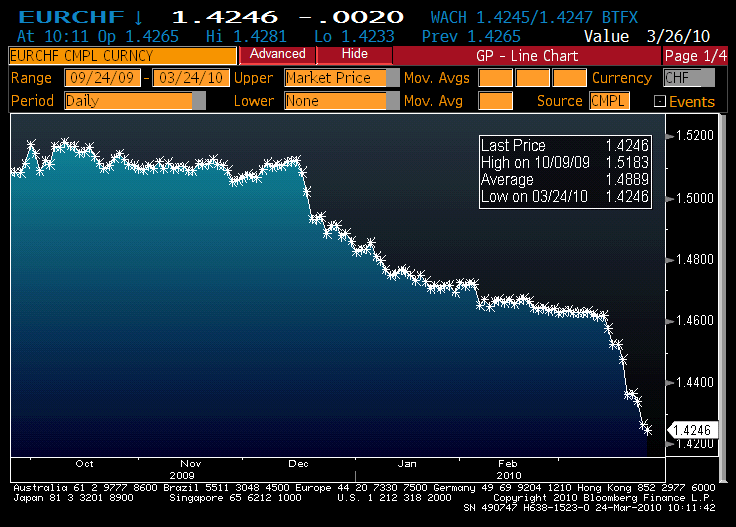
Most currencies have remained within ranges and the most interesting currency pair is EUR/CHF having failed to react to verbal warnings from the Swiss National Bank (SNB) about excessive CHF strength. EUR/CHF looks vulnerable to a further decline unless the SNB follows up rhetoric with action. Even if there is FX intervention by the SNB it may prove to be a temporary barrier to a market with an eye on the psychologically important 1.4000 level.

Despite the pressure on the Japanese government and Bank of Japan (BoJ) to engineer a weaker JPY, export performance has proven resilient, with exports jumping 45.3% on the year in February, helped by the strength of demand from Asia. Unfortunately this is doing little to end Japan’s deflation problem and even if there is less urgency for a weaker JPY to boost exports, JPY weakness will certainly help to reduce deflationary pressures in the economy. USD/JPY is stubbornly clinging to the 90.00 level, with little inclination to move in either direction.
Optimism dissipates

Markets have been highly fickle so far this year. Optimism about strong recovery led by China – recall the fact that disappointment from the surprisingly weak US non-farm payrolls report in December was outweighed by strong Chinese trade data – has dissipated. Instead of rejoicing at China’s robust GDP report last week, which revealed a 10.7% rise in the fourth quarter of 2009, investors began to fret about whether China would have to move more aggressively to tighten monetary policy. Fuelling these fears was the release of Consumer price data which showed inflation rising above expectations to 1.9% YoY in China.

If such fears were not sufficient to hit risk appetite, US President Obama’s plan to limit the size and trading activities of financial institutions dealt another blow to financial stocks. The plan followed quickly after the Democrats lost the state of Massachusetts to the Republicans and managed to shake confidence in bank stocks whilst fuelling increased risk aversion. Meanwhile, rumblings about Greece continue to weigh on markets and Greek debt spreads continued to widen even as global bond markets rallied.

Following the US administration’s plans to restrict banks’ activities the fact that the rise in risk aversion was US led rather than broad based led to an eventual pull back in the dollar which helped EUR/USD to avoid a break below 1.40. Risk trades including the AUD came under pressure as risk appetite pulled back. A drop in commodity prices did not help. The AUD was also hit by news that Australia’s Henry Tax Review would look to tax miners in the country. As a result AUD/USD dropped below 0.90 though this level is likely to provide good buying levels for those wanted to take medium term AUD long positions. The one currency that did benefit was the JPY which managed to drop below sub 90 levels.

The aftermath of the “Volker Plan” will reverberate around markets this week keeping a lid on equity sentiment. Meanwhile Greece will be in the spotlight especially its bond syndication. A bad outcome could be the trigger for EUR/USD to sustain a move below 1.40 though it looks as though it may find a bottom around current levels, with strong support seen around 1.4029. The German IFO business survey for January will be important to provide some direction for EUR and could be a factor that weighs on the currency if as expected it reveals some loss of momentum in the economy.

Aside from the Fed the other G3 central bank to meet this week is the Bank of Japan but unless the Bank is seen to be serious about fighting deflation, USD/JPY may remain under downward pressure against the background of elevated risk aversion. Below 90.0 there does appear to be plenty of USD/JPY buyers however, suggesting that further upside for the JPY will be limited. USD/JPY will find strong support around 88.84.

Much will depend on the key events in the US this week including the Fed FOMC meeting and the President’s State of the Union speech. USD bulls will look for some indication that the US government is serious about cutting the burgeoning budget deficit. Also watch out for the confirmation vote on the renomination of Bernanke as Fed Chairman which could end up being close. There is a heavy slate of data to contend with including new and existing home sales, consumer confidence, durable goods orders, the first glance at Q4 GDP and Chicago PMI.

Economic reality check supports dollar

The US dollar appears to be making a tentative recovery of sorts at least when taking a look at the performance of the US dollar index.  Much of this can be attributable to a softer tone to equities. The S&P 500 registered its biggest back to back quarterly rally since 1975 over Q3 and either through profit taking or renewed economic doubts, stocks may be in for shakier ground into Q4. 

This increase in equity pressure/risk aversion is being triggered by weaker data. Since the Fed FOMC on 24th September the run of US data has generally disappointed expectations; in addition to the ISM survey, existing and new home sales, durable goods orders, consumer confidence and ADP jobs data all failed to match forecasts.   This list was joined by the September jobs data which revealed a bigger than expected 263k drop in payrolls.  Consequently doubts about the pace of recovery have intensified as markets face up to a reality check.

The dollar’s firmer tone is not just being helped by weaker stocks but also by plenty of official speakers discussing currency moves. Although this is potentially a dangerous game considering the recent turnaround in Japanese official comments on the Japanese yen the net effect is to support the dollar.  In particular, Treasury Secretary Geithner stressed the importance of a strong dollar, whilst European officials including Trichet, Almunia and Junker appear to have become more concerned with the strength of the euro. 

In the current environment such comments will contribute to putting further pressure on the euro which in any case has lagged the strengthening in other currencies against the dollar over recent months.   Although ECB President Trichet highlighted “excess volatility” in his comments about currencies overnight implied FX volatility is actually relatively low having dropped significantly over recent months.  The real reason for European official FX concerns is quite simply the fact that the eurozone remains highly export dependent and that recovery will be slower the stronger the euro becomes.  

It’s not just G10 officials that are becoming concerned about currency strength against the dollar as Asian central banks have not only been jawboning but also intervening to prevent their currencies from strengthening against the dollar.   A firmer dollar tone is likely to put Asian currencies on the back foot helping to alleviate some of the upward pressure over the short term but the overall direction for Asian FX is still upwards.

Risk gyrations and FX positioning

I must admit it has been quite tough to get a handle on the sharp moves in markets over recent days. Market sentiment shifted from positive to negative and back again in a matter of hours, meaning that anyone wanting to put on a long term trading position has had to have had a significant risk tolerance to hold onto their positions.

Attention was focused squarely on Chinese stocks last week but market fears over tighter regulation eased as the week progressed. Market sentiment was helped by strong existing home sales data in the US, continuing the run of better than forecast US economic data releases. Globally data releases mirrored this tone.

A cautiously upbeat tone from central bankers at the Jackson Hole symposium sets up a positive backdrop for markets. Although Fed Chairman Bernanke noted that the rebound in growth was likely to be slow and ECB President Trichet talked about a “bumpy road ahead” the overall tone was positive.

Importantly there was no indication that a reversal in monetary policy was in sight, with the Fed’s Kohn even indicating that there was no inconsistency between the Fed maintaining low rates for an “extended period” and keeping inflation low. The comments should help to ensure that markets do not misinterpret the signs of recovery as a cue to begin hiking interest rates.

This week’s data slate will maintain the run of good news. However, there are a few risks. Consensus forecasts look for US consumer confidence to improve in August but the weak labour market situation may hold some downside risks for the Conference Board measure of confidence just as it did for the Michigan reading.

US durable goods orders are set to bounce back and new home sales are likely to echo at least some of the gains in existing home sales last week. In the eurozone, attention will focus on the August German IFO survey and this release is likely to mirror the gains in the PMI, with a healthy gain in the headline reading expected.

Risk trades continue will be favoured after overcoming last week’s setbacks keeping the USD under downward pressure but within ranges and risk currencies including AUD, NZD, CAD and NOK under upward pressure. The USD index is verging on testing its 5th August low of 77.428, whist the JPY is also weaker though its moves may be more limited ahead of upcoming elections.

The IMM report shows that speculative investors have cut pared back USD short positions further, but the shift in positioning was relatively small from the previous week, with net aggregate USD short positions at -94.8k contracts compared to -96.1 in the previous week. Notable shifts in positioning over the week include a cut back in net EUR long positions to their lowest level since the week of 5th May 2009.

Commodity currencies suffered some pullback in net long positioning too with speculative AUD and NZD contracts being cut although net CAD long positions did increase slightly. Given the resumption in risk appetite into this week it seems highly likely that positioning will reverse and net USD short positions will increase.